I am an independent Shopify developer based in Manchester, working with businesses across the UK. I build and improve Shopify themes, product pages, configurators, integrations and migrations, with technical SEO built in. You work with me directly, with no agency layers between the brief and the code.
Tell me about your projectSee selected work
When a freelance Shopify developer fits
A freelance Shopify developer is a good fit when the work is clearly defined and needs hands-on development: a custom theme, a tricky product page, an app or integration, or a migration. It also suits stores that already have marketing and design support but need someone to build and fix things properly.
It is less suitable if you need a large team producing campaigns, photography and content all at once. In that case an agency may suit you better.
Some signs that a freelancer is a sensible choice:
- You can describe the outcome you want, even if not the technical route.
- You value speaking to the person doing the work.
- The project is one build, or a steady run of improvements.
If you are still choosing a platform, Shopify vs WooCommerce sets out the trade-offs. Searching for a Shopify expert in the UK usually means one of two things: someone to build, or someone to advise. I do both, and I describe the split in each proposal. My terms of business cover scope, payment and ownership.
What I build
- Theme development
- Custom product pages and configurators
- Apps and integrations
- B2B
- Migrations
- Performance
Theme development
I build and customise Online Store 2.0 themes using sections and blocks, so your team can rearrange pages in the theme editor without needing a developer for every change. Shopify’s own guidance on templates, sections and blocks is the foundation I work from. I keep Liquid clean, scripts light and markup accessible.
Custom product pages and configurators
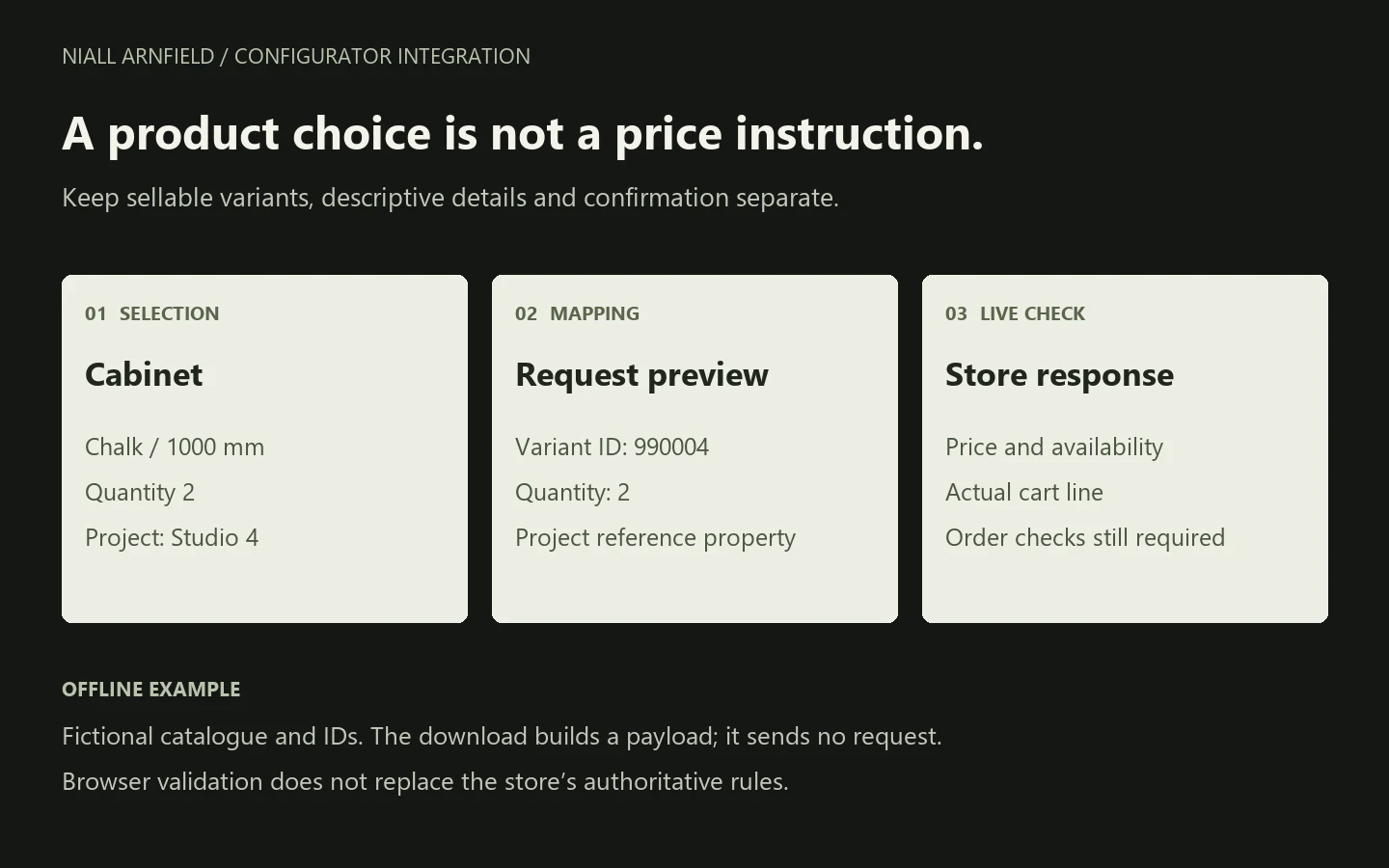
Some products need more than a variant picker. I build product pages with custom options, conditional logic and 3D product configurators, and make sure the selections reach the cart and order correctly. The detail is in Shopify product configurator integration, with general background in the product configurator guide.
This draws on leading development of a 3D product configurator platform, Praxis Digital 3D, used by 20+ UK businesses from 2021 to 2025.
For example, a store selling products with several material, size or finish options may need those choices shown visually, validated against rules and then carried through to the order. Planning how that data appears in the cart, the confirmation email and the admin order is part of the work.
Apps and integrations
I connect Shopify to inventory, fulfilment, accounting, CRM and marketing tools, using existing apps where they do the job and custom integration where they do not. I also review the apps you already have installed and recommend removing those that duplicate each other or add unnecessary weight.
Where an existing app already does the job well, I will say so. Custom code is worth the maintenance only when an app cannot do what the store needs, or adds more weight than the feature is worth.
B2B
For trade customers, I set up and extend account-based pricing, ordering flows and restricted catalogues. Take a look at B2B ecommerce website development for how I scope these projects.
Migrations
Moving to Shopify from another platform needs careful handling of products, customers, orders and URLs. My migrate to Shopify guide covers the process, including redirect mapping so search visibility is protected.
On Shopify, that can include checking the checkout and cart behaviour that your plan allows, any customisations made there, and how tracking scripts load. I explain what can and cannot be changed before promising anything.
Performance
I measure first, then fix. That usually means reviewing theme code, third-party scripts, image handling and app weight. Read more in Core Web Vitals.
Theme work is also where I make long-term maintenance easier. Settings go into the theme editor where sensible, sections are reusable rather than duplicated, and code is commented so another developer can pick it up later. You should never be locked in to me to make routine changes.
Shopify SEO
Many search problems on Shopify stores are template problems, which is why a developer who understands SEO is useful. I handle canonical tags, collection and product structure, structured data, internal links and crawl behaviour as part of the build, and can audit an existing store too.
For a fuller explanation of how I approach it, see my guide to Shopify SEO services.
Examples of what I check on a Shopify store include collection and product URLs, duplicate paths, structured data on product pages, internal links from collections to products, and the effect of installed apps on page weight. These sit naturally alongside the build, so SEO is not a separate project bolted on at the end.
Freelancer vs agency
| Consideration | Freelance developer | Agency |
|---|---|---|
| Who you speak to | The person building your store | Often an account or project manager |
| Scope | Development, design and technical SEO | Wider mix of services across a team |
| Scale | Focused builds and ongoing improvements | Large, multi-stream programmes |
| Handover | Direct, with fewer steps | Passes through several roles |
A freelancer is not automatically cheaper or better. The right choice depends on the size of the project and how much coordination you want to handle. I will be upfront when something is beyond what one person should take on.
How a project runs
Each stage has an acceptance check, so we both know what done means.
- Discovery. We agree goals, products, apps and constraints. Acceptance check: a written scope you have approved.
- Design and plan. I define page structure, sections and any custom behaviour. Acceptance check: signed-off layouts and a list of requirements.
- Build in a development theme. Work happens in an unpublished theme, so your live store is untouched. Acceptance check: each feature works as described.
- Test. I check cart, checkout flow, discounts, markets, mobile layouts and accessibility basics. Acceptance check: a completed test list, with issues resolved or agreed.
- Launch. Redirects, tracking and search settings are verified using the ecommerce launch checklist. Acceptance check: live pages and orders confirmed.
- Review. We look at performance and search data and deal with anything that appears. Acceptance check: an agreed follow-up list.
If you are budgeting, website design cost explains what influences price. For wider scope, see ecommerce website development services.
If your project is a Shopify migration, a redesign or a new build, the same structure applies. Larger projects can be split into phases, with each phase accepted before the next begins, so you are never committed to more than you have seen working.
Design studies
These are concept projects, not paid client work. They show how I think about layout, product presentation and structure.
- Velune footwear storefront redesign, a concept for a footwear store.
- Second Core ecommerce redesign concepts.
- ProSalonFurniture website design.
For real project examples, see the Praxis Digital 3D case study and the Knowledge Transfer Partnership with Manchester Metropolitan University. I hold an MRes in Web Innovation and 3D E-commerce and a BSc in Computer Games Technology, both with first class honours.
Shopify developer FAQs
Can you work on my existing theme?
Yes. I review the theme first, then recommend whether to extend it, refactor parts of it or rebuild.
Can you add a 3D configurator to Shopify?
Yes. The important part is how selections pass into the cart and order. I test the whole flow in a development theme before anything goes live.
Do you handle migrations from WooCommerce or other platforms?
Yes. I plan product, customer, order and URL migration together, so nothing is left behind. See migrate to Shopify for detail.
How do I get a quote?
Send a short outline of what you need. I will reply with questions and, if it fits, a written scope and quote. I do not publish fixed prices because they depend on the work involved.
- For search work on larger stores, see Shopify Plus SEO and the Shopify SEO audit.
- If the store feels slow, see Shopify speed optimisation: a measured baseline, targeted fixes and a retest.
- For configurable products, read the guide to Shopify metafields for configurable products.
Related reading: web design and development agency.
Talk about your Shopify project
If you need a freelance Shopify developer for a build, a fix or a migration, tell me about it through the contact page. I will reply with questions and, where it makes sense, a proposed way forward. How I handle your details is set out in my privacy policy.
Tell me about your projectSee selected work
Related guides
- For Shopify B2B, the B2B checkout and approvals guide explains how company accounts, approvals and payment terms change what checkout must show.
- Already on Shopify but the store feels tired? See website redesign.
- For step-by-step fixes, see how to get past the Shopify variant limit, set up Shopify redirects at scale and optimise Shopify images, or browse all the Shopify, WooCommerce and 3D how-to guides.