
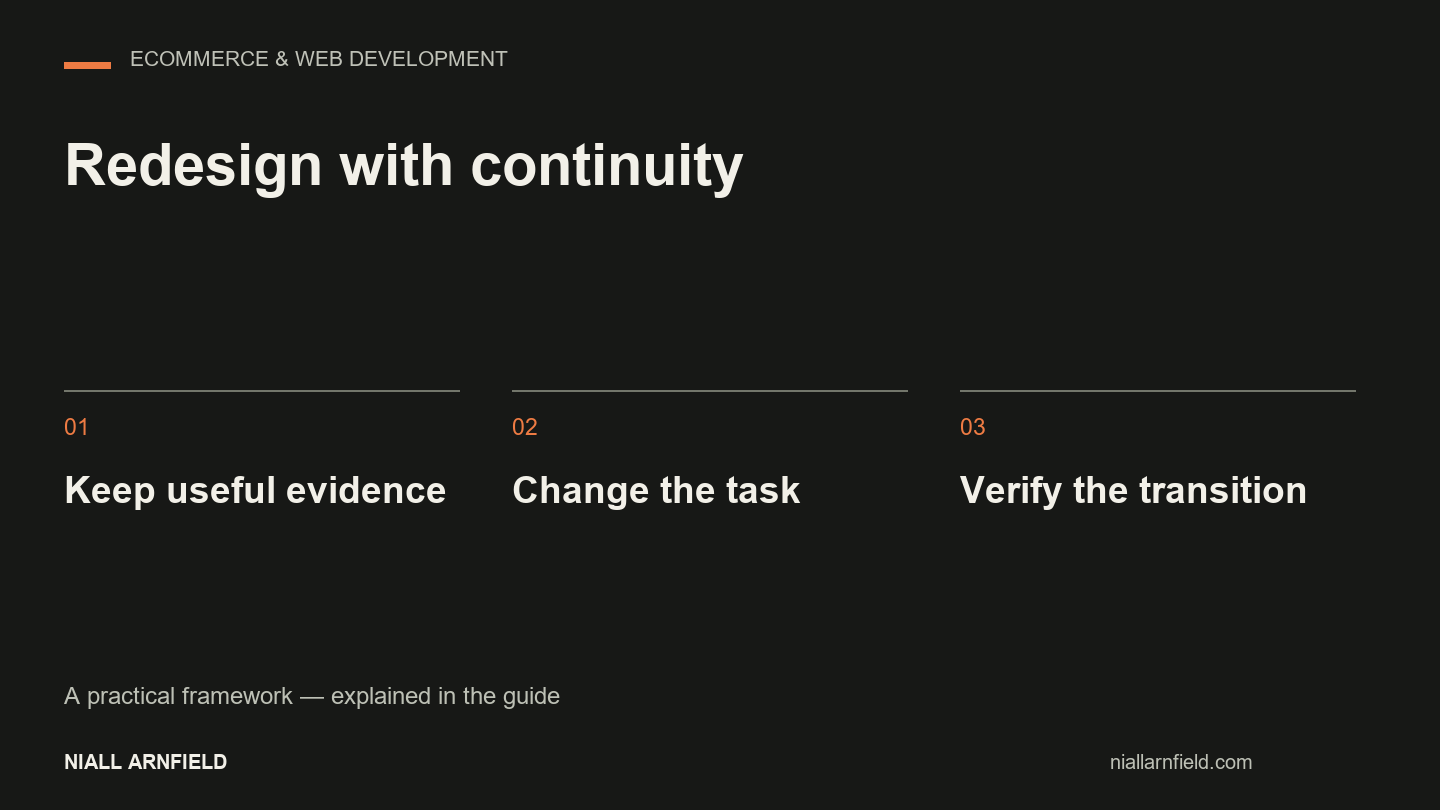
A website redesign should improve the customer’s task while preserving the useful work already invested in the site. That includes content, search visibility, recognisable brand elements and the operational knowledge your team uses every day.
Discuss your projectSee selected work
I work on redesigns across ecommerce and service websites. The brief starts with what needs to change: an unclear offer, an awkward catalogue, difficult editing, slow pages or a site that no longer reflects the business. A new visual style can support that work, but it cannot substitute for it.
Establish what the redesign must improve
Choose a few concrete tasks. A customer might need to compare two products, find a compatible accessory or understand whether your service fits their project. Staff might need to publish a new range without rebuilding a template. Observe where those tasks currently fail before specifying the solution.
Review existing landing pages and enquiries as well as the homepage. A page that looks dated may still answer a valuable question. Conversely, a polished campaign page may generate visits that never reach a meaningful next step.
Make a keep, change and retire inventory
| Decision | Evidence to collect | Release action |
|---|---|---|
| Keep | Useful content, working task or relevant search demand | Preserve the value and test the new presentation |
| Improve | A specific gap or failure | Change the affected content or interaction with an acceptance test |
| Consolidate | Two pages competing to answer the same need | Select the stronger destination and map old routes appropriately |
| Retire | No continuing purpose and no suitable equivalent | Choose an honest response and remove obsolete internal links |
This inventory prevents a common failure: rebuilding the visible navigation while losing useful pages that visitors reach directly from search, bookmarks or previous campaigns.
How to redesign without casually discarding SEO
Record existing URLs, titles, indexability, incoming links and the pages receiving relevant impressions or clicks. Preserve URLs where the purpose is unchanged. When a URL genuinely changes, map it to the closest relevant destination rather than sending everything to the homepage.
Keep important content available in the rendered page and make navigation links crawlable. Check canonical URLs, redirects, image references and the sitemap after launch. The migration SEO checklist provides a more detailed sequence.
No redesign process can promise that rankings will remain fixed. The objective is to avoid preventable loss, make changes traceable and investigate a change in performance against a dated release record.
Ecommerce redesign needs catalogue evidence
Test the proposal against representative products, not a perfect sample assembled only for the design presentation. Include unavailable options, long titles, inconsistent source images, bundles and products with substantial technical information.
Agree how filters, product cards, variations and cart feedback should behave. Preserve product and order identifiers where integrations depend on them. A redesigned shop must remain understandable to the systems and people fulfilling the orders.
The editable ecommerce brief separates launch essentials from later options. That is particularly useful when a redesign begins to accumulate new integrations and operational changes.
Design each page around its job
Good design makes the next useful action obvious. Before choosing a visual treatment, write the page’s opening heading and its intended action.
- Service page: can you solve my problem? Show scope, process, relevant work and a clear enquiry route.
- Product page: is this the right item? Show dimensions, options, price, delivery and accurate imagery.
- Comparison page: which option fits? Use consistent criteria and explained trade-offs.
- Article: can you answer this question? Give a direct answer, examples, sources and a next step.
Use a small set of type sizes, consistent spacing and short sections with descriptive headings, and put qualifications next to the claim they qualify. Images should explain something, diagrams need a readable text equivalent, and essential words should not live only inside a picture. Decide how content changes when space runs out: a two-column comparison may stack, and a wide table may need a labelled scroll region. Test long product names, zoomed text, validation errors and missing images, because these are ordinary conditions.
I have put two small original examples, a service page and a product comparison page, in an editable HTML starter pack. They have no build step, external font or third-party script, and they are starting points, not finished client sites. Replace the sample text and inspect the layout before connecting a real form or shop. Then ask a reader to find a suitable product or locate the contact route and watch where they hesitate. Accessibility needs its own review, covered in the accessibility section of my web design service.
Compare redesign proposals on the same scope
A redesign quote should state the templates, content work, migration, integrations, testing and handover included. Identify assumptions about what the business will supply. Compare the total ongoing commitment as well as the initial build fee; the website cost guide provides a worked method.
If you are searching for website redesign services near you, decide what proximity is meant to solve. Workshops, photography or frequent on-site collaboration can make location important. For a remote delivery process, named decision owners, useful prototypes and clear review checkpoints may matter more. Verify a provider’s actual location rather than relying on a city name in a headline.
Choosing a web design agency or developer
The best supplier is the one that can deliver the website you need, within a scope you understand and can maintain. A polished portfolio does not show who built the work, how complex it was or what happens after launch. Ask every candidate to respond to the same brief, so price differences reflect the work and not different assumptions.
- Relevant work: a comparable journey with the supplier’s role explained. Pause if attribution is unclear or you only see screenshots.
- Scope: templates, content, integrations and exclusions. Pause at a single “website” line with no acceptance criteria.
- Delivery: milestones, dependencies and review responsibilities. Pause at a launch date set before catalogue and content needs are known.
- Ownership: account, domain, source and licence arrangements. Pause if you cannot get a usable copy of the work.
- Support: update process, response times and change pricing. Pause if maintenance is implied but not defined.
Rate each criterion as demonstrated, partly demonstrated or unverified, and keep mandatory requirements apart from preferences. An award should come with a year, category and the work recognised, and it is supporting evidence at most. Agency or independent developer? An agency may offer wider capacity, while an independent gives direct access to the person making technical decisions. Ask who does the work, who reviews it and what happens if someone is unavailable. Copywriting, photography, accessibility review and search migration are not automatically part of design, so say so up front.
Location matters only if on-site discovery, photography or workshops are essential. Otherwise judge communication, review tools, time-zone overlap and decision records. Check how many templates are included, who supplies content, how product data is prepared, how many review rounds are planned and what counts as a change request. Bring the current URL, the business problem, a budget range and one journey that must improve, and ask what the supplier would investigate before quoting.
If the redesign changes URLs or the platform, plan the search side early with an SEO migration service, so rankings are protected through launch.
Related reading: web design and development agency, Velune footwear storefront redesign, Second Core redesign concepts and Soinvogue ecommerce redesign.
Define acceptance before the launch date
A practical acceptance list covers the customer’s task, staff editing, mobile layout, accessibility, performance, redirects, analytics and enquiry or order handling. Name the person who verifies each item. Keep a rollback route and a plan for handling data created during the transition.
After release, check the public site and the critical paths again. Monitor the changed page groups against the pre-release baseline, allowing for reporting delay and differences in demand. A launch screenshot demonstrates appearance, not commercial success.
Discuss a website redesign with the current site, its strongest pages and the specific tasks you want to improve. I can help separate a focused improvement from a rebuild and define the evidence that should decide between them.
Related guides
- Before a redesign goes live, a technical SEO audit of the current site records which pages, redirects and templates carry search visibility, so the rebuild does not quietly lose it.
- Redesigning a WordPress site? Check the WordPress SEO checklist before and after launch so search settings are not lost.
- If the redesign changes URLs, work through the website migration SEO checklist before launch.