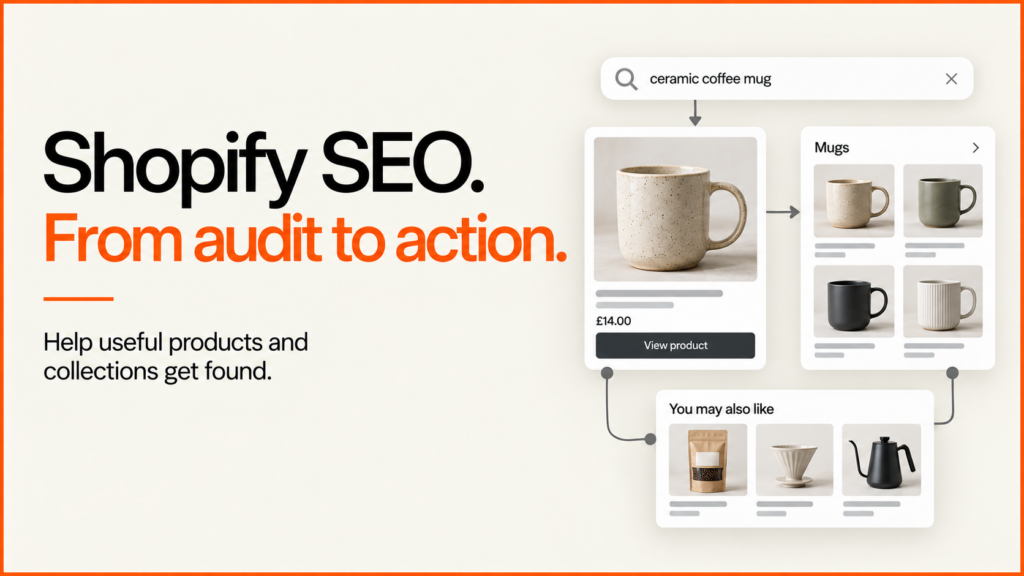
Shopify SEO audits and technical implementation, delivered directly by an independent developer. I help UK and international retailers identify why important collections and products are difficult to find, then implement the agreed improvements to content, navigation and theme behaviour.
If you are comparing a Shopify SEO agency, I offer a direct working relationship from diagnosis through release. My ecommerce experience spans beauty, furniture and other sectors. We agree the deliverables, who approves each change and how the live result will be checked. The terms of business cover scope, payment and who owns the work. My guide to choosing an SEO consultant lists the questions worth asking any supplier.
Discuss a Shopify SEO audit or fixMigration checklist
Use the migration checklist if a platform move is driving the project.
For an initial enquiry, include your store URL, an affected collection or product, and the problem you want to resolve. Account access can be agreed after the scope is clear.
Choose the help your store needs
| Starting point | Useful engagement |
|---|---|
| Unclear cause | A bounded audit: query/page evidence, representative templates and a prioritised implementation plan. |
| Known issues | A delivery project: scoped theme, content, collection or migration changes with rollback and live verification. |
| Regular changes | Ongoing review: catalogue releases, content ownership, technical checks and measured search outcomes. |
Start with the affected product range or buying journey. A missing collection, an indexing problem and a slow product template need different work; they should not automatically lead to the same retainer.
What the work covers
Discovery and indexing
Check response codes, canonicals, redirects, sitemaps and representative filter or parameter routes. Compare the public output with Search Console evidence. Shopify’s robots.txt guidance explains its default protections; crawl-rule changes need a specific diagnosis. For two common causes of duplicate collection URLs, see faceted navigation SEO on Shopify and canonical tags on collection product URLs.
Shopify supplies SEO foundations, including generated sitemaps and editable search listings. Its SEO documentation describes those controls. They still need a coherent catalogue and relevant page content.
A clear role for each collection and product
Assign important search intents to appropriate pages. Collections support range-level decisions; product pages explain the specific item. Supporting articles should help customers choose rather than duplicate the commercial page.
Improve the information buyers need: compatibility, specifications, options, delivery and care. Put repeatable product information into maintainable fields and templates, with a named owner for its accuracy.
Connect priority pages through ordinary navigation and contextual links. Google’s ecommerce guidance explains crawlable hierarchy; Shopify’s structure guidance covers menus and descriptive links.

Product markup and theme performance
Inspect rendered structured data from the theme and apps together. Check that product, offer and availability information agrees with the visible page, using Google’s ecommerce structured-data guidance. A valid test result does not guarantee a rich result.
Investigate the actual loading or interaction problem before removing features. Separate platform behaviour from theme code, app scripts and oversized media. Record test conditions and distinguish lab scores from real-user measurements.

A practical delivery process
- Record the baseline. Date the query/page, indexing and analytics evidence; identify commercially relevant pages.
- Inspect representative journeys. Include normal products, variants, unavailable items and the important collection templates.
- Agree priorities. Give each important intent a preferred page and resolve genuine overlap.
- Scope implementation. Name each change, dependency, approval owner and acceptance check.
- Release carefully. Review theme changes in a controlled version, keep recovery copies and read back the live result.
- Review outcomes. Compare consistent reporting periods, accounting for demand, seasonality and other releases.
For example, if a buying guide and a collection both target the same commercial search, first inspect intent and their current query/page evidence. The answer may be a clearer collection and a supporting guide with a different role. This is an illustrative diagnosis, not a claimed client result.
What you should receive
- A page-level record of findings, evidence and prioritised work.
- An explicit split between developer delivery, merchant decisions and third-party dependencies.
- A keyword-to-page map with reasons for retaining, improving or consolidating content.
- Dated implementation and measurement records, with unknowns clearly identified.
- A reviewable release, recovery route and verification of deployed changes.
- Editable documentation and agreed responsibility for ongoing maintenance.
Search rankings and crawling schedules remain outside a developer’s control. Completed work, verified deployment and measured commercial outcomes are different claims and should be reported separately.
Scope, timing and access
Catalogue complexity, theme condition, app behaviour, markets, migration history and content readiness affect the work. Separate the audit, implementation and ongoing review in the proposal. Share the main problem and a representative product range so the estimate has a useful basis.
Access follows the agreed scope. Diagnosis may need Search Console, analytics and relevant store read access. Implementation requires separately agreed permissions for the specific changes. Account ownership stays with you.
Shopify SEO apps or an agency?
The right app solves a verified limitation without adding a bigger one. Shopify already provides native search controls, and an app does not make a useful collection page unnecessary. Write the requirement first, then decide whether an app, a theme change or hands-on work is the answer.
- Large product images: look at image processing and delivery, and ask for actual downloaded file sizes at relevant screen sizes.
- Inconsistent product data: structured data should come from the real catalogue and match the visible price, availability and product.
- Unmanaged broken URLs: ask for redirect management, a reviewed destination map and an export.
- Repetitive metadata: templates need page-level overrides so important collections and products get distinct titles.
- Weak collection content: this is an editorial and theme job. An app may not help.
Before installing anything, list the theme, apps and snippets that already generate titles, canonical links and structured data, and give each output one owner. Two helpful apps can both print product markup. Run any trial on a theme backup, change one feature at a time, and compare the public HTML for a product, a collection, an article and an unavailable item, not only the homepage. Check network requests too, because an app that loads scripts on every page affects speed differently from one that works off the page.
If the problem is collection architecture, missing product information or a slow theme, it is quicker to fix that directly. Vendor feature lists, such as those for Plug in SEO or Smart SEO, are claims to test on your store, not independent results.
Shopify SEO expert, consultant or agency: which do you need?
The three labels get used loosely, so it helps to separate them by how the work is actually organised. A Shopify SEO expert or consultant is usually one person who audits, advises and often implements. A Shopify SEO agency is a team with account management, specialists and process. An in-house hire is someone who sits inside your business full time.
None of these is better in general. The right choice depends on how much work there is, how much of it touches theme code, and how many people you want to coordinate.
| Option | Works well when | Watch for |
|---|---|---|
| Independent consultant | You want one accountable person who can diagnose issues and make the theme or template changes directly. | Capacity. One person cannot run large content, PR and paid programmes at the same time. |
| Agency | You need several disciplines at once, such as content production, digital PR and reporting across channels. | Layers between you and the person doing the work, and fixes that sit in a developer queue. |
| In-house | SEO is a constant, day-to-day need across a large catalogue and several teams. | Cost, hiring time, and a single person who still needs developer access for template fixes. |
I work as an independent, so you deal with me directly and the same person who finds an issue can fix it in the theme. If your needs are mostly large-scale content or outreach, an agency or in-house team may be a better fit, and I will say so.
Shopify Plus SEO
Shopify Plus does not change how search engines read a page, but it changes the shape of the problems. The same fundamentals apply: crawlable URLs, clear canonicals, fast templates and accurate structured data. What grows is the surface area. If you sell in several countries, the Shopify Markets and hreflang guide covers the set-up, and Shopify redirects at scale covers bulk URL changes.
Multiple storefronts and markets are the first example. Shopify Markets can serve different countries and languages from domains or subfolders, and it outputs hreflang annotations for you. The Shopify Help Center guide to international SEO for markets explains what is handled automatically. The work is in checking that each market has distinct, intentional content, correct currency and a sensible canonical setup, rather than near-duplicate pages.
Checkout extensibility matters because older checkout customisations and script-based tracking are replaced by newer extension points. That affects how conversion and analytics events are measured, which in turn affects how you judge SEO performance.
Scripts and apps accumulate at scale. Each one can add JavaScript, requests and layout shift, so an app audit is part of any Plus SEO review. See Core Web Vitals for how I measure this.
B2B on Shopify, including company accounts and customer-specific catalogues, raises its own questions about which pages should be indexable and which should sit behind a login. For wider platform context, see B2B ecommerce website development.
How to choose a Shopify SEO agency or consultant
Whether you hire an agency, a consultant or an expert freelancer, these six questions separate a clear process from a generic pitch.
- Who will do the work? Ask for the name of the person who will audit, and the person who will implement. If they differ, ask how findings are handed over.
- Can they change the theme, or only advise? Many Shopify SEO issues live in Liquid templates. Find out whether fixes are made, reviewed or only recommended.
- What does the audit deliver? You should expect a prioritised list with evidence from Search Console and crawl data, not a generic tool export.
- How will success be measured? Look for agreed baselines in impressions, clicks, indexed pages and revenue from organic search, rather than promises about rankings.
- How do they treat apps? A good answer includes removing or replacing apps that add weight, not only installing more.
- What happens if something breaks? Ask about staging, approvals and rollback before any template or redirect change goes live.
If you are still deciding on the type of support, the pages on SEO consultancy and technical SEO audits set out how I scope each.
Common questions
Can you implement the findings?
Yes. My work can include diagnosis and agreed technical delivery, including theme and catalogue-related changes. The proposal identifies merchant approvals and other dependencies.
Is Shopify suitable for organic search?
It provides useful foundations. The store’s content, structure, implementation and competition still matter; the platform alone does not determine results.
When will results appear?
We can agree delivery dates for scoped work. Search outcomes depend on the starting state, demand, competition and recrawling, so they need a separate review period.
Do I need another SEO app?
Only if it solves an identified requirement. Check native controls and existing output first; use the Shopify SEO app guide to assess overlap.
I do not guarantee first-page positions. I make the scope, evidence and completed changes reviewable.
How do I choose a Shopify SEO agency?
Ask who implements the work, which page types the audit covers, and what a finished finding looks like. Request a redacted sample, check that the proposal separates diagnosis from delivery, and be wary of anyone guaranteeing first-page positions.
What about duplicate product URLs like /collections/x/products/y?
Shopify makes a product available at its main /products/ URL and also at a collection-scoped path. Themes normally set a canonical tag pointing to the main product URL. The thing to check is that your internal links and structured data also use the canonical URL. Google explains the principle in its guide to consolidating duplicate URLs.
Should collection pages have content?
Usually, yes, but only useful content. A short introduction that helps a shopper choose, plus clear filters and internal links, is better than a long block of text added for its own sake. Place it so it does not push products down the page.
Do I need a developer for Shopify SEO?
For basic metadata, no. For canonical logic, structured data, faceted navigation, redirects and theme performance, you will need someone comfortable editing the theme. Working with one person who does both the SEO analysis and the code avoids hand-off delays.
What does a Shopify SEO audit include?
A good audit covers indexing and crawl behaviour, URL and canonical handling, collection and product page structure, internal links, structured data and page performance. It should end with a prioritised list of fixes and the evidence behind each. You can see how I scope this in the technical SEO audit guide.
For a one-off review of a Shopify store across collections, products, apps and structured data, see the ecommerce SEO audit.
Running a larger store on Plus? See Shopify Plus SEO for markets, filters, apps and headless storefronts. If you want a one-off review first, start with a Shopify SEO audit.
Prepare a focused first project
Explore theme development, ecommerce SEO strategy or Shopify migration for the relevant next step. Shopify Plus work may add market, integration and organisational requirements; scope the actual store rather than assume every project is alike.
Send your store, its priority product categories and the problem you are seeing, or review my development and SEO services. How I handle your details is set out in my privacy policy.
Discuss a Shopify SEO audit or fixSee selected work
If the fixes need theme or app development as well, my Shopify developer page covers that work.