
I am an independent WooCommerce developer based in Manchester, working with businesses across the UK. I build and improve WooCommerce stores, from custom themes and product configurators to B2B pricing, integrations and migrations. You work with me directly: the person who scopes the project is the person who builds it. My terms of business set out how projects are scoped and paid for.
Tell me about your projectSee selected work
When WooCommerce is the right platform
WooCommerce suits businesses that need control over how the store behaves. That might be unusual product types, trade pricing, custom checkout rules or a close link to content on WordPress. You own the code and the data, and you can host it where you choose.
It is not always the best answer. If you want a managed platform with minimal maintenance and a standard catalogue, Shopify may be simpler. I compare the two in Shopify vs WooCommerce, and I will tell you honestly if I think you are better off elsewhere.
Questions I ask early on:
- How complex are your products, variations and pricing rules?
- Who will maintain the store day to day, and how technical are they?
- Which systems does the store need to connect to?
- How important is full control of hosting, data and code?
What I build
Custom themes
I build WooCommerce themes around your catalogue and brand rather than adapting a general-purpose template. That means clean templates, accessible markup and components your team can edit without breaking the layout. Where a child theme or lightweight starter is the sensible option, I use that instead of building from scratch.
Product types and configurators
Products that need options, rules or visual feedback are where WooCommerce can work particularly well. I build custom product types, variation logic and 3D product configurators that feed the correct selections into the basket and order. The integration details are covered in WooCommerce product configurator integration, with background in the main product configurator guide.
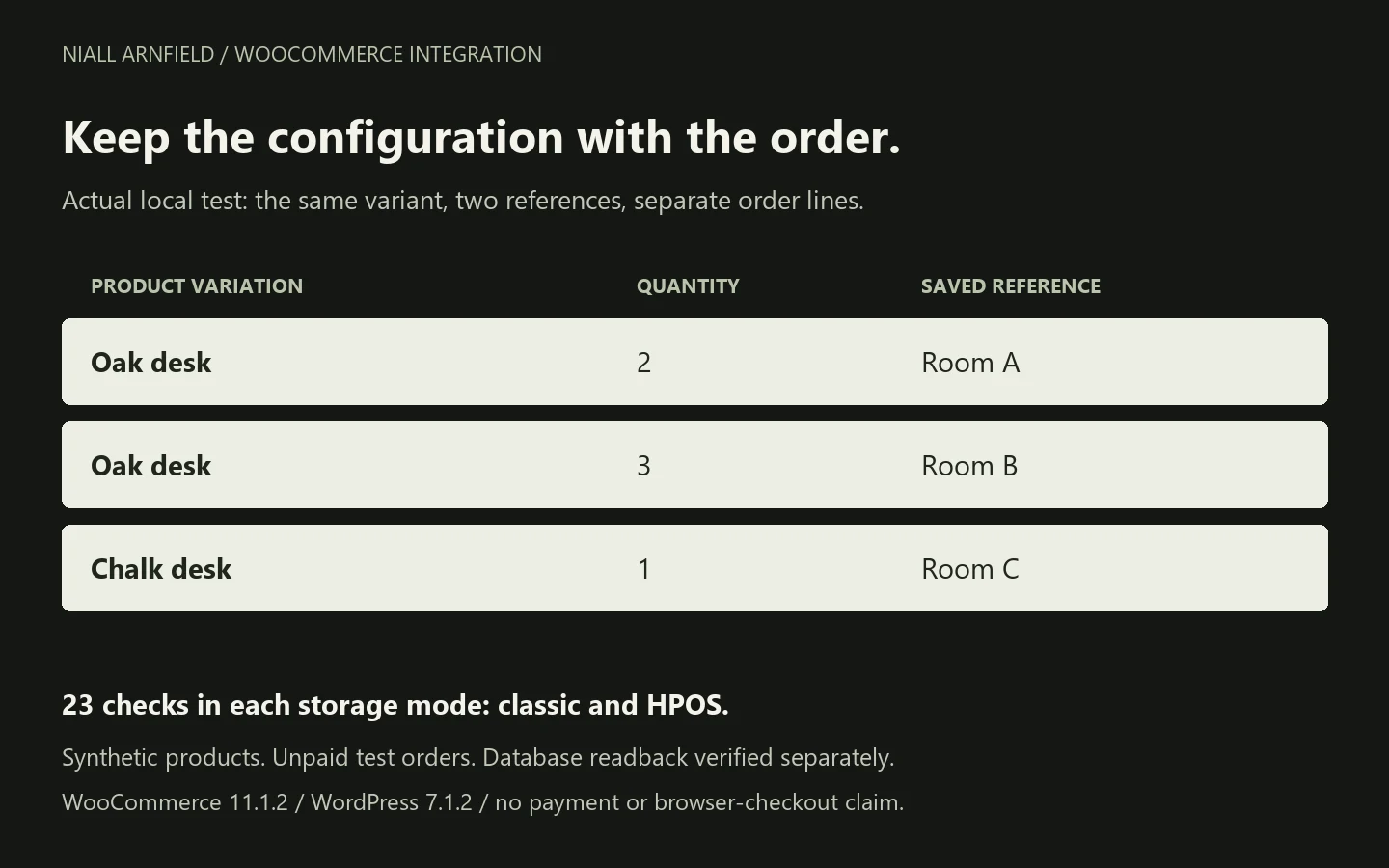
My configurator experience comes from leading development of a 3D product configurator platform, Praxis Digital 3D, used by 20+ UK businesses between 2021 and 2025.
B2B pricing and accounts
Trade customers often need account-based pricing, minimum quantities, quote requests, reordering and approval steps. I scope these around how your sales team already works. More detail is in B2B ecommerce website development.
For example, a store selling made-to-order products might need each customer’s chosen options shown clearly in the basket, on the order email and in the admin screen your team uses to fulfil it. I treat those places as part of the build, not an afterthought.
Integrations
I connect WooCommerce to payment providers, shipping and fulfilment tools, accounting software, CRMs and stock systems. Each integration is documented with what data moves, in which direction, and what happens when a sync fails.
Migrations
Migrations to WooCommerce from another platform, or away from it, need planning. A migration plan covers products, customers, orders, URLs and redirects, so search visibility and customer accounts are protected.
If your project is mainly WordPress rather than ecommerce, see my WordPress developer UK page. For wider scope, the ecommerce website development services page gives the overview.
Performance and hosting
A WooCommerce store is only as quick as its theme, plugins, database and hosting allow. I start by measuring the current site, then fix what the data points to: heavy plugins, uncached pages, oversized images, slow queries and render-blocking scripts.
Modern WooCommerce also supports High-Performance Order Storage, which moves orders into dedicated tables. The WooCommerce developer documentation on HPOS explains the change, and I check that custom code and plugins are compatible before it is enabled.
- For more on how I approach this, read WordPress speed optimisation and Core Web Vitals. I also advise on hosting choices, including whether the store needs more than shared hosting.
Plugins deserve particular attention. Each one adds code, database queries or front-end scripts, so I prefer a small number of well-maintained plugins and custom code only where it earns its place. That also makes updates safer and the site easier to hand over to your team.
WooCommerce SEO
Search visibility is easier to build into a store than to fix afterwards. During development I handle URL structure, category and product templates, canonical tags, structured data, internal links and handling of filtered or paginated pages.
For existing stores, I can begin with a technical SEO audit to find what is blocking indexing or diluting category pages. Broader strategy for product and category pages is covered in ecommerce SEO.
I also check that product feeds, sitemaps and category archives behave sensibly, since these are common places for duplicate or thin pages to appear on a WooCommerce store.
Agency or independent developer
If you are searching for a WooCommerce agency in the UK, it is worth knowing what each option actually offers.
| Consideration | Agency | Independent developer |
|---|---|---|
| Point of contact | Usually an account manager or project manager | The person doing the work |
| Breadth of skills | Wider team across design, copy and marketing | Focused on development, design and technical SEO |
| Capacity | Can run large parallel workstreams | Best for focused projects and ongoing support |
| Communication | Through several people | Direct, with fewer hand-offs |
I work without agency layers, so decisions are quicker and you are never relaying requirements through someone else. If a project needs a larger team, I will say so early.
How a project runs
Every project is different, but this is the structure I follow. Each stage has an acceptance check, so both of us know when it is done.
- Discovery. We agree goals, products, integrations and constraints. Acceptance check: a written scope you have approved.
- Plan and design. I set out the structure, key templates and any custom behaviour. Acceptance check: you sign off layouts and a list of functional requirements.
- Build on staging. Development happens on a private staging site, never on the live store. Acceptance check: each agreed feature works as described on staging.
- Test. I test checkout, payments, emails, variations, tax and shipping rules, plus mobile layouts and accessibility basics. Acceptance check: a test list completed, with issues resolved or agreed.
- Launch. Redirects, tracking and search settings are checked as the site goes live, using the ecommerce launch checklist. Acceptance check: live orders and key pages verified.
- After launch. We review performance and search data, then fix anything that appears. Acceptance check: an agreed list of follow-up items, closed or scheduled.
For help estimating budgets, see website design cost.
Relevant work
The Soinvogue project is a WordPress ecommerce redesign for a beauty brand. It shows how I approach structure, design and product pages on a WordPress-based store.
For configurator work, the Praxis Digital 3D case study describes the platform I led development on. My Knowledge Transfer Partnership with Manchester Metropolitan University (2017 to July 2019) covered a product configurator for a furniture manufacturer.
I hold an MRes in Web Innovation and 3D E-commerce and a BSc in Computer Games Technology, both with first class honours.
WooCommerce developer FAQs
Do you work with agencies or only direct clients?
Mostly direct clients, but I am happy to talk if another business wants development support. In every case, the scope and responsibilities are written down before work begins.
Can you take over an existing WooCommerce store?
Yes. I begin with a review of the theme, plugins, performance and security, then agree what to fix, replace or leave alone.
Will my WooCommerce store be able to handle a 3D configurator?
Usually, yes. The key is making sure the configurator passes clear, validated options to the product, basket and order. I would test this on staging before launch.
Do you provide hosting or ongoing support?
I can recommend hosting options and help set up the environment. Ongoing development and maintenance can be arranged separately once the project is live.
How much does a WooCommerce project cost?
It depends on scope, which is why I do not publish fixed prices here. After an initial conversation I provide a written scope and quote. The website design cost guide explains what typically affects the price.
If search traffic is the main concern, my WooCommerce SEO service covers faceted URLs, Product schema, sitemaps and template speed.
Planning variations and add-ons? Read the WooCommerce product options guide, with a combination calculator and mapping worksheet.
Related reading: web design and development agency, ProSalonFurniture website design and Second Core redesign concepts.
Talk about your WooCommerce project
If you are planning a new WooCommerce store, a migration or improvements to an existing one, send me a short outline of what you need through the contact page. I will reply with questions, and if it looks like a good fit, a proposed scope. How I handle your details is set out in my privacy policy.
Tell me about your projectSee selected work
Related guides
- Selling to trade customers on WooCommerce? The B2B checkout and approvals guide covers account approval, purchase orders and payment terms.
- Before a WooCommerce site goes live, run through the WordPress SEO checklist.
- For step-by-step fixes, see how to migrate WooCommerce to HPOS, manage variable products at scale and fix WooCommerce structured data, or browse all the Shopify, WooCommerce and 3D how-to guides.