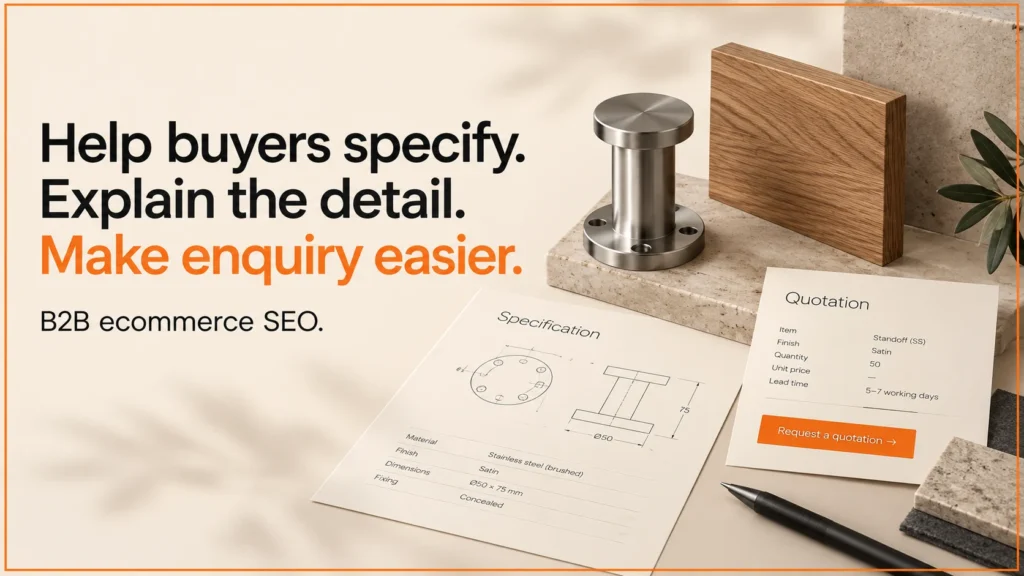
B2B ecommerce SEO helps a buyer find the right part, check the specification and reach an enquiry or order with the detail your team needs. I work on catalogue structure, part-number pages, technical documents and measurement, so search traffic turns into qualified conversations rather than loose page views.
Discuss your projectSee selected work
This service suits manufacturers, distributors and wholesalers who sell through a catalogue, a trade portal or a quote process. It works on Shopify, WooCommerce, Magento and custom builds. I am an independent designer-developer based in Manchester, working across the UK, and you work with me directly. It can sit alongside B2B ecommerce development or a wider ecommerce SEO programme.
How B2B search differs from retail
A trade buyer rarely browses. They search for a part number, a standard, a size or a compatibility question. The same item may be known by a manufacturer code, your own code and a plain-English name. Sales cycles are longer, several people may be involved, and the final step is often a quote, not a basket.

That changes what good SEO looks like. Page titles still matter, but the real work is making each product, specification and document answer a precise question. It also means the goal is a qualified enquiry. A visit alone proves little.
Map the buyer’s questions to the catalogue
I start with the words your customers and your sales or support team use. Keep the relationships between names clear, instead of creating many near-identical pages. This worksheet uses a fictional component supplier. It is illustrative only. Replace the examples with your own product groups and evidence.
| Buyer question | Useful destination | Evidence the page needs |
|---|---|---|
| Which fixing suits this panel? | Compatibility guide linked to the relevant range. | Verified constraints and product references. |
| Is part ABC-120 still available? | The product or an intentional replacement page. | Current availability and replacement rationale. |
| Can I order this in a custom finish? | Product options or a configurator. | Valid finishes and a clear quote hand-off. |
| What are the dimensions? | Product specification. | Units, drawing revision and approved source. |
| How do I buy a large quantity? | Trade enquiry or order process. | What information is needed and what happens next. |
The table also shows which pages to build first. Start where buyers ask the most and where a wrong answer costs the most.
What I check and fix
Part numbers and specification pages
Each product needs one clear page with its part number, key dimensions, materials and standards written as text. I check that the manufacturer code, your internal code and common alternatives all appear on the page, so a search for any of them can match. Specification tables should be real HTML tables, not images.
Part-number titles also need care. A title that is only a code gives a searcher little reason to click. A short product type plus the code usually works better. I also check that variants do not each create a thin page with the same text.
Gated pricing, login walls and crawlability
Search engines cannot log in. A crawler sees only what a signed-out visitor sees. So anything you want found must exist on a public URL.
That does not mean publishing private price lists. Agree a rule with your commercial team. Public pages can carry the description, specification, drawings, compatibility and an enquiry route. Customer-specific prices, contract terms and restricted documents stay behind the account. A page that shows only “log in to see this” answers nothing, so I look for a public layer that still helps.
On Shopify, B2B features such as companies and B2B catalogs control which products and prices a logged-in company sees. I check what a signed-out visitor and a crawler see in each case. WooCommerce has no built-in wholesale pricing, so trade pricing usually comes from an extension, and I test how that extension changes the public HTML. Adobe Commerce (Magento) B2B uses shared catalogs, and the same signed-out test applies. I do not assume any of these hides or shows what you intend.
Technical documents and PDF datasheets
Google can index PDFs, and it lists them among its indexable file types. A datasheet can therefore rank, and a buyer may land on it instead of your product page. I check three things.
- Linking. Every datasheet should be linked from its product page with a descriptive label, and the product page should hold the key facts as text.
- Currency. Old revisions should not outrank the current one. I look for duplicates and decide which stay indexable.
- Control. PDFs cannot carry a meta tag, so a noindex rule for files that should stay out of search is set with an X-Robots-Tag HTTP header.
A PDF also has a title and file name that show in results. I check both. “Final-v3-OLD.pdf” is not a good first impression.
Compatibility pages
Compatibility is a common B2B search: which seal fits this pump, which bracket fits this frame. Where the answer is stable and checkable, a dedicated page can serve it better than a note buried in a product tab. I check that each compatibility claim has a verified source and that the page links to both sides of the relationship. I do not invent claims, and I flag any your team cannot confirm.
Superseded and discontinued products
Existing customers often search an old reference for years. Redirecting every old code to the homepage wastes that demand. I decide each case on its facts.
- Direct replacement exists. Redirect, or keep the page with a clear note and a link to the replacement.
- Spares or support still matter. Keep the page live, mark it as superseded and link to parts and documents.
- No replacement. Keep a useful page with alternatives, or remove it cleanly.
Faceted catalogues
Large catalogues use filters for material, size, rating and finish. Each combination can create a new URL, and thousands of near-duplicate pages can waste crawling. Google’s guide to managing faceted navigation URLs sets out the options. I decide which filtered pages deserve to be indexed, for example a material and product type that buyers really search, and which should be kept out of crawling. The decision comes from search demand and catalogue data, not a blanket rule.
Configurators for made-to-order products
If buyers choose dimensions, finishes or options before ordering, a configurator needs to be found as well as used. I check that the product page explains the options as text, that valid combinations are clear, and that a completed configuration reaches your team as a usable quote request. I led development of the Praxis Digital 3D configurator platform, used by 20+ UK businesses from 2021 to 2025, so I know how product rules and data connect. See my pages on product configurators and configurator product data.
Common problems
These are typical patterns, not findings from any client.
| Problem | Why it matters | Usual fix |
|---|---|---|
| Catalogue only visible after login | Crawlers see nothing to index. | Public product and specification layer, private prices kept private. |
| Specs only inside PDFs | Buyers must open a file to check one fact. | Key specifications as page text, PDF linked. |
| Old datasheet revisions indexed | Buyers may find outdated data. | Link to current files and control the old ones. |
| Old part numbers redirect to the homepage | Lost demand and confused buyers. | Replacement or superseded page for each case. |
| Filters create endless URLs | Crawling is diluted across duplicates. | Index a small set of useful filters, limit the rest. |
| Enquiry form carries no product detail | Sales cannot tell what was wanted. | Pass part number and options into the form. |
Long sales cycles and measuring qualified enquiries
A buyer may visit several times over weeks before asking for a quote. Last-click reports undervalue that early search visit. I agree meaningful steps with your team: viewing a specification, downloading a datasheet, completing a configuration, sending an enquiry with usable product information. Those are different from counting every page view as a lead.
I then combine Search Console landing pages and query groups with those agreed events. Your sales team stays in charge of qualification. I do not promise rankings or a set number of leads, and consent and tracking changes need careful handling so the data stays trustworthy.
What the service includes
- A buyer-intent map for your product groups, based on the worksheet above.
- Template findings for product, category, compatibility, document and filtered pages.
- A public versus account-only content recommendation for your commercial team.
- Catalogue and redirect rules for superseded products.
- Agreed implementation support, or precise briefs for your developer.
- A measurement plan and a retest register for completed fixes.
For a wider site review, see the technical SEO audit. If you are changing platform, the work belongs with my SEO migration service. If the checkout is the weak point, read about B2B ecommerce checkout.
How a project runs
- Scope. You send the store URL, platform, a representative catalogue export, examples of buyer questions and the intended enquiry or ordering workflow.
- Access. Usually read-only Search Console and analytics, plus details of your account and pricing setup.
- Review. I crawl the site, sample each template and test what a signed-out visitor and a crawler see.
- Plan. You receive prioritised findings and the intent map, and I walk through them with you.
- Fix and retest. I make or brief the changes, then test the live result against agreed acceptance tests.
I cannot guarantee rankings. I can show what blocks discovery, what weakens pages and which fixes are worth your team’s time.
Frequently asked questions
What is B2B ecommerce SEO?
It is the work of making a trade catalogue easy for search engines to find and easy for buyers to trust. That covers part numbers, specifications, documents, filters and the route to an enquiry or order.
Can Google see pages behind a login?
No, a crawler cannot sign in, so content behind a login is not available to index. Put the public product information on open URLs and keep account prices private.
Should I publish trade prices?
That is a commercial decision. Many suppliers show a “from” price or none at all, and publish everything else. I help you choose what to show so pages still answer the buyer’s question.
Do PDF datasheets help SEO?
They can be indexed and can bring in visitors. They work best linked from a product page that also holds the key specifications as text.
Do you work with Shopify, WooCommerce and Magento?
Yes. The checks are the same, but the problems differ by platform. See Shopify SEO and WooCommerce SEO for platform detail.
Next step
If you are comparing suppliers for B2B SEO, my guide to choosing an SEO consultant lists the evidence to ask for.
To scope B2B ecommerce SEO, send the store URL, a sample catalogue export, a few real buyer questions and how enquiries or orders are handled today. Contact me to discuss your B2B ecommerce SEO.
For hands-on help with a trade catalogue, see working with an SEO consultant.