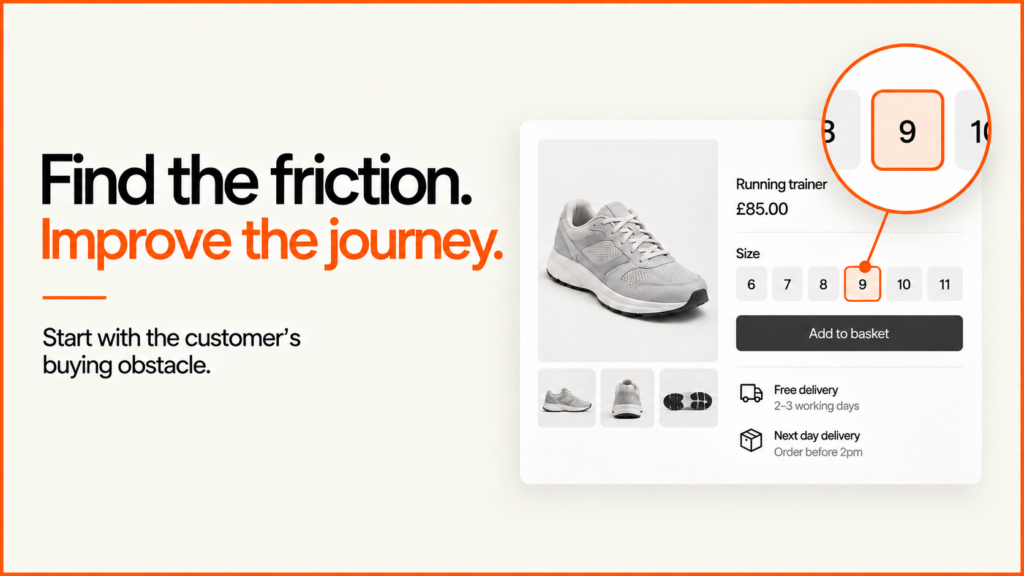
Ecommerce conversion rate optimisation starts with one question. Why does a suitable shopper not buy? The reason might be missing dimensions, unclear delivery, an unusable option selector or a payment failure. Changing button colours is unlikely to be the best use of your budget. Look into those problems first.
Discuss your projectSee selected work
I approach CRO through website build work and the shopper’s journey. My aim is to make buying easier for the right shopper. I keep details accurate and the site accessible. I respect the business’s operating needs.
Define the conversion and its denominator
Decide whether you measure completed orders, accepted enquiries or another outcome. Record whether the rate uses sessions, users or a narrower group. Exclude test traffic and spam when relevant. Without a stable definition, a rate cannot support a fair comparison.
Segment carefully. Mobile and desktop, new and returning shoppers, traffic source and product group may act differently. Do not slice a small dataset so finely that random variation looks like the story.
For enquiry-led journeys, use the enquiry measurement guide. It shows how to tell accepted submissions from reviewed opportunities. Do this before you work out a rate.
Look for decision friction
| Journey stage | Question to investigate | Possible intervention |
|---|---|---|
| Arrival | Does the landing page match the promise that brought the visitor? | Clearer page ownership and opening information |
| Product selection | Can the customer understand differences and compatibility? | Comparison content, specifications or a suitable configurator |
| Basket | Are price, delivery and selected options clear? | Better summaries and earlier cost information |
| Checkout | Do forms, payment and error recovery work? | Verified fixes within the platform’s capabilities |
| After purchase | Does confirmation explain the next step? | Accurate order and fulfilment communication |
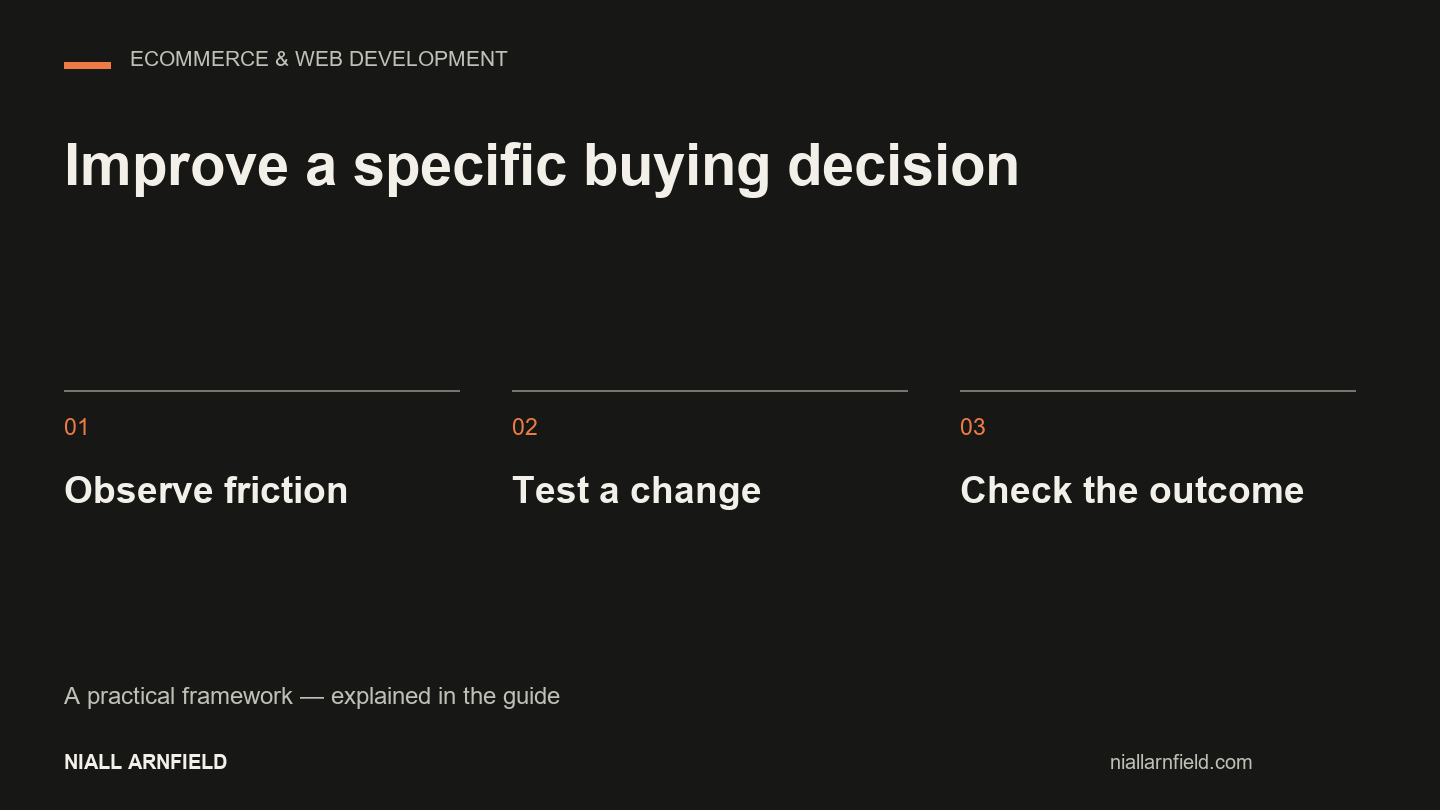
Write a testable hypothesis
For example: “Customers cannot tell the two fitting sizes apart. A labelled measurement diagram beside the selector will reduce size-related support questions and improve successful selection.” This is a proposed experiment, not a measured result.
Define the primary outcome, the guardrails and who can take part in the test. Guardrails might include refunds, support demand, loading time and accessibility. A higher order rate matters less if the change causes more incorrect purchases.
Choose a method that fits the traffic
A controlled A/B test needs enough data to answer the question with useful confidence. On a small site, usability observation, support evidence and verified defect correction may be more practical. A short test with too few visitors is underpowered.
When you use before-and-after comparisons, record promotions, stock changes, traffic mix and seasonal effects. These can explain a change on their own, apart from the interface. State the limitation. Do not credit every rise to CRO.
Shopify and configurable products
Shopify CRO work can involve theme sections, product details, app behaviour and platform-supported checkout settings. Check what is available before you promise a checkout change. The theme development guide covers work you can maintain.
For complex products, a product configurator can help shoppers explore valid options. It can produce a useful specification. Introduce one to solve a decision problem you have already found. Use the configurator ROI worksheet first. It makes your assumptions clear before you project value.
Track enquiries and separate them from qualified leads
Conversion rate optimisation (conversion rate optimization in US spelling) only works if the numbers mean what you think. A completed form submission is not automatically a qualified enquiry. It may be spam, a duplicate or a request outside your services. Keep four measures separate.
- Submission attempt: someone or something tried to send the form. Validation may still fail.
- Application acceptance: the request reached the success path. Name the boundary, such as a stored record or mail processing. In WordPress, a successful
wp_mail()return does not prove inbox delivery. - Analytics event: the tool saw an event within its collection and consent limits.
- Qualified enquiry: a reviewer applied agreed criteria and found a genuine, relevant opportunity.
Fire the lead event only from a checked success path. Do not fire it just because a browser reached a thank-you URL. On this site, the server checks the form first. The success page uses a short-lived receipt. One verified acceptance sends both a success event and a lead event. These are two names for one outcome. Adding them together double-counts it. I tested the contact-event function offline on 23 September 2026. All 18 checks passed. It proves the function’s decisions only. It does not prove email delivery, spam detection or GA4 ingestion. You can download the test pack, checklist and monthly review sheet.
Review accepted messages against criteria you agree in advance. Classify each cohort the same way: spam, duplicate, other non-qualified, qualified or unreviewed. Record the review date. Quote a qualification rate only for a fully reviewed cohort. Do not call it a visitor conversion rate. Do not divide inbox totals by a consented analytics sample. Keep enquiry text and email addresses out of analytics payloads. Remember that URLs and page titles can contain personal data.
Measure product configurator engagement
If you sell configurable products, page views cannot show whether the model loaded. They cannot show whether a shopper explored options. They cannot show whether the sales team got a usable specification. Define a small set of events. Decide what each one proves.
- Open: the visitor chose to start the viewer. This is an attempt, not a working render.
- Ready: the first product model loaded.
- Select: a changed product or finish loaded, or the visitor confirmed a fallback selection.
- Share: someone copied the selection link. It does not prove anyone opened it.
- Error: the application or model failed to load. Record it apart from completed actions.
Report repeated actions as events. Use one clear visitor or session definition. A shopper might change six finishes, copy two links and send one enquiry. Adding those together gives a false picture of demand. The embedded viewer should pass messages to the parent page. It should do so only after it checks the origin, the sending iframe and the allowed fields. It should pass them only when the site’s consent check allows analytics. A consented sample is not a census. Missing events do not prove nobody used the tool. The downloadable worksheets list event names, triggers and twelve acceptance cases.
- Opens without a successful load: inspect app errors, model requests and device performance.
- Loads, but few choices change: check whether the options and controls answer the customer’s question.
- Many interactions, few useful enquiries: review the next-step invitation, audience relevance and enquiry rules.
- Many submissions, poor quality: review spam handling and qualification before claiming a CRO gain.
These patterns point to checks, not causes. Compare like periods. Treat small count changes at low traffic as weak proof. Check ingestion in the correct analytics property before you rely on a report. Sending a custom parameter does not create a dashboard dimension.
Prioritise by evidence, not enthusiasm
Conversion rate optimization (the US spelling of optimisation) services only help if the backlog is ranked sensibly. Score each opportunity on the same factors. Keep the scores relative and explain them. A precise-looking number does not remove judgement.
| Factor | Question to ask |
|---|---|
| Impact | How important is the affected task? |
| Confidence | How strong and relevant is the evidence? |
| Reach | How many suitable users meet the problem? |
| Effort | What design, engineering and QA are required? |
| Risk | Could the change harm accessibility, trust, data or another journey? |
| Dependency | What must be fixed or supplied first? |
Not every idea needs an A/B test. Fix a confirmed defect directly. Use a usability test for comprehension or navigation problems. Compare prototypes before costly builds. Keep a controlled test for cases where traffic and tracking support it. An A/B test needs a written audience, allocation, primary measure, guardrails, quality checks and a stopping rule. Do not keep checking results and stop at the most attractive moment. Whatever the outcome, record the evidence, limits and decision. Failed ideas still reduce uncertainty that way.
Common mistakes
- Treating conversion rate as the only business measure.
- Testing a broken or unverified funnel.
- Copying a competitor’s pattern without customer evidence.
- Testing several unrelated changes as one treatment.
- Ignoring accessibility, refunds, support demand or lead quality.
- Calling any positive movement a result without a decision rule.
- Keeping findings in a slide deck instead of the product backlog.
When you hire help, ask how analytics will be validated first. Ask what qualitative evidence is included. Ask who defines the primary and guardrail measures. Ask how inconclusive or negative results will be recorded.
Measure with first-party data and honest attribution
Cross-site tracking is more restricted than it was. However, Chrome did not complete the blanket third-party cookie deprecation the industry expected. Consent choices, browser limits and split journeys still reduce what cross-site tools can see. So build tracking around what your own site can observe.
- Consent: collect data for a stated purpose and respect the visitor’s choices.
- Contract: agree stable event definitions before comparing numbers.
- Quality: report unknown or modelled attribution apart from observed conversions.
- Retention: keep only the data you need.
Audit what your dashboards actually measure before the next budget decision. Attribution that relies on cross-site identity tends to over-credit the final touchpoint. It tends to under-credit earlier ones. So a dashboard figure is not proof that a channel still performs.
Judge upsell prompts by abandonment, not just acceptance
An upsell prompt adds a choice at the moment someone decides whether to buy. A plugin dashboard usually reports only how many visitors accepted it. Compare cart abandonment and order value. Compare visitors who saw the prompt with those who did not. Treat any difference as a hypothesis to test, not a settled result. Prompts for complementary items are more likely to cut effort than unrelated suggestions. One example is the right cartridges for a printer. A shopper would otherwise have to remember those. In categories where brand perception matters, such as luxury, check fit before conversion mechanics.
Related reading: Velune footwear storefront redesign, Second Core redesign concepts and Soinvogue ecommerce redesign.
Start with one important journey
Bring a product page, your current conversion definition and the points where shoppers ask for help. I can look into the journey. I can prepare one clear change and check the build. Discuss ecommerce conversion optimisation or review the broader ecommerce development service. How I handle your details is set out in my privacy policy.
Related guides
- Trade buyers drop out for different reasons, such as waiting on a colleague’s sign-off. The B2B checkout and approvals guide shows how to keep that work from being lost.
- When small fixes are not enough, a website redesign may be the better route.
- If buyers struggle to find the right product in a large range, the product finder and filter design guide covers guided matching, filters and what to show when nothing fits.