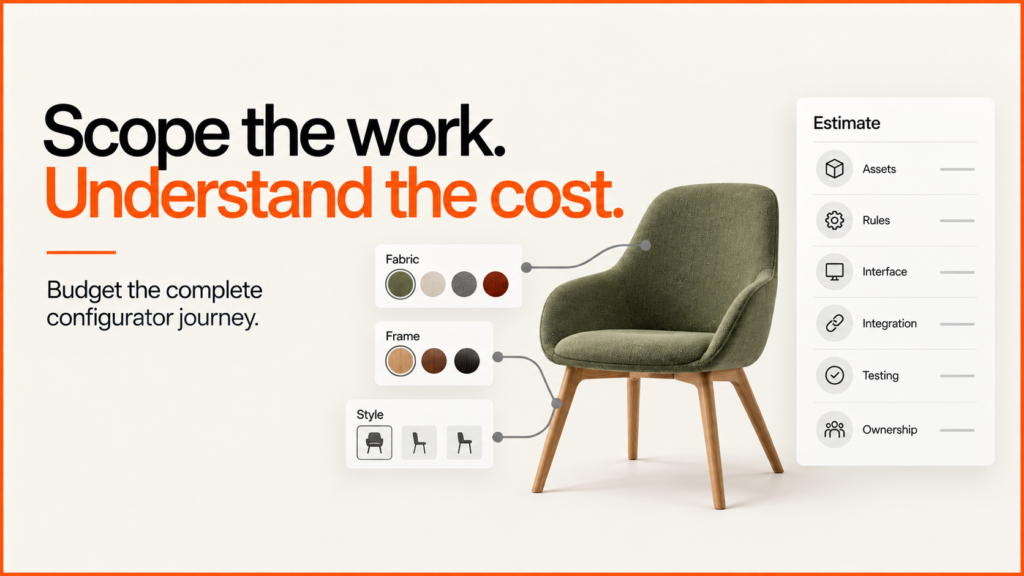
The cost of a 3D product configurator depends on what the customer can change, how those choices affect the product, and what happens when they finish. A colour preview and a made-to-order system with dealer pricing may look similar on screen. They are very different projects to deliver and maintain.
Discuss your product rangeTry the cost calculator
Before comparing estimates, agree one representative product and one complete customer journey. This gives suppliers something concrete to price and gives you a way to check whether their proposals cover the same work.
What belongs in the budget?
| Workstream | What changes the effort | Ask the supplier to specify |
|---|---|---|
| Product definition | Dependencies, exclusions, dimensions and exceptions. | Who supplies and approves the rules; how contradictions are resolved. |
| 3D assets | Existing model quality, separate components, finishes and reference material. | Model preparation, texture work, visual approval and source-file handover. |
| Customer interface | Number of steps, mobile controls, saved selections and accessible alternatives. | The actual tasks tested, including errors and returning to an earlier choice. |
| Commercial integration | Quote requests, basket lines, pricing, availability and downstream systems. | Which system owns each value and which environments are included. |
| Release assurance | Supported devices, slow connections, catalogue coverage and failure recovery. | Acceptance criteria, test evidence and responsibility for fixing defects. |
| Ongoing operation | Catalogue changes, platform updates, hosting and support. | Recurring charges, change allowances, ownership and exit arrangements. |
A model count alone is a poor estimate. Ten products that share a tested structure may be easier to add than one product with undocumented compatibility rules and several pricing exceptions. Ask how subsequent products are priced once the initial pattern is established.
Compare scope before comparing the headline price
Consider an illustrative furniture project with twelve chair models and eight upholstery choices. There are 96 model-and-finish selections if every finish is available on every chair. That does not automatically mean 96 separately authored 3D models: geometry and materials may be reusable. Equally, it does not mean that checking one chair proves the whole range works.
Now add alternative bases, prohibited combinations and account-specific prices. The visual catalogue has not necessarily grown very much, but rule definition, validation and testing have. These examples explain cost drivers; they are not claims about a particular client’s catalogue or a quotation for your project.
An app, a platform or a custom build?
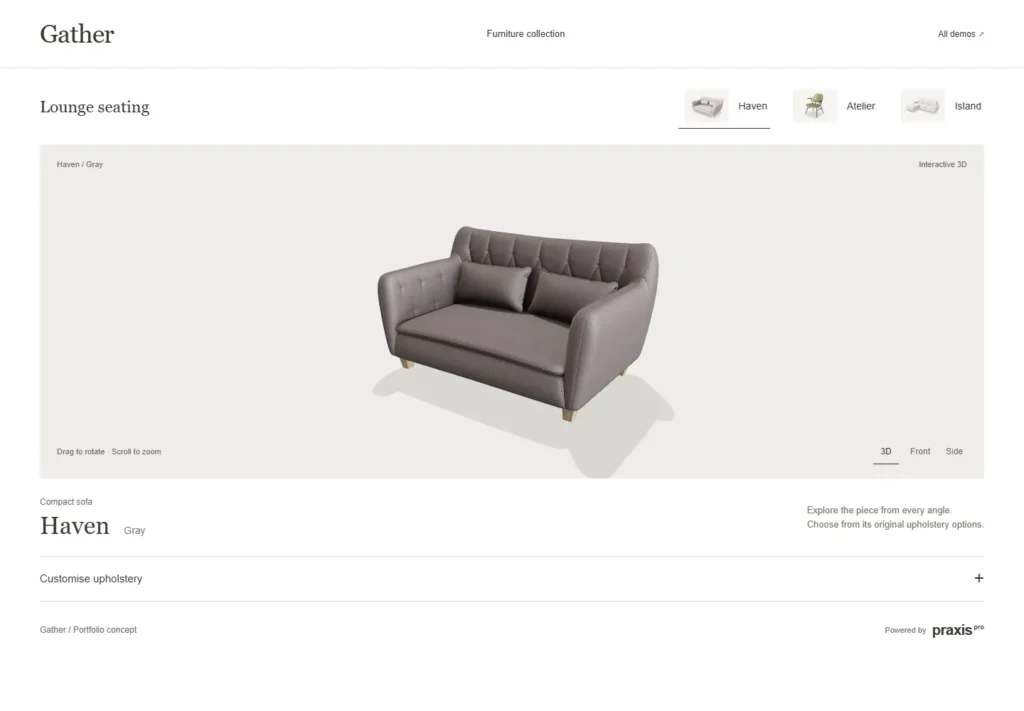
An existing app can be a sensible fit when its option types, output and maintenance model match your products. A configurable platform can offer reusable rendering and catalogue foundations with a tailored front end. A custom build gives more control over unusual rules and workflows, with corresponding responsibility for development and upkeep.
These approaches overlap. A bespoke interface can sit on reusable technology; an app can still need substantial asset preparation and integration. Shopify’s configurator overview describes both app and custom routes. Evaluate them against a representative task, rather than assuming that one delivery label guarantees a lower total cost.
Use a three-column estimate
| Must work at launch | Priced separately | Explicitly excluded |
|---|---|---|
| One agreed product family, approved finishes and valid combinations. | Additional families, languages or retailer interfaces. | Unspecified products and unsupported asset formats. |
| A complete quote or checkout hand-off with a written configuration summary. | CRM, ERP or dealer-account integrations beyond the first workflow. | Manufacturing drawings unless separately commissioned. |
| Mobile and keyboard checks, failure handling and a handover. | Ongoing catalogue updates and support beyond the agreed period. | Guaranteed sales uplift or search rankings. |
Record assumptions beside the estimate: how many review rounds are included, whether usable source models exist, and who can approve product accuracy. An unresolved assumption should have a discovery task, not disappear inside a fixed figure.
To total build, asset, internal and ongoing costs with your own figures, use the configurator cost calculator. It shows the arithmetic and exports a CSV to file with each proposal.
Reduce uncertainty with a complete pilot
Choose a product that exposes the difficult decisions: a dependent option, a changed component, a material choice and the intended commercial output. Take it from selection to an accepted quote request or valid basket entry. A polished viewer that stops before that last step has not tested the integration budget.
Use the pilot to establish the cost of adding another product, the process for changing a finish and the checks needed after a catalogue update. Those are practical inputs to a rollout decision. Keep any expected time savings or sales benefits as assumptions until you measure them.
To test whether a proposed scope makes commercial sense, use the product configurator ROI worksheet. It separates released staff capacity, cash savings and assumed additional orders.
When comparing delivery routes, use the build-or-buy evaluation guide and supplier worksheet to test the same product, commercial handoff and maintenance tasks in each proposed solution.
Judge the return with an ROI worksheet
A configurator earns its place when it solves a worthwhile commercial problem: less effort preparing quotations, fewer invalid specifications, or more suitable enquiries turning into accepted orders. Cost is only half of that case, so set it against benefits you can evidence. The editable ROI worksheet (.xlsx) has a blank column for your own figures, a fictional worked example and a zero-sales-uplift comparison. It needs no email address and contains formulas but no macros.
| Input | Useful evidence | Avoid |
|---|---|---|
| Eligible enquiry volume | Enquiries for the products and workflow the configurator will actually cover. | Treating every website visit as a sales opportunity. |
| Time per quotation | Comparable tasks measured before and during a pilot, including corrections. | Counting only the quickest successful demonstration. |
| Additional accepted orders | An explicit assumption you can check later against comparable enquiries. | Borrowing another business’s conversion increase. |
| Contribution per order | Revenue less the incremental cost of fulfilling that order. | Treating the full selling price as profit. |
| Delivery and operation | Build, assets, internal work, support, maintenance and contingency. | Leaving out internal preparation, or counting a support cost twice. |
Freed time is not automatically a cash saving. If 120 eligible enquiries each need twenty fewer minutes of work, that releases forty staff hours a month. At a loaded labour cost of £30 an hour the capacity is worth about £1,200, but payroll does not necessarily fall. Count it as cash only when you can name the spending that changes, such as avoided overtime, and do not count the same hours again as additional orders.
Here is an illustrative worked example using fictional figures. An external build of £12,000, £3,000 of asset preparation and eighty internal hours at £30, plus 10% contingency, gives an upfront investment of £19,140. Platform and support at £370 a month for twelve months bring year-one cost to £23,580. Benefits run for nine months. At twelve additional accepted orders a month, each contributing £250, year-one benefit is £27,000, a net benefit of £3,420 or roughly 14.5%. With no additional orders the same case loses the full £23,580. The order assumption is doing all the work, so keep timing and uncertainty visible and test a disappointing outcome as well as an upside. The worksheet does not model financing, tax, discounting or seasonality.
Weighing a hosted platform against a custom build? See configurator platform alternatives.
Related reading: bike configurator guide, door and window configurators and garden building configurators.
Get a scope you can estimate
There is no published fixed price for my bespoke configurator work. I scope the product rules, assets, interface and integration together, then agree the appropriate delivery route. Send a representative product, available model files and the action you want a customer to complete.
To see what a scoped single-product build can look like, try the retro appliance demo. Its page explains which choices it handles and what it leaves out.
Use the configurator brief template, check your project readiness, or discuss a configurator project. The development service explains the broader delivery process.
For how these costs play out in one trade, see salon furniture websites and configurators.
New to the idea? Start with what a product configurator is and when one is worth it.