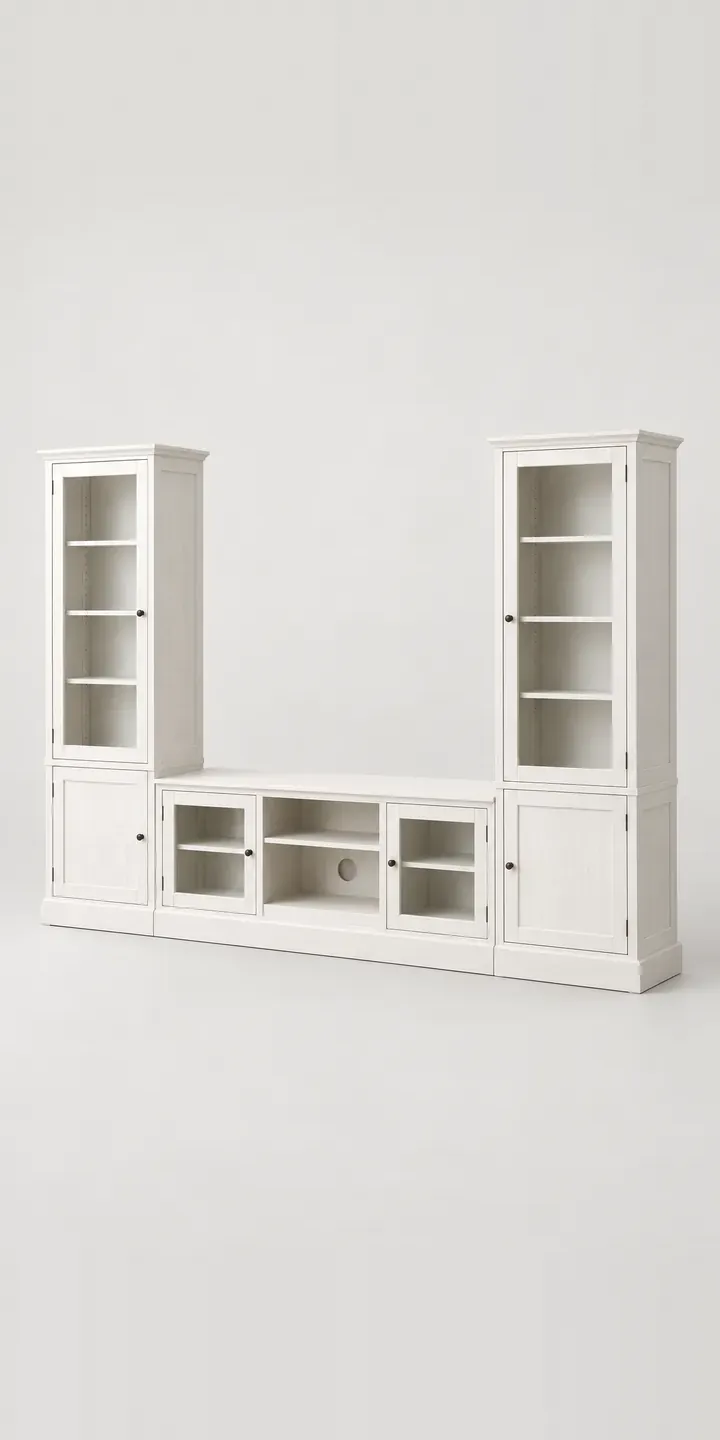
The demo on this page builds an illustrative TV storage wall: a TV bench with glass-panelled doors, framed by cabinets with small round knobs. Set a finish and a width, and a quote request is ready.
Storage walls are bought by measuring a wall, not by browsing. The buyer starts with the width available, often an awkward one with a chimney breast, radiators or sockets, and works out what fits around the television. Finish decides whether the unit blends in or anchors the room. White pine and light grey recede, natural pine warms a cottage lounge, and dark grey frames the screen so it almost disappears when switched off.
Furniture Configurator demo
TV Storage Wall
- Product
- TV Storage Wall
- Colour
- White Pine
- Width
- 240 cm
Illustrative product. The design and images are generated examples, not a real model for sale.
What you can configure
Finishes on screen are white pine, light grey, natural pine and dark grey, with black brown and sage completing six. The width choice of 240, 320 or 400 cm goes to the summary, not the image. For a storage wall, width is the first decision and finish the second. A production build would therefore redraw the arrangement for each width before the finish is applied.
- Colour: White Pine, Light Grey, Natural Pine, Dark Grey
- Width: 240 cm, 320 cm, 400 cm
Why a configurator suits storage walls
Storage combinations are where online furniture sales get complicated. Each width is a different set of cabinets, shelves and benches, and every finish applies across all of them. Before anyone swaps a glass door for a solid one, there are eighteen walls to show. Most retailers fall back on a few fixed combinations and a planning service by appointment.
A configurator replaces much of that appointment. The buyer chooses the width, sees which combination fits and adjusts it, while the configurator checks that their television fits the bench opening. The order arrives as a list of components the warehouse can pick, rather than a sketch that has to be interpreted.
Returns are a serious cost in this category. A storage wall usually ships as many separate packages, and an order that does not fit the wall comes back the same way. Showing the overall dimensions, the TV opening and the depth beside the image, generated from the product data, is the simplest protection against that.
How a production version would be built
A storage wall is a modular build at heart. Each component, such as the TV bench, side cabinets and wall shelves, is modelled once and rendered in every finish. The configurator composites them into the chosen width from a fixed camera. Glass and solid doors are separate layers. The retailer supplies the component list with dimensions and finishes, the combinations that make up each width, the largest screen each bench takes, and cable access details. Configured walls go to the basket as their component products, so stock is tracked per package. My 3D product visualisation page covers rendering when photography is not available.
Build sheet for this range
- Colours in the full range: 6 (4 shown in this demo)
- Width choices: 3
- Combinations to support: 6 × 3 = 18
- Images for one photograph per combination at 3 angles: 54
- Images if widths can be shown as separate layers, at 3 angles: 27
- Data each of the 18 combinations needs: a SKU or variant ID, price, stock or lead time, and any dimensions or specification that change
Questions about storage wall configurators
Can the configurator check whether a customer's TV will fit?
Yes. Each bench can store its maximum screen width, and the buyer enters their television size. The configurator then flags combinations where the screen would overhang, or suggests a wider bench. It is a simple rule that heads off a common complaint after delivery.
Can buyers plan around chimney breasts and alcoves?
Partly. A configurator can let buyers enter the wall width and alcove depths, then suggest combinations that fit. Full room planning with chimney breasts and windows is closer to a design tool, which needs 3D. For most storage walls, fitting the width and showing clear dimensions covers most of the real questions.
Will pine grain look consistent across all the components?
If the components are rendered with the same timber texture and lighting, yes. With photography, pine varies from board to board, so each component must be shot under identical conditions. I usually render storage walls for that reason: the grain, the knobs and the glass stay consistent however many components are combined.
Can the configured storage wall be ordered as separate packages?
Yes. The configurator resolves the wall into its component products and adds each to the basket with its own stock code. That keeps warehouse picking and delivery planning accurate. It also lets the retailer show availability per component, so buyers know if one cabinet is holding up the order.
More furniture configurator demos
All furniture configurator demos
A configurator for your storage walls
This demo uses an illustrative product. If you sell storage walls, I can build the same experience around your own range, photography and ordering process, connected to Shopify, WooCommerce or a quote workflow. I reply to enquiries within two UK working days.