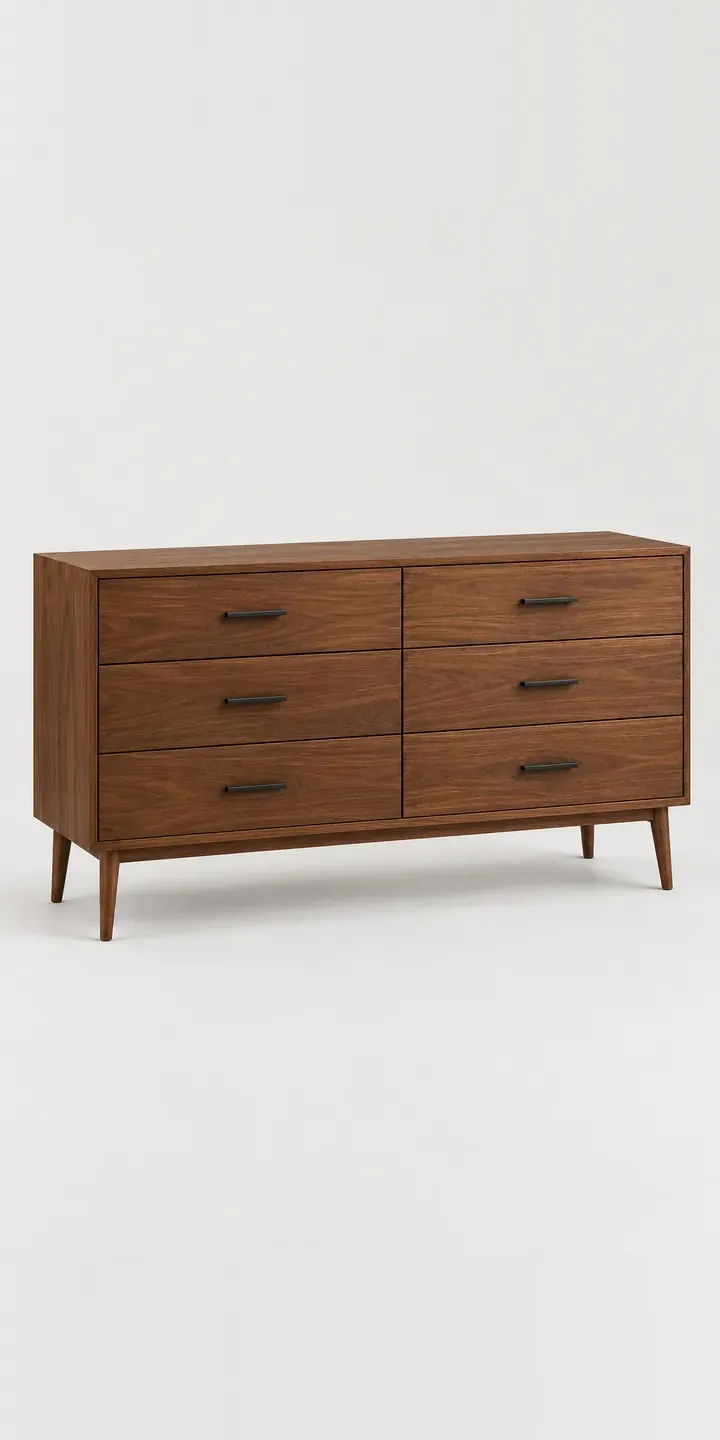
Mid-century in style, this illustrative chest of drawers sits on slim tapered legs, with metal pulls on flush fronts. Choose a finish and a width of 107 or 142 cm to put together a quote request.
Buyers of mid-century furniture often know the originals and judge new pieces against them. Proportion matters: how high the legs lift the carcass, how the drawers are divided, how the pulls sit. Finish carries period associations too. Walnut and teak feel true to the era, while ebony and white give the same shape a sharper, contemporary edge. Raised legs also keep the floor visible beneath, which makes a small bedroom feel larger.
Furniture Configurator demo
Tapered Leg Chest
- Product
- Tapered Leg Chest
- Colour
- Walnut
- Width
- 107 cm
Illustrative product. The design and images are generated examples, not a real model for sale.
What you can configure
Clicking a swatch moves the chest between walnut, light oak, white and ebony. Teak and grey are the two further finishes. Width is a choice of 107 or 142 cm, recorded in the summary while the picture stays the same. With only two widths, this chest is mostly about finish, and the metal pulls play their part, because their tone reads differently against pale and dark timber.
- Colour: Walnut, Light Oak, White, Ebony
- Width: 107 cm, 142 cm
Why a configurator suits chests of drawers
Twelve combinations is a modest range, and that is a reason to show every one properly rather than a reason to skip a configurator. For a style-led piece, the difference between walnut and teak is the whole sale. Buyers who cannot see it tend to hesitate, or compare against vintage originals where at least the piece is in front of them.
Hardware is the natural next option. Mid-century chests are often offered with a choice of pull finishes, such as brass, black or brushed steel, and each changes the character of the piece. A configurator handles that as one extra layer per pull type, rather than a new photograph of every chest. The demo keeps the pull fixed, but it is a common first extension.
The retailer is often a small brand or design shop selling mainly online. A configurator lets that business present a range with the clarity of a much larger furniture house. A saved configuration link also gives customers something to share before committing to a piece they expect to keep for years.
How a production version would be built
This chest is a straightforward image build. Each finish is rendered once per width, twelve images in total, with legs and pulls identical in every one. Pull finishes can be added later as small layers over the drawer fronts. The retailer supplies finish names, timber and veneer details, dimensions for each width, and the pull options if offered. Rendering keeps the tapered legs crisp and the proportions exact, which matters more to this audience than to most. On Shopify, each finish and width pairing becomes a variant.
Build sheet for this range
- Colours in the full range: 6 (4 shown in this demo)
- Width choices: 2
- Combinations to support: 6 × 2 = 12
- Images for one photograph per combination at 3 angles: 36
- Images if widths can be shown as separate layers, at 3 angles: 24
- Data each of the 12 combinations needs: a SKU or variant ID, price, stock or lead time, and any dimensions or specification that change
Questions about chest of drawers configurators
Can the configurator offer different pull finishes?
Yes. Pulls become a separate image layer over the drawer fronts, one per finish, so brass or black pulls can be shown on any chest without new photography. Rules can also block pairings you do not want to sell. The demo keeps one pull finish to keep the example simple.
Will walnut and teak look different enough on screen?
They will, if tone and grain are shown at a scale buyers can see. Walnut tends to be darker and cooler, teak warmer and more golden. I render or photograph both under identical light, then add a close detail of a drawer front. Buyers then compare like with like, not two images taken on different days.
Will the leg proportions look right in every image?
They will if every image comes from the same model or the same camera setup. Mid-century buyers notice proportion, so I avoid wide-angle lenses that exaggerate the legs and keep a slightly raised, natural viewpoint. Rendering from a 3D model guarantees the legs are identical across all finishes.
Can customers save a configured chest and come back to it?
Yes. A saved chest gets its own short link, which reopens the same finish and width. Customers share it with a partner or keep it while they measure the room. The link can also be attached to a quote request, so your team sees exactly what was chosen.
More furniture configurator demos
All furniture configurator demos
A configurator for your chests of drawers
This demo uses an illustrative product. If you sell chests of drawers, I can build the same experience around your own range, photography and ordering process, connected to Shopify, WooCommerce or a quote workflow. I reply to enquiries within two UK working days.