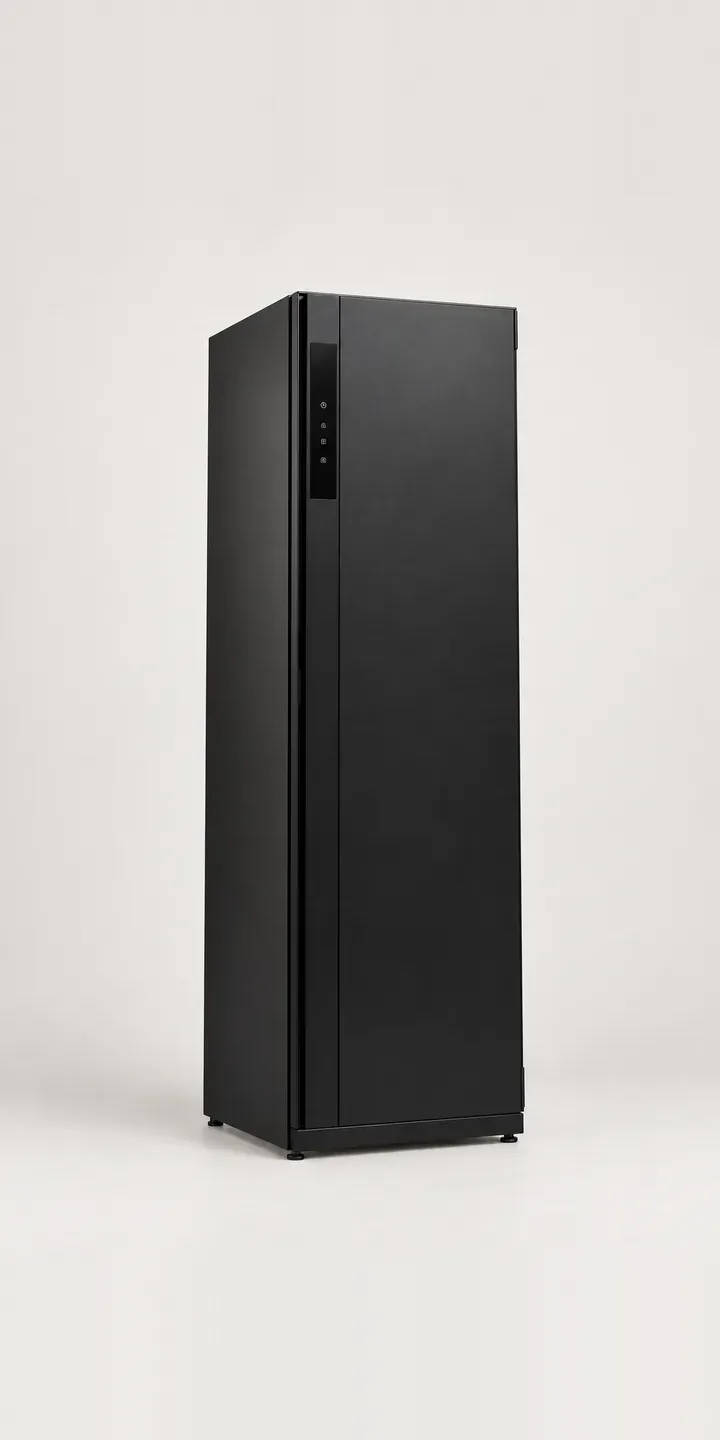
This illustrative garment care cabinet refreshes clothes with steam on a hanging rail. The configurator lets you pick a door finish and a hinge side, then sends the configuration as a quote request.
A steam closet sits halfway between an appliance and a piece of furniture. It stands in a dressing room or hotel entrance hall, at full height, where people see it every day. Buyers check capacity and cycle times, but the purchase turns on whether the door looks like part of the room. That is why the finish list runs from matte black to mirror and linen.
Appliances Configurator demo
Garment Care Cabinet
- Product
- Garment Care Cabinet
- Colour
- Matte Black
- Hinge
- Left
Illustrative product. The design and images are generated examples, not a real model for sale.
What you can configure
Matte black, white, mirror and linen are in the demo, from a range that adds walnut and forest. Each suits a different room: mirror doubles as a full-length dressing mirror, linen and white blend into pale joinery, and matte black works against dark timber. The hinge option sets which side the door opens. It is captured in the summary, though the picture stays the same for both sides in this demo.
- Colour: Matte Black, White, Mirror, Linen
- Hinge: Left, Right
Why a configurator suits steam closets
Hotels are a natural market for this product, and hotel orders are rarely uniform. Rooms are often built as mirror-image pairs. The same suite type may then need a left hinge on one side of the corridor and a right hinge on the other. A furniture schedule that says forty cabinets in linen is not enough. A configurator that records finish and hinge per room type produces a schedule the supplier can pick from.
In residential sales, the buyer is often working with a joiner or interior designer on a dressing room. They need to see the finish next to their chosen timber or paint, and they need a reliable specification to pass on. Six finishes with two hinge sides gives twelve variants, and each should arrive as a code, not a description.
The mirror finish deserves its own mention. It is the hardest to sell online, because a photograph of a mirror shows whatever the camera saw. Buyers cannot judge the finish from a reflection of a studio. Treating it properly, with a neutral reflection and a detail of the edge, makes it a credible choice instead of the one nobody risks.
How a production version would be built
A production build needs one image per finish and hinge side, twelve in all. The handle position and panel edge change with the hinge, and a flipped image looks wrong on a mirror door. Rendering suits this product: the cabinet is a simple form, and a 3D model controls the mirror's reflection precisely. The supplier provides finish codes, dimensions, ventilation clearances and any fitted-furniture options. For contract buyers, the configurator can sit beside a wardrobe configurator and export the full room schedule to a quote.
Build sheet for this range
- Colours in the full range: 6 (4 shown in this demo)
- Hinge choices: 2
- Combinations to support: 6 × 2 = 12
- Images for one photograph per combination at 3 angles: 36
- Images if hinges can be shown as separate layers, at 3 angles: 24
- Data each of the 12 combinations needs: a SKU or variant ID, price, stock or lead time, and any dimensions or specification that change
Questions about steam closet configurators
Can hotel buyers order left and right hinge versions on one schedule?
They can. Each room type becomes a configured line with its finish, hinge side and quantity. The quote groups them into a single schedule that can be exported as a spreadsheet for the project team. A change to a room type updates every line that uses it, rather than being edited by hand.
How do you photograph a mirror-finish door so it looks right online?
It is usually better to render it. A 3D render lets me control what the mirror reflects, typically a soft neutral room, so the door reads as a mirror without showing a studio. A close detail of the edge and frame then confirms the build quality that a flat reflection cannot show.
Can the cabinet be shown built into a dressing room or wardrobe run?
Yes. A secondary view can place the chosen finish inside a run of joinery, with flanking wardrobe doors in a matching or contrasting finish. That matters for interior designers presenting a scheme. The main configurator stays focused on the product itself, so colour comparisons remain fair.
Can the configurator handle walnut finishes with natural grain variation?
Yes, with honest presentation. The image shows a representative panel, and a short note explains that each door will differ slightly in grain. For a project order, a sample request can be added to the configurator, so the designer approves the actual veneer batch before production.
More home appliance configurator demos
Laundry Tower
Mopping Robot Vacuum
Retro Fridge-Freezer

Bagless Stick Vacuum
Built-In Dishwasher
Fitted Dishwasher
All home appliance configurator demos
A configurator for your steam closets
This demo uses an illustrative product. If you sell steam closets, I can build the same experience around your own range, photography and ordering process, connected to Shopify, WooCommerce or a quote workflow. I reply to enquiries within two UK working days.