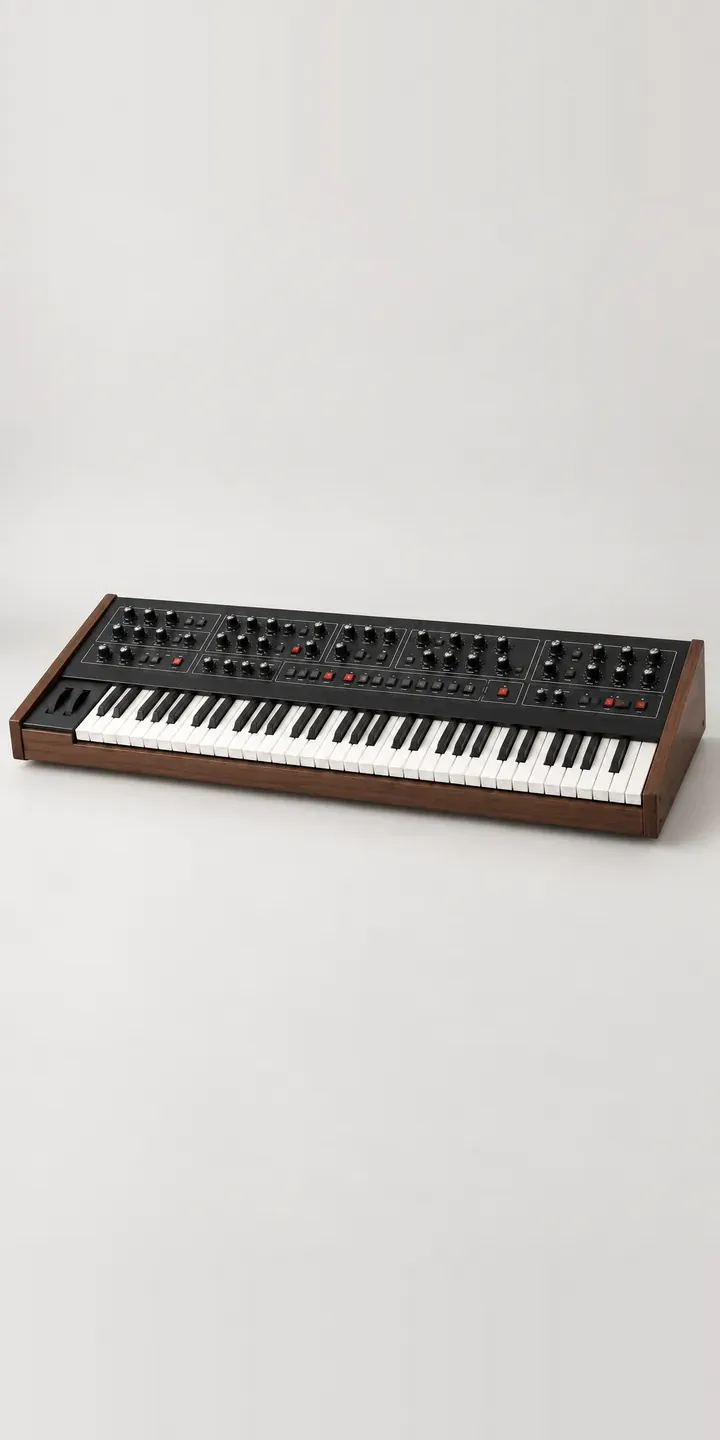
Wooden end cheeks frame the illustrative analogue polyphonic synthesizer in this demo. Choose a finish and a 61- or 73-key keybed, and the summary holds the specification for a quote or pre-order.
Analogue poly buyers are often collectors as much as players. They care about the voice architecture, but the instrument also has to look right on a teak desk or beside a rack of vintage gear. Here each finish pairs a panel colour with the wood of the end cheeks, so black walnut and silver oak are different objects, not just different paints. The extra twelve keys of the 73 matter to players who want two-handed parts without reaching for an octave button.
Music Configurator demo
Analogue Poly Synth
- Product
- Analogue Poly Synth
- Colour
- Black Walnut
- Keys
- 61 Keys
Illustrative product. The design and images are generated examples, not a real model for sale.
What you can configure
Black walnut, silver oak, cream and navy are shown, from six finishes that also include burgundy and grey ash. Each image keeps the join between wooden end cheek and metal panel, and the rows of knobs above the keys, in the same position. Key count is 61 or 73. Collectors check how a synth fits their desk, so a production build would picture the longer 73 chassis. This demo notes the choice in the summary only.
- Colour: Black Walnut, Silver Oak, Cream, Navy
- Keys: 61 Keys, 73 Keys
Why a configurator suits synths
Boutique synth makers usually build in batches. Timber is ordered, panels are printed and cases are assembled in runs, and each finish adds stock to hold. Twelve combinations of finish and key count is manageable for a small workshop only if demand is known before the run starts.
A configurator gives that visibility. Buyers place a reservation against a precise build, and the maker sees how many navy 73s and walnut 61s to make before ordering wood. Finishes that attract little interest can be dropped or offered as limited editions next time, rather than sitting unsold on a shelf. The workshop plans from real requests instead of a hunch formed at a trade show.
Collectors also value documentation. A configured build, with finish, key count and serial number recorded, becomes part of the instrument's history. Makers who run limited finishes can show how many were made, and a saved configuration page gives the owner something to point to when the synth is eventually resold.
How a production version would be built
For this synth, I would photograph or render each finish on the 61 and the 73 separately, because the wood and the panel colour both carry real texture. Wood grain especially should not be recoloured. If the maker has CAD for the chassis, rendering from CAD is often cheaper than shooting twelve real units before they exist. The maker supplies finish names, wood species, key counts, batch dates and allocation per finish. Orders can feed a pre-order list, a Shopify deposit product or a quote, with each reservation logged in the maker's CRM.
Build sheet for this range
- Colours in the full range: 6 (4 shown in this demo)
- Keys choices: 2
- Combinations to support: 6 × 2 = 12
- Images for one photograph per combination at 3 angles: 36
- Images if key counts can be shown as separate layers, at 3 angles: 24
- Data each of the 12 combinations needs: a SKU or variant ID, price, stock or lead time, and any dimensions or specification that change
Questions about synth configurators
Can we take orders for a finish before the first units are built?
Yes, if you have CAD or a convincing prototype. Renders let you show every finish before production, and the configurator can take a reservation or deposit against each build. Labelling the images as renders is sensible. When finished units arrive, you can swap in photographs without changing the configurator.
How do you handle natural variation in the wooden end cheeks?
By saying so clearly and showing it. The configurator shows a representative cheek for each species with a short note that grain and tone vary. A small gallery of real cheeks from past batches helps buyers understand the range. Collectors generally appreciate that honesty more than a perfectly uniform image.
Can panel colour and wood be chosen separately?
They can be, if your workshop supports it. On an image-based build, the panel and the cheeks become separate layers, so any panel colour can be paired with any wood. That turns six fixed finishes into many more combinations, so check whether your batch process can handle the extra stock first.
Can the configurator cap a limited edition at a fixed number of units?
Yes. Each finish can carry an allocation, and the configurator counts reservations against it. When the run is full, the option closes or switches to a waiting list. The count can also be shown publicly, which suits limited synth runs where buyers like to know how many exist.
More musical instrument configurator demos
All musical instrument configurator demos
A configurator for your synths
This demo uses an illustrative product. If you sell synths, I can build the same experience around your own range, photography and ordering process, connected to Shopify, WooCommerce or a quote workflow. I reply to enquiries within two UK working days.