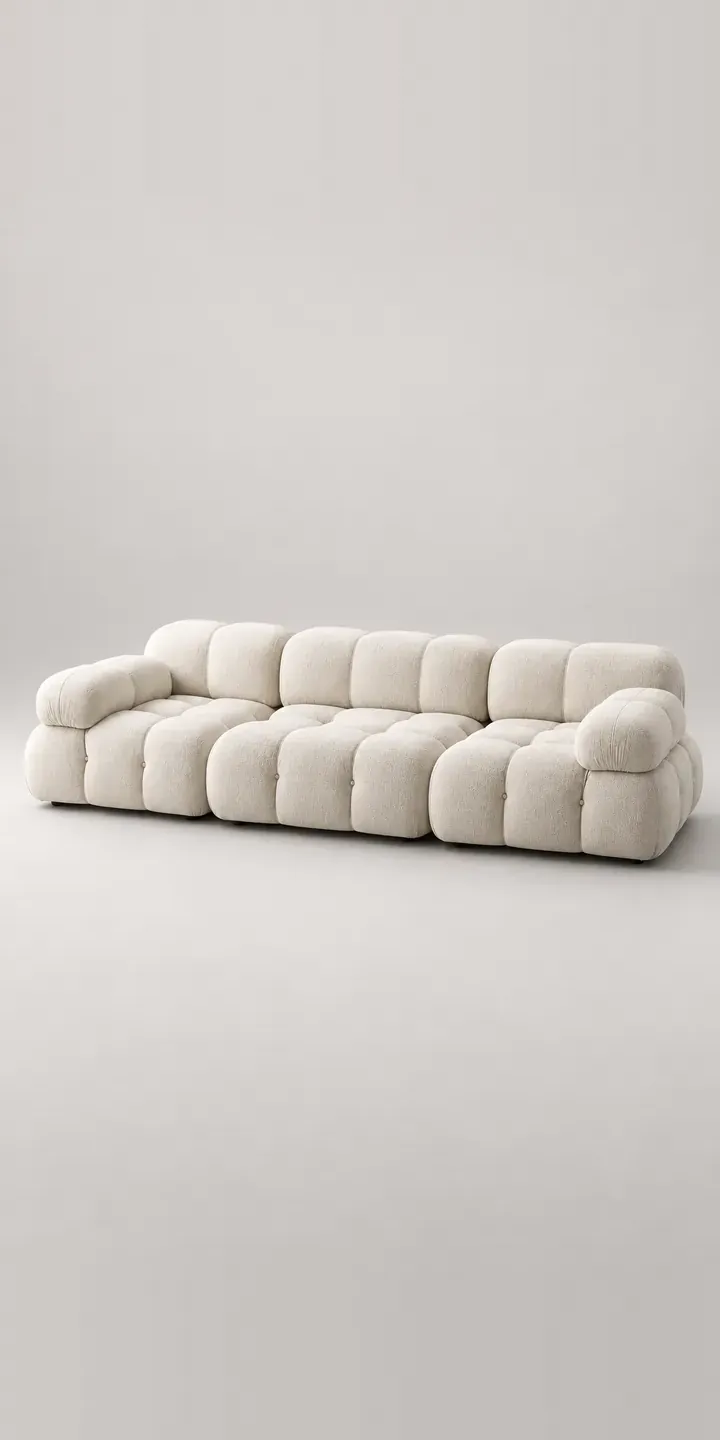
This example sofa is a low quilted system sold by the module, with padding puffing between the stitched seams and rounded corners where the units meet. Try it in four colours and three lengths, and the result goes out as a quote request.
With a sofa sold by the module, the purchase is rarely finished on day one. Plenty of buyers start with three modules in a first flat and add more after a move. So the real decision is a colour they will still want to match in a few years, and a length that works now without boxing them in later. Quilting adds a twist: the stitched grid casts small shadows, so a colour reads deeper here than on a flat-faced sofa.
Furniture Configurator demo
Quilted Sofa
- Product
- Quilted Sofa
- Colour
- Off-White
- Modules
- 3 modules
Illustrative product. The design and images are generated examples, not a real model for sale.
What you can configure
Choose Off-White, Camel, Moss or Terracotta, then pick three, four or five modules. The colour swap is live, while the module count goes into the summary and the picture stays as it is. On a quilted system the colour choice matters more than it seems. Pale covers show the quilting as soft shadow lines, whereas terracotta and moss flatten it into texture.
- Colour: Off-White, Camel, Moss, Terracotta
- Modules: 3 modules, 4 modules, 5 modules
Why a configurator suits sofas
Before anyone asks for a corner or an ottoman, six colours and three run lengths already give eighteen configurations. For a modular system that range is the selling point, and it is also the hardest thing to photograph. Showroom floors usually hold one run in one colour, so the rest of the system exists only in a price list.
The bigger commercial issue is the follow-up order. When a customer comes back for a fourth or fifth module, the retailer needs to know exactly what they bought: cover, colour and ideally the dye lot. A configurator that saves each build against the customer record makes that repeat order a lookup rather than a guess. The buyer can also reopen their saved sofa and see it grown by one module before paying.
Contract interiors benefit too. Hotel lounges and office breakout spaces often specify long, low runs of seating. A designer can send a configured link to a client for sign-off instead of assembling a mood board by hand, and the approved build becomes the quote.
How a production version would be built
The efficient route for a quilted system is layered images. Each module type is rendered from the same camera in every cover. The configurator butts them together to form the run, so five modules need no more photography than three. The rounded corner where modules meet needs care in compositing, which is why consistent lighting matters more than resolution. Saved builds use a short link, covered in my notes on saving and sharing configurations. The retailer supplies module codes, dimensions and colour availability, and orders flow to the basket or to a quote.
Build sheet for this range
- Colours in the full range: 6 (4 shown in this demo)
- Modules choices: 3
- Combinations to support: 6 × 3 = 18
- Images for one photograph per combination at 3 angles: 54
- Images if layouts can be shown as separate layers, at 3 angles: 27
- Data each of the 18 combinations needs: a SKU or variant ID, price, stock or lead time, and any dimensions or specification that change
Questions about sofa configurators
Can customers save a sofa and add modules to it later?
Yes. A saved configuration has its own link and can be attached to the customer's order history. When they return, the configurator opens their existing run and lets them add a module in the same cover. Your team also gets the original order reference, which helps with colour matching across production batches.
How do you handle dye lot differences when someone adds a module later?
The configurator cannot remove the risk, but it can manage it. Each order can store the fabric batch from your production system, and a note can appear when a buyer adds to an existing sofa. Some retailers then route repeat orders to a quote, so the workshop can check stock of the original batch first.
Will the quilting look accurate in each colour?
It will if every colour is shot under the same light, because quilting is really a pattern of small shadows. Paler covers show it strongly and deeper colours soften it. I usually add a close detail image per colour, so buyers can see the stitched grid at real scale rather than only the whole sofa.
Can the configurator show corner units and other module types?
Yes, once the build moves beyond this demo. Each module type becomes its own image layer or 3D part, with rules for which pieces can sit next to each other. This demo keeps to straight runs of three to five modules. A full system with corners, ends and ottomans is a common next step once those runs are working.
More furniture configurator demos
All furniture configurator demos
A configurator for your sofas
This demo uses an illustrative product. If you sell sofas, I can build the same experience around your own range, photography and ordering process, connected to Shopify, WooCommerce or a quote workflow. I reply to enquiries within two UK working days.