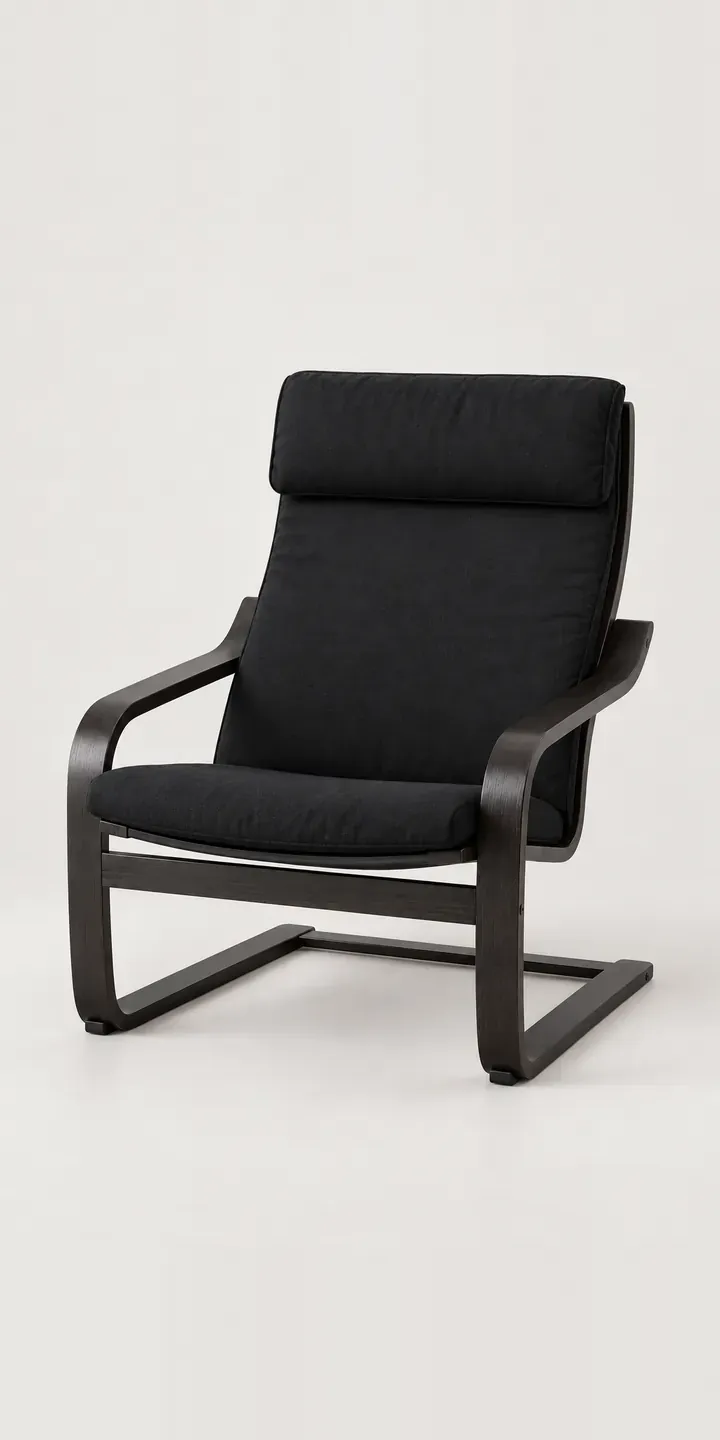
An illustrative cantilevered armchair with a laminated birch frame and a loose cushion resting in the bentwood curve. Choose a colour and a fabric or leather cover, and the summary lists your chair.
This kind of chair is bought on comfort and value, then kept for years. The springy frame does the work and the cushion sets the look. Buyers weigh practical things. Fabric might pill or hold pet hair, leather can feel cold in winter, and the cushion may need swapping when tastes change. Colour sets the mood last. Natural reads light and Nordic, black is graphic, and rust brings warmth to a plain room.
Furniture Configurator demo
Bentwood Armchair
- Product
- Bentwood Armchair
- Colour
- Black
- Cover
- Fabric
Illustrative product. The design and images are generated examples, not a real model for sale.
What you can configure
The demo shows black, natural, light grey and rust, out of six colourways that also include forest green and dusty blue. The laminated layers along the bent arm are visible in each shot, as is the loose cushion against the curved back. Fabric or leather goes into the summary, though the photograph does not switch material here. In production, each cover would have its own texture and colour list.
- Colour: Black, Natural, Light Grey, Rust
- Cover: Fabric, Leather
Why a configurator suits armchairs
Cushion and frame behave like separate products. Six colourways in two cover materials is twelve chairs before any frame variation, and fabric and leather rarely share an identical palette. A configurator that treats the cushion as a layer over a constant frame keeps the photography lean and the choice clear.
Fabric against leather is a decision about the household rather than the room. Leather wipes clean and develops a patina, while fabric feels warmer and costs less to replace. Setting out that trade-off in a sentence beside the option helps buyers choose once. It also gives the retailer a natural place to explain care, which cuts down on questions after delivery.
Chairs in this category sell in volume and compete on price, so every return hurts. Returns usually come down to comfort or colour. Comfort is hard to judge online. A short description of the cantilever flex and cushion depth, beside an accurate image of the chosen colour, still gives the buyer a much better idea. A matching footstool can then be offered in the same cover.
How a production version would be built
A layered 2D build fits this chair well. The frame is photographed or rendered once per frame finish, and each cushion cover is a separate layer in the same position. A new fabric therefore needs one new cushion image rather than a new chair. Required data: frame finishes, cover materials, a colour list per material, and stock. Colour and cover map to variants on Shopify or WooCommerce. If frame and cushion ship in separate cartons, stock can be held for each part independently.
Build sheet for this range
- Colours in the full range: 6 (4 shown in this demo)
- Cover choices: 2
- Combinations to support: 6 × 2 = 12
- Images for one photograph per combination at 3 angles: 36
- Images if covers can be shown as separate layers, at 3 angles: 24
- Data each of the 12 combinations needs: a SKU or variant ID, price, stock or lead time, and any dimensions or specification that change
Questions about armchair configurators
Can fabric and leather covers have different colour ranges?
Each cover material carries its own colour list in the product data, so choosing leather can switch the swatches to the leather palette. If a colour exists in both, the configurator keeps it selected when the cover changes. Customers only ever see combinations you actually make.
How do you show the difference between fabric and leather texture?
With a close-up per cover alongside the main image. At full-chair scale, a dark fabric and a dark leather can look alike, but a macro shot shows weave or grain clearly. A short line on care and feel next to each option completes the picture for the buyer.
Can the configurator explain how the cantilever frame feels?
It can describe it, and that is the honest limit. A short note on how the frame flexes, the seat height and cushion depth, and perhaps a brief video of someone sitting down, all help. Customers who know they prefer a firm, upright seat can then rule the chair out before ordering.
Is a configurator worth it for a lower-priced chair?
It can be, when the chair sells in volume. Lower prices make returns and support time a larger share of the margin, so clearer choices pay back faster. A simple layered build for one chair family is a modest project. My configurator cost guide sets out what affects the budget.
More furniture configurator demos
All furniture configurator demos
A configurator for your armchairs
This demo uses an illustrative product. If you sell armchairs, I can build the same experience around your own range, photography and ordering process, connected to Shopify, WooCommerce or a quote workflow. I reply to enquiries within two UK working days.