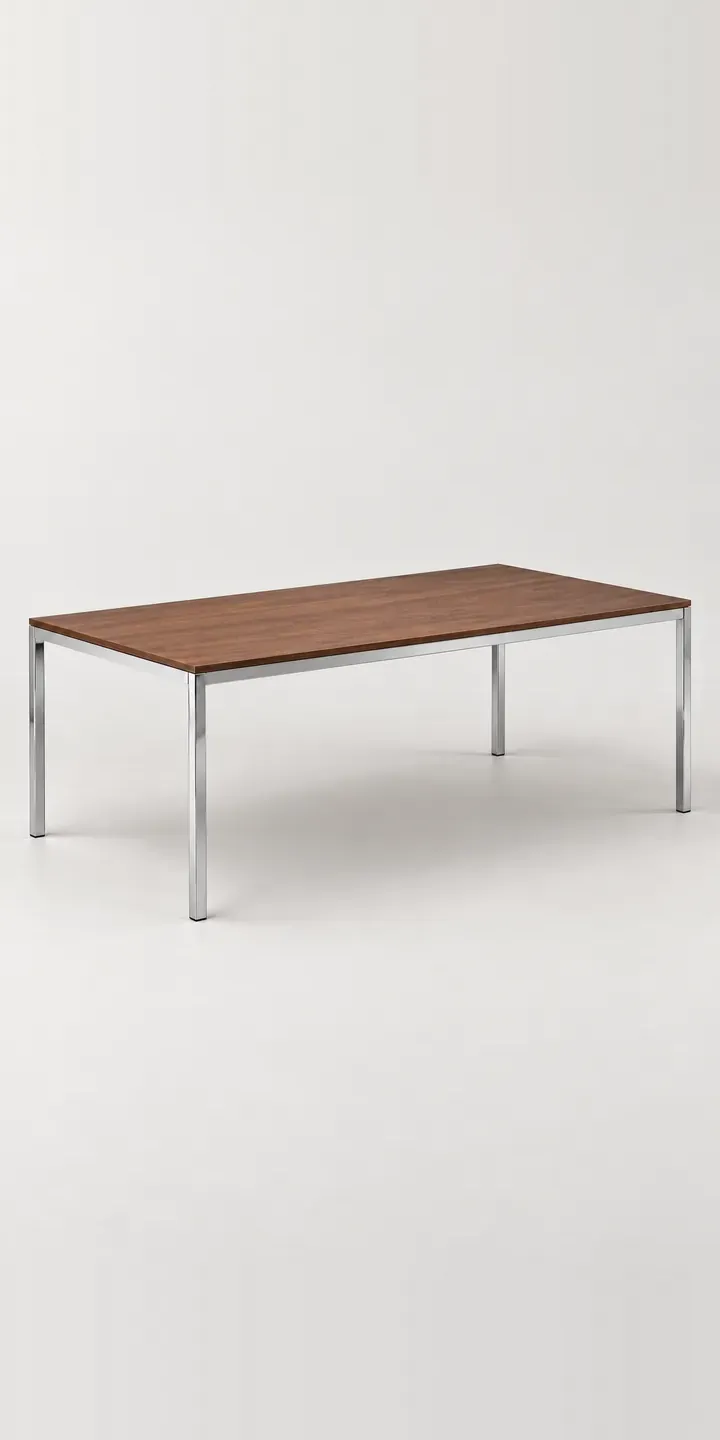
A slender chrome base and a thin, straight-edged top define the illustrative table in this demo. Choose a top finish and a length of 180, 225 or 300 cm, and the configured table is ready to quote.
Tables like this sit in two very different rooms. In a boardroom they set the tone for every meeting and have to work around screens, cables and chairs on castors. In a townhouse dining room the same table needs to feel light and leave plenty of knee room. In both cases the buyer is choosing a top that suits the room's other materials, and a length that fits the space and the people who use it.
Furniture Configurator demo
Steel Base Table
- Product
- Steel Base Table
- Colour
- Walnut
- Length
- 180 cm
Illustrative product. The design and images are generated examples, not a real model for sale.
What you can configure
On the same polished base, the demo swaps between walnut, white, black oak and light oak tops. A full version would add grey marble and teak. The 180, 225 or 300 cm length is captured for the quote, but the image keeps one size. Against chrome, the top finish sets the mood. Walnut warms the steel, white sharpens it, and black oak makes the whole table read as one dark line.
- Colour: Walnut, White, Black Oak, Light Oak
- Length: 180 cm, 225 cm, 300 cm
Why a configurator suits tables
Boardroom tables are rarely bought straight from a product page. A facilities manager or workplace designer requests a quote, compares suppliers and needs a specification to circulate. A configurator speeds that up by producing the specification itself: top finish, length and any requirements, captured in one structured request rather than a run of emails.
Residential buyers come at it differently. They want to see the table in their chosen top before committing, and with stone and timber in one range, the tops differ in weight, care and price. Showing each top on the full table helps them judge whether marble is worth it, rather than choosing from a sample chip.
The combinations add up quickly. Eighteen top and length pairs exist before cable access, chair counts or a second base finish come into it. A configurator lets the manufacturer offer those extras without the product page turning into a spreadsheet, and lets dealers quote from the same data the factory uses.
How a production version would be built
With a constant base, I would render the base once and composite each top over it. The alternative is rendering the full table per top and length from a 3D model. Rendering suits the chrome, which reflects its surroundings and is hard to photograph consistently. The manufacturer supplies top materials, thicknesses, dimensions and weights per length, and any boardroom options such as cable ports. Corporate enquiries route to a quote with a PDF specification, and residential orders can go to the basket. My product data guide explains how to structure those options.
Build sheet for this range
- Colours in the full range: 6 (4 shown in this demo)
- Length choices: 3
- Combinations to support: 6 × 3 = 18
- Images for one photograph per combination at 3 angles: 54
- Images if lengths can be shown as separate layers, at 3 angles: 27
- Data each of the 18 combinations needs: a SKU or variant ID, price, stock or lead time, and any dimensions or specification that change
Questions about table configurators
Can the configurator include cable management and power options?
Yes, in a production build. Cable ports, power modules and their positions become options with their own rules, for example only offering certain modules on longer tables. They can appear as overlays on a plan view, which is clearer for meeting room buyers than a photograph. This demo keeps to top and length.
Is a marble top difficult to show accurately?
It is the hardest top in the range. Every slab is different, so any image is representative rather than exact. I would show a typical top plus close photographs of real slabs, and explain how the stone is selected. Weight is worth showing too, since a stone top changes delivery and installation.
Can it produce a specification sheet for office fit-outs?
Yes. Once a table is configured, the buyer or a dealer can download a PDF with an image, dimensions, top finish and product codes. Workplace designers use these in tender documents, so including your references and any certifications from the product data makes them more useful.
Can the chrome base look convincing in a render?
Yes, with care. Chrome is a mirror, so a render needs a believable environment for it to reflect, or it looks black and flat. I build a neutral studio scene for the reflections and keep it identical for every top, so the base looks the same whichever finish is chosen.
More furniture configurator demos
All furniture configurator demos
A configurator for your tables
This demo uses an illustrative product. If you sell tables, I can build the same experience around your own range, photography and ordering process, connected to Shopify, WooCommerce or a quote workflow. I reply to enquiries within two UK working days.