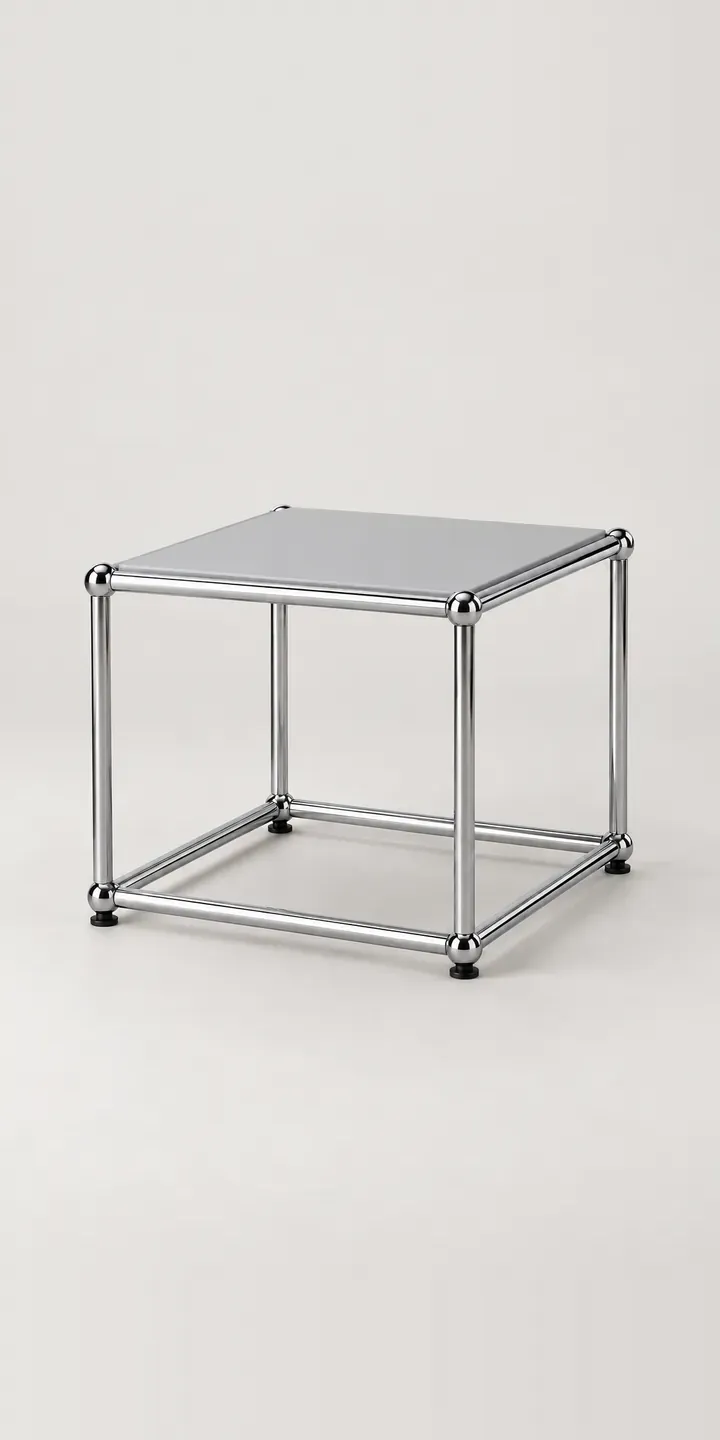
This illustrative side table is built like system furniture: chrome tubes joined by polished spherical connectors, with powder-coated steel panels. Choose a panel colour and a height, and the summary holds the specification.
Height defines the job. At 37 cm it sits beside a low lounge chair. At 50 cm it lines up with the arm of many sofas. At 74 cm it becomes a pedestal or a small desk return. Buyers of this kind of furniture include architects and office specifiers as well as homeowners. They think in those terms, and want the panel colour to hold across a whole scheme.
Furniture Configurator demo
Steel Side Table
- Product
- Steel Side Table
- Colour
- Light Grey
- Height
- 37 cm
Illustrative product. The design and images are generated examples, not a real model for sale.
What you can configure
Light grey, white, graphite and steel blue panels are live in the demo, out of six colours that also include mustard and brick red. The chrome tubes and connectors stay the same in every image, which is the point of a system: the frame is constant and the panels carry colour. Height is recorded in the summary but leaves the image unchanged. In production, each height would show its own proportions.
- Colour: Light Grey, White, Graphite, Steel Blue
- Height: 37 cm, 50 cm, 74 cm
Why a configurator suits side tables
Modular steel furniture lives on specifications. A specifier needs exact dimensions, the colour code, the number of panels and any doors or drawers, often for a dozen pieces across an office floor. Handled through emails and PDFs, that process is slow and error-prone. A configurator turns each piece into a clean, repeatable specification that can be quoted and ordered.
Colour is the other commercial lever. Powder-coated panels are often made to order, so buyers commit to a colour weeks before seeing it in person. Consistent on-screen colour, a sample request and a clear lead time for each colour all reduce the risk. Brighter colours like mustard and brick red are where that reassurance matters most.
The same system can scale from a side table to a sideboard or a storage wall. One configurator can cover the whole range, since the parts are shared. That gives dealers a single tool to quote from, and gives the manufacturer cleaner order data across every showroom.
How a production version would be built
For tube-and-panel furniture, a layered or 3D build both work. In layered 2D, each tube length, connector and panel colour is rendered separately and assembled by rule. 3D makes sense once the range runs from side tables to large storage units, as every configuration can be drawn without new renders. The manufacturer's part dimensions, colour codes, compatibility rules and lead times drive it. The output is a specification with a parts list, sent to a dealer quote, a trade account or a WooCommerce basket.
Build sheet for this range
- Colours in the full range: 6 (4 shown in this demo)
- Height choices: 3
- Combinations to support: 6 × 3 = 18
- Images for one photograph per combination at 3 angles: 54
- Images if heights can be shown as separate layers, at 3 angles: 27
- Data each of the 18 combinations needs: a SKU or variant ID, price, stock or lead time, and any dimensions or specification that change
Questions about side table configurators
Can the configurator produce a specification sheet for architects?
Each configuration can generate a PDF or a shareable link listing dimensions, colour codes, parts and any options. Architects can drop it into a specification or send it to a dealer for pricing. Because it comes from the same data as the order, it stays accurate when the range changes.
Can one configurator cover side tables, sideboards and larger units?
If they share a system of tubes, connectors and panels, yes. The configurator works from parts and rules, so a side table is a small configuration and a storage wall is a large one. Range-wide configurators take longer to set up, but each new product after the first is mostly data.
How do you handle powder-coat colours that are made to order?
Each colour carries its own lead time in the product data, and the configurator shows it as the customer picks. Stock colours can ship quickly while made-to-order colours show a longer window. A sample request button next to bright colours helps, since they are the hardest to judge on screen.
Will chrome and powder coat look right in the images?
Chrome is the harder of the two. It reflects whatever is around it, so I render or photograph it in a controlled environment and keep the reflections identical for every colour. Powder coat is easier but still needs calibrated lighting to show the slight texture and sheen of the finish.
More furniture configurator demos
All furniture configurator demos
A configurator for your side tables
This demo uses an illustrative product. If you sell side tables, I can build the same experience around your own range, photography and ordering process, connected to Shopify, WooCommerce or a quote workflow. I reply to enquiries within two UK working days.