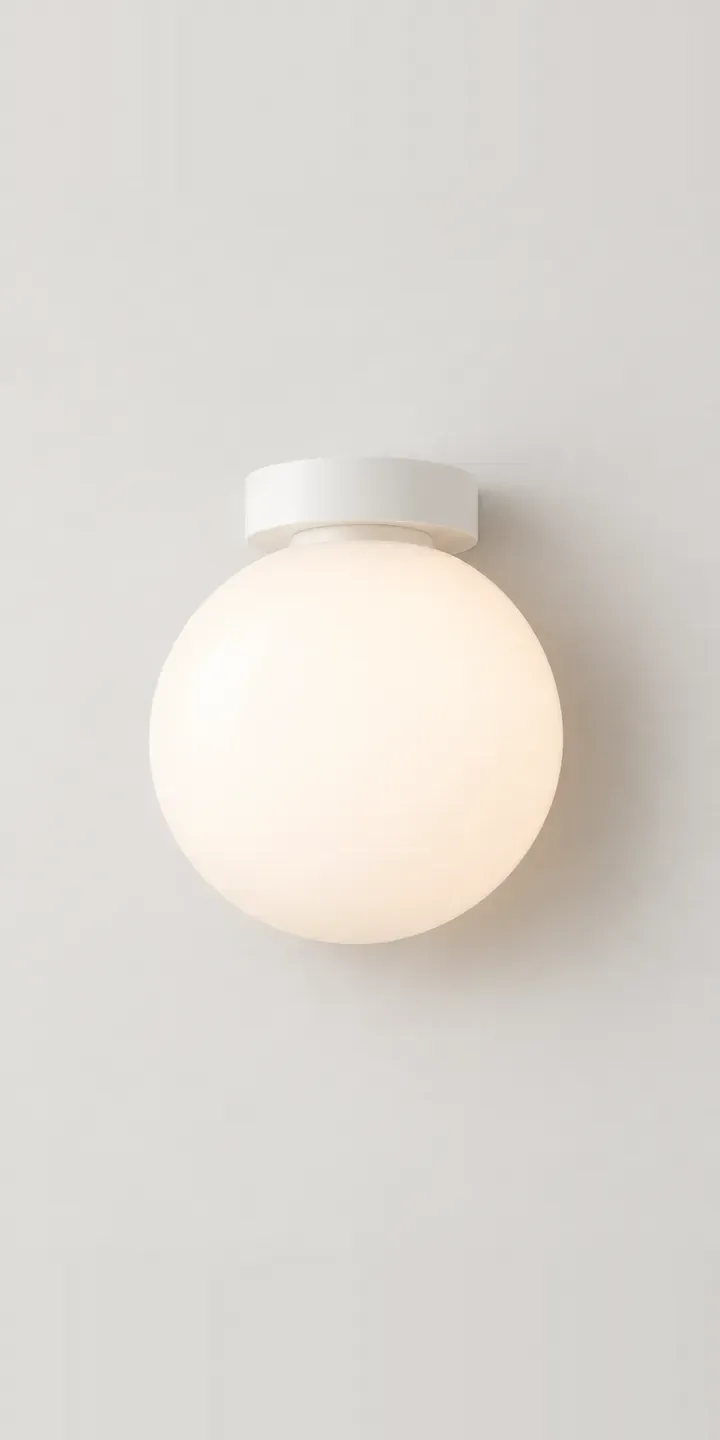
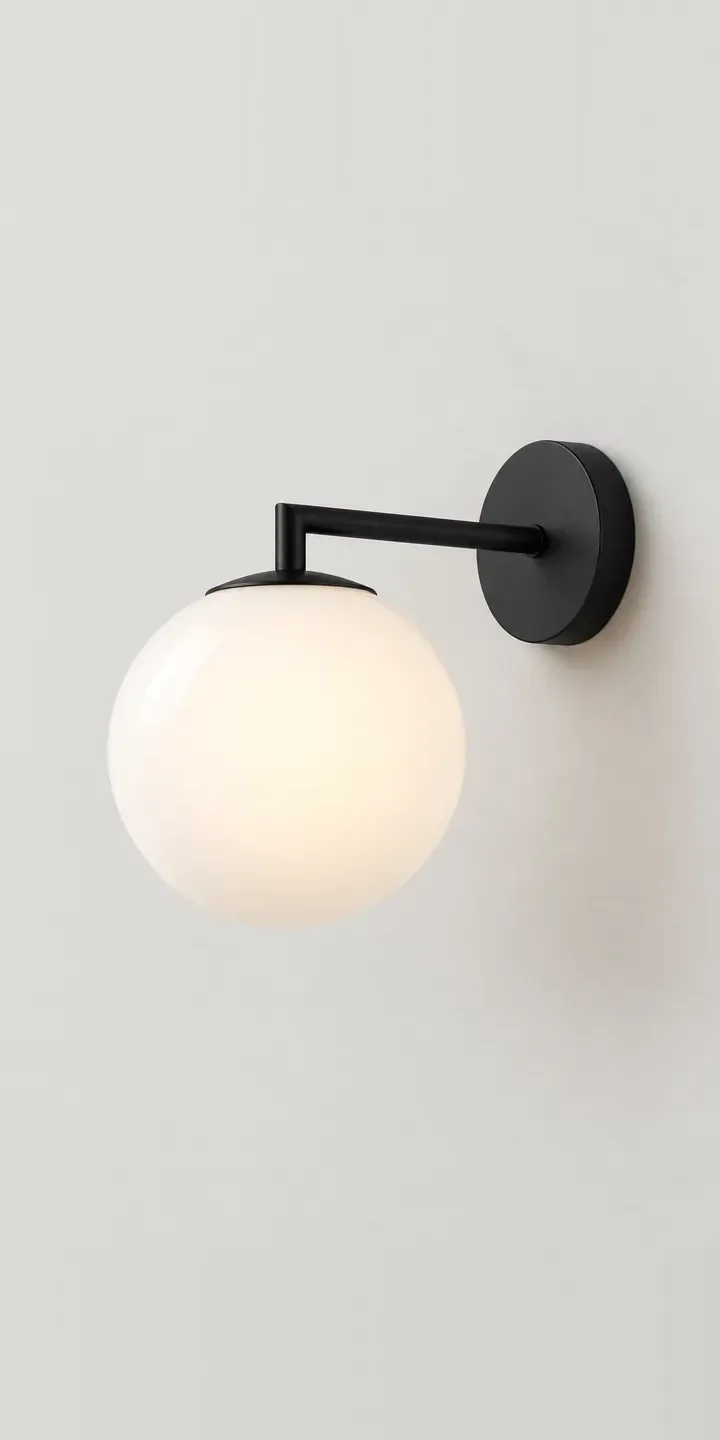
A satin opal glass globe sits on a short neck and a round wall plate in this illustrative wall light. Pick a metal finish and one of two diameters before sending a quote request.
With a globe wall light, size is the decision that keeps buyers awake. A 330 mm globe and a 450 mm globe look alike in a product photograph on a plain background. On a landing or above a washstand, the difference is dramatic. The finish of the neck and plate is the smaller choice, though it still needs to sit with the taps, hinges and handles nearby.
Lighting Configurator demo
Flush Wall Globe
- Product
- Flush Wall Globe
- Colour
- White
- Diameter
- 330 mm
Illustrative product. The design and images are generated examples, not a real model for sale.
What you can configure
Swatches switch between white, black, brass and satin chrome, and bronze and copper are also offered. Only the neck and plate change, as the opal globe is the same throughout. Diameter is 330 mm or 450 mm. In a production build the diameter would change the image, ideally shown against a wall with a familiar object for scale. Here it is recorded in the summary alongside the finish.
- Colour: White, Black, Brass, Satin Chrome
- Diameter: 330 mm, 450 mm
Why a configurator suits wall lights
Scale is the most common reason a large wall light goes back. On a plain background both diameters fill the frame and look identical. On the wall, the larger one can dominate a narrow landing, while the smaller can look lost on a tall stairwell. A configurator that shows each size against the same wall settles the question before the order.
Twelve variants come from six finishes and two diameters, and globe lights are often bought in multiples for corridors, stairwells and guest bedrooms. That makes them a regular item on contract and hospitality specifications. Architects and lighting designers need dimensions, weight and fixing details as well as the look, and they need them quickly.
A configurator that ends in a quote suits that buyer. It records finish, diameter and quantity per position and sends them to the supplier with the project name. The supplier replies with lead times and trade terms instead of rekeying a schedule from a PDF.
How a production version would be built
Here I would render from CAD rather than photograph. A render can place both diameters on the same wall at true scale, with a doorway or chest beneath for reference. It can also swap the metal finish without moving the glass. The retailer supplies finishes, diameters, projection from the wall, weight, lamp holder and any IP rating. A downloadable specification sheet can be generated from the configured choice for architects. Retail orders go to the basket, while contract orders go to a quote. My page on 3D product visualisation covers how scale renders are produced.
Build sheet for this range
- Colours in the full range: 6 (4 shown in this demo)
- Diameter choices: 2
- Combinations to support: 6 × 2 = 12
- Images for one photograph per combination at 3 angles: 36
- Images if diameters can be shown as separate layers, at 3 angles: 24
- Data each of the 12 combinations needs: a SKU or variant ID, price, stock or lead time, and any dimensions or specification that change
Questions about wall light configurators
How can a configurator show the difference between 330 mm and 450 mm on the wall?
Place both sizes in the same wall render, at true scale, with a familiar object beneath such as a chest or doorway. Switching between them shows the change immediately. A dimension overlay helps too, but the scale view does most of the work. Rendering from CAD makes this far easier than photographing two globes in one room.
Can architects download a specification sheet for the configured light?
Yes. A PDF can be generated with the chosen finish, diameter, dimensions, weight and product code. That sheet can be attached to a lighting schedule or sent to a client for sign-off. It saves the supplier answering the same request for every project.
Can the configurator take orders for several positions on a project?
Yes. Each configured light can be added with a quantity and a position name, such as landing or guest bathroom. The quote request lists them together, with the project name and delivery address. Your sales team receives a schedule they can price directly.
Does the opal glass need photographing in every finish?
No. The globe is identical across finishes, so it can be shot or rendered once, lit and unlit, and the metal neck and plate swapped underneath. That cuts the number of images considerably and keeps the glass looking exactly the same in every version.
More lighting configurator demos
Framed Globe Pendant
Geometric Pendant
Globe Floor Lamp
Globe Wall Light
Hinged Desk Lamp
Hinged Wall Lamp
All lighting configurator demos
A configurator for your wall lights
This demo uses an illustrative product. If you sell wall lights, I can build the same experience around your own range, photography and ordering process, connected to Shopify, WooCommerce or a quote workflow. I reply to enquiries within two UK working days.