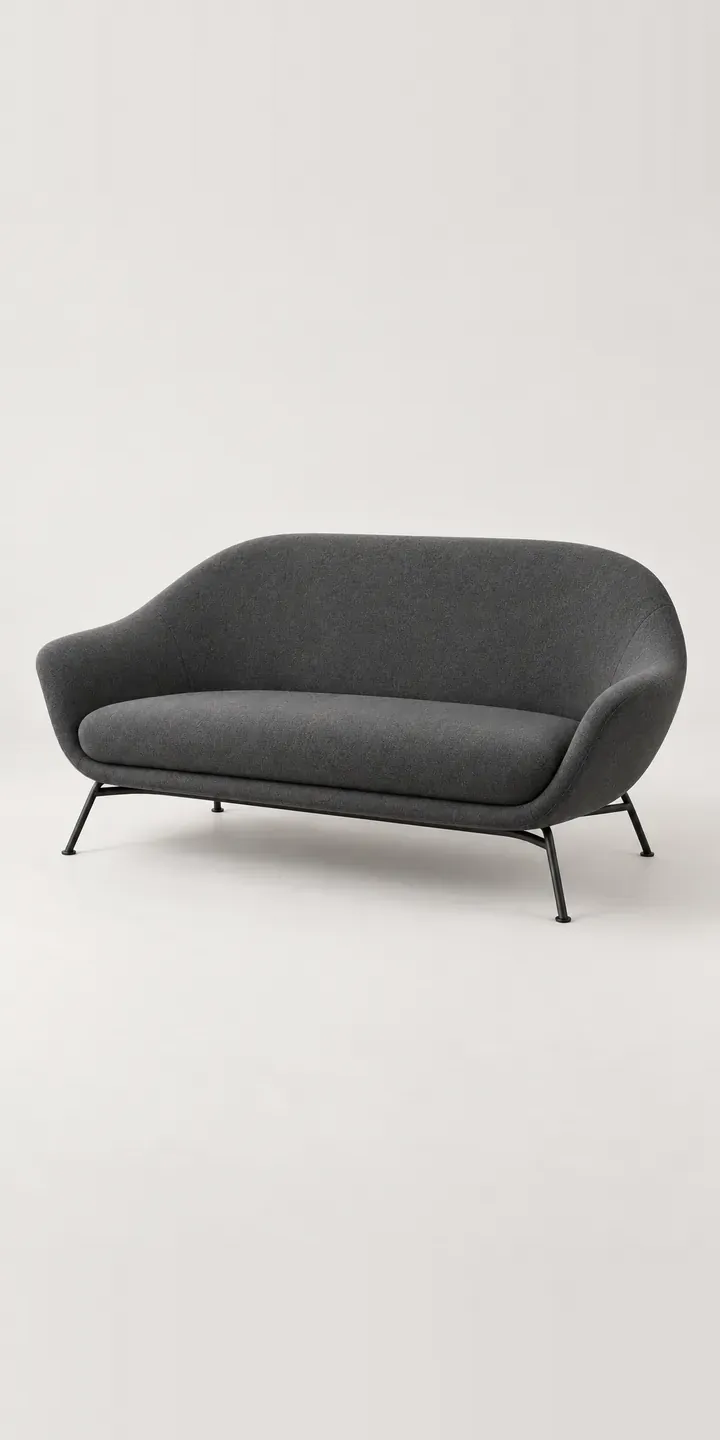
Two seats sit inside one continuous shell on this illustrative loveseat, with the back curving round into the arms. Choose its colour and cover here, then send the build as a quote.
Curved upholstery is unforgiving. Every seam follows the shell, and the cover has to stretch round a tight radius without puckering. That gives the material more weight here than on a boxy sofa. Wool takes colour richly and softens the outline; leather shows the curve as a clean, taut line. Hotel and lounge specifiers tend to settle the material first and the colour second.
Furniture Configurator demo
Curved Loveseat
- Product
- Curved Loveseat
- Colour
- Dark Grey
- Cover
- Wool
Illustrative product. The design and images are generated examples, not a real model for sale.
What you can configure
Wool or leather is the first choice to make, even though this demo records it in the summary rather than in the picture. The colour swatches cover dark grey, cream, camel and teal from six finishes. The range also lists black leather as a finish in its own right. That points to a real production issue: not every colour comes in every material, and the configurator has to know which pairings exist.
- Colour: Dark Grey, Cream, Camel, Teal
- Cover: Wool, Leather
Why a configurator suits loveseats
Not every colour exists in every material. Six finishes and two covers look like twelve options, but some colours are wool-only and others leather-only. A product page that shows a grid of swatches without those rules invites orders that cannot be made, followed by an awkward phone call. The buyer then waits for an answer while their interest cools.
A configurator removes impossible combinations at the moment of choice. Select leather and the wool-only colours grey out. It is a small interface detail with real commercial weight on a made-to-order piece, where the workshop may not spot the mismatch until the hide is ordered.
Loveseats also sell heavily into hospitality: hotel lounges, members' clubs, bar corners. Those buyers order in multiples and need the same specification across a whole project. A configuration they can save, share with an interior designer and reopen for a repeat order is worth more to them than another styled photograph. Consistency across a whole floor of identical pieces matters more to them than choice.
How a production version would be built
Compositing separate parts is harder on a curved shell, because the seams and shading wrap continuously. I would usually render one image per valid colour and material pairing from a single 3D model, which keeps the curve and highlights consistent. On the data side, the maker lists each material, the colours offered in it and any leather grades. Rules for invalid pairings live in the product data rather than the page. The order then goes to a quote request for projects or a Shopify basket for retail.
Build sheet for this range
- Colours in the full range: 6 (4 shown in this demo)
- Cover choices: 2
- Combinations to support: 6 × 2 = 12
- Images for one photograph per combination at 3 angles: 36
- Images if covers can be shown as separate layers, at 3 angles: 24
- Data each of the 12 combinations needs: a SKU or variant ID, price, stock or lead time, and any dimensions or specification that change
Questions about loveseat configurators
Can the configurator stop customers choosing a colour that isn't available in leather?
Yes. Each colour is tagged with the materials it comes in, and the interface disables the rest once a cover is picked. The buyer never reaches an impossible combination. When your supplier changes the leather range, you update the data and the page follows without any development work.
Will leather and wool look different enough on screen?
They will if the images are lit for it. Leather picks up a soft highlight along the curve of the shell, while wool stays matt with a visible texture up close. I would add a detail view of the arm seam for each material, since that is where buyers judge quality on a curved piece.
Can a hotel order several loveseats in different finishes through one enquiry?
That works best as a project quote rather than a basket. The specifier configures each version, adds it to a list with quantities, and sends the whole set as one request. You receive a single structured enquiry with every finish named, instead of a chain of separate emails.
How long does a loveseat configurator take to build?
It depends mostly on whether a 3D model already exists and how many material pairings need imaging. One curved piece with clean product data is a modest project; a full upholstery range is larger. I reply to enquiries within two UK working days and can scope the work once I have seen the range.
More furniture configurator demos
All furniture configurator demos
A configurator for your loveseats
This demo uses an illustrative product. If you sell loveseats, I can build the same experience around your own range, photography and ordering process, connected to Shopify, WooCommerce or a quote workflow. I reply to enquiries within two UK working days.