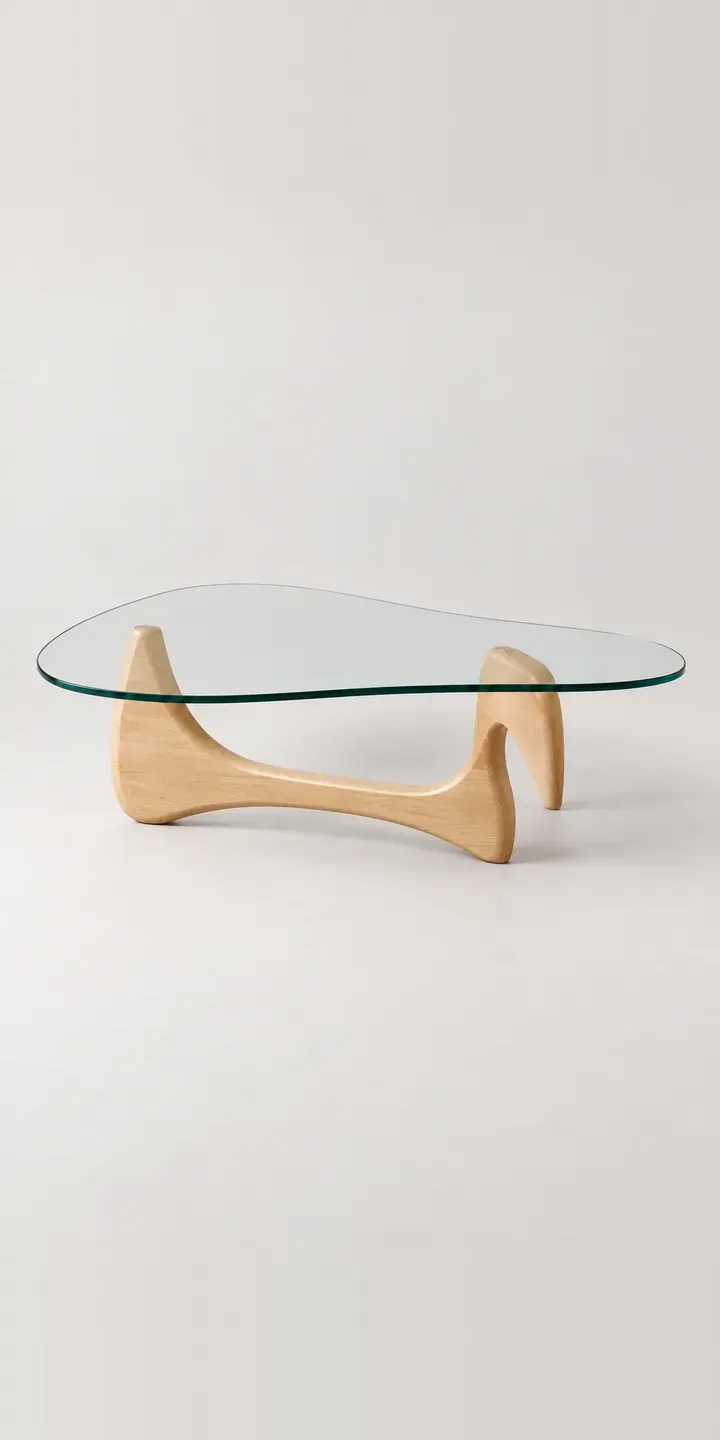
On this illustrative coffee table, a freeform glass top rests on two curved timber pieces that interlock. You choose the timber and a standard or large size, then request a quote.
Because the top is clear, the base carries the whole visual decision. Natural ash looks light and Scandinavian. Ebonised timber turns the base into a dark sculptural shape seen through the glass. Cherry and walnut sit between the two and deepen over time. People choosing a table like this are thinking about their floor and rug as much as the table, since both show through.
Furniture Configurator demo
Glass Coffee Table
- Product
- Glass Coffee Table
- Colour
- Natural Ash
- Size
- Standard
Illustrative product. The design and images are generated examples, not a real model for sale.
What you can configure
Only the base changes when you click a swatch, because the glass stays constant. Natural ash, walnut, ebonised and cherry are live, from six timbers. Standard or large is a choice in the summary; the image keeps standard proportions in this demo. With a freeform top, size alters more than length. A larger top changes the curve and the overhang beyond the base, so a production build would show each size.
- Colour: Natural Ash, Walnut, Ebonized, Cherry
- Size: Standard, Large
Why a configurator suits coffee tables
Glass is hard to photograph well. Every timber needs its own shoot to show grain through reflections, and twelve combinations quickly become a demanding brief. Many retailers settle for one finish in hero images and a row of wood chips, which undersells the darker bases most of all. Each timber also reads differently through glass than on its own, so a wood chip is a poor guide.
Timber choice also drives lead time on many tables of this type. Some finishes are held in stock while others are made to order. A configurator can show that as the buyer switches timber, so expectations are set before the order rather than corrected by email afterwards.
Coffee tables are often bought once the sofa and rug are already chosen. Interior designers and furnishing retailers want to drop the table into a scheme. A clean image per timber on a neutral background is more useful to them than any styled room set. It is also what they paste into client presentations.
How a production version would be built
An image-based build suits this table. Each timber is photographed or rendered once per size, with identical glass across all of them, so the base is the only variable. Rendering is often easier than photography here, because reflections in the glass can be placed precisely. Timber names, stock status, glass details and dimensions for both sizes are the data to gather. The same data can drive a wider table configurator for dining and side tables in matching timbers, with variations feeding a WooCommerce basket.
Build sheet for this range
- Colours in the full range: 6 (4 shown in this demo)
- Size choices: 2
- Combinations to support: 6 × 2 = 12
- Images for one photograph per combination at 3 angles: 36
- Images if sizes can be shown as separate layers, at 3 angles: 24
- Data each of the 12 combinations needs: a SKU or variant ID, price, stock or lead time, and any dimensions or specification that change
Questions about coffee table configurators
How do you stop glass reflections hiding the base in configurator images?
Mostly through lighting and camera angle. In a studio or a render, reflections can be placed where they flatter the edge of the glass rather than obscure the timber beneath. A slightly raised viewpoint helps too. I keep one consistent view across every finish, so buyers compare timbers rather than changing reflections.
Can buyers see the timber grain up close before ordering?
They can, with a detail image per finish. A close view of the interlocking joint shows grain, colour and the quality of the curve better than the full product shot. For walnut and cherry, a short note that the wood will mellow keeps expectations honest.
Can the configurator flag which timbers are made to order?
Yes. Each timber carries a stock status or lead time, shown the moment it is selected. Darker or specialist finishes are often made to order where natural timbers are held in stock, and stating that up front avoids awkward follow-up emails after checkout.
Can a large glass top have different delivery terms from the standard size?
It can. Each size can carry its own shipping class, delivery note and lead time in the product data, and the summary shows them before checkout. Large glass tops often need two-person delivery, and buyers prefer to know that while they are still choosing the size.
More furniture configurator demos
All furniture configurator demos
A configurator for your coffee tables
This demo uses an illustrative product. If you sell coffee tables, I can build the same experience around your own range, photography and ordering process, connected to Shopify, WooCommerce or a quote workflow. I reply to enquiries within two UK working days.