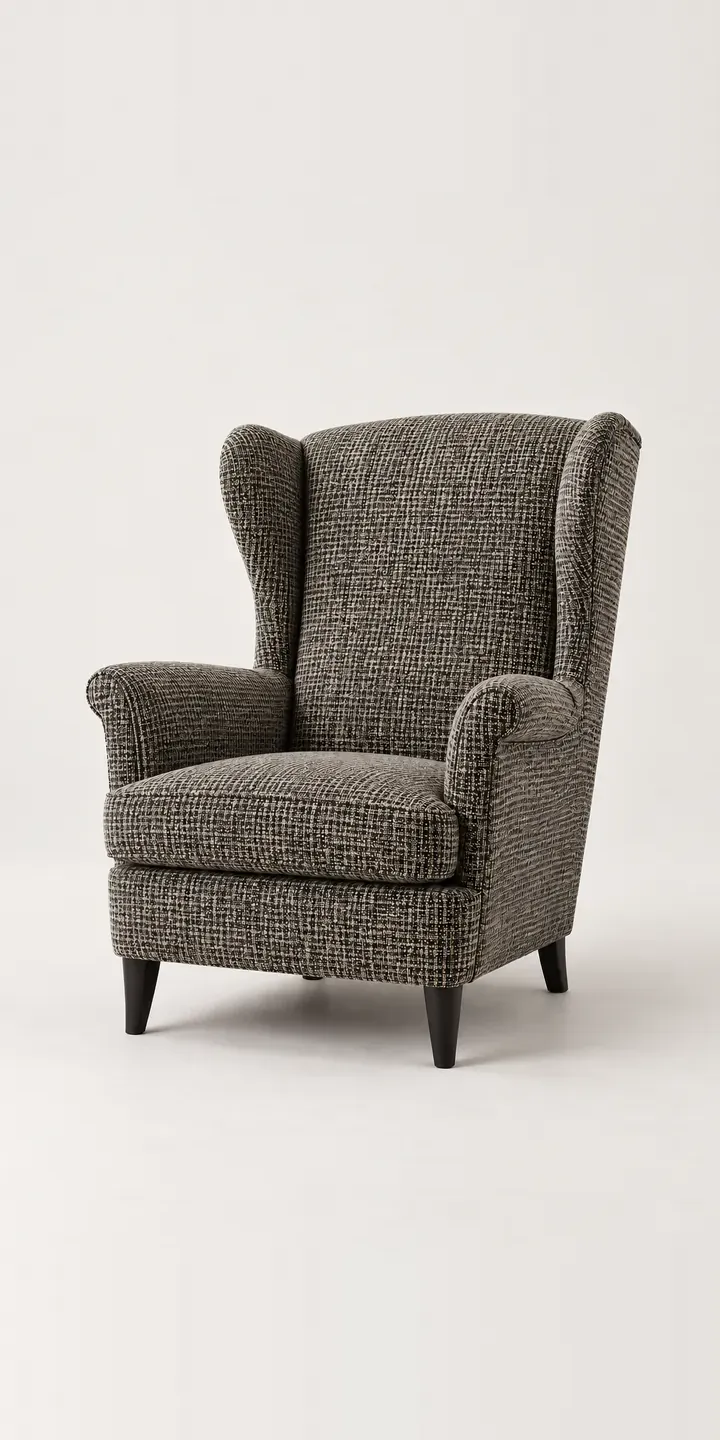
Projecting wings, a taut upholstered back and dark wood front legs mark out the illustrative wingback chair in this configurator. Choose a fabric and decide on the footstool before asking for a quote.
Wingback buyers are often furnishing one particular spot: beside a fire, in a bay window, at the foot of a bed. They sit in the chair for long periods, so seat height and back support matter as much as looks. Fabric is the other slow decision. A textured weave like salt and pepper hides wear and suits a country house. A flat mustard or dark green turns the chair into the focal point of a room.
Furniture Configurator demo
Wingback Chair
- Product
- Wingback Chair
- Colour
- Salt Pepper
- Set
- Chair
Illustrative product. The design and images are generated examples, not a real model for sale.
What you can configure
Fabrics on screen are salt and pepper, dark green, light grey and mustard, from a range of six that adds navy and rust. Ticking the footstool adds it to the summary without changing the picture. On a wingback the fabric covers a lot of curved surface. Flecked weaves read differently on the wings than on the seat, which a flat colour swatch cannot show.
- Colour: Salt Pepper, Dark Green, Light Grey, Mustard
- Set: Chair, With Stool
Why a configurator suits armchairs
Traditional upholstery is often made to order, and many makers offer far more fabrics than they could ever photograph. Here it is six covers and an optional stool, but a real workshop might carry dozens of fabrics across several chair models. A configurator lets the maker add a fabric by adding images, not by booking a shoot.
Many upholsterers also accept customer's own material, where the buyer supplies the fabric. That is usually handled by phone. A configurator can include it as an option, showing the fabric quantity and suitable weights. Choosing it routes straight to a quote. It saves the workshop a conversation it has over and over.
The footstool matters commercially. Offered as a set with the price difference visible, it is an easy addition. The buyer has already chosen the chair for long evenings by the fire. Listed on another page, it is easily missed, and ordering it later means a second delivery and a second workshop slot.
How a production version would be built
For a wingback, I would photograph or render the chair once per fabric, with the footstool on a separate layer beside it. Textured weaves need real fabric scans or careful photography, because a flat colour on a 3D model makes salt and pepper look like plain grey. The maker supplies fabric names, composition, rub counts, any price bands, and the fabric quantities for the customer's own material option. Standard fabrics can go to the basket, and customer's own material orders go to a quote. For another upholstered example, see the seating product configurator demo.
Build sheet for this range
- Colours in the full range: 6 (4 shown in this demo)
- Set choices: 2
- Combinations to support: 6 × 2 = 12
- Images for one photograph per combination at 3 angles: 36
- Images if sets can be shown as separate layers, at 3 angles: 24
- Data each of the 12 combinations needs: a SKU or variant ID, price, stock or lead time, and any dimensions or specification that change
Questions about armchair configurators
Can customers choose their own fabric in the configurator?
Yes. A customer's own material option can sit in the fabric list, showing the quantity required and any limits on weight or type. Choosing it routes the build to a quote rather than the basket, so the workshop can check the fabric before accepting. A neutral image of the chair works for the preview.
How do you show textured fabrics like salt and pepper accurately?
With high-resolution photography or scanned fabric textures, under light that shows the weave. Flecked fabrics blur into a flat colour at small sizes, so a close detail image per fabric is essential. A swatch request beside the fabric list is the honest final step for anything heavily textured.
Can fabrics be grouped by price band?
Yes. Fabrics can be grouped into bands, with the price updating as the buyer moves between them. Each group can carry a short note on composition and wear, so buyers understand why a wool costs more than a cotton blend. It mirrors how many upholstery workshops already price their ranges.
Can seat height and other dimensions be shown for buyers who need a supportive chair?
Yes. Seat height, seat depth, arm height and back height can all sit in the product data and display beside the image. For wingback buyers, who often choose a chair for comfort over long periods, those figures matter as much as the fabric. If your workshop offers taller legs, they can be added as an option.
More furniture configurator demos
All furniture configurator demos
A configurator for your armchairs
This demo uses an illustrative product. If you sell armchairs, I can build the same experience around your own range, photography and ordering process, connected to Shopify, WooCommerce or a quote workflow. I reply to enquiries within two UK working days.