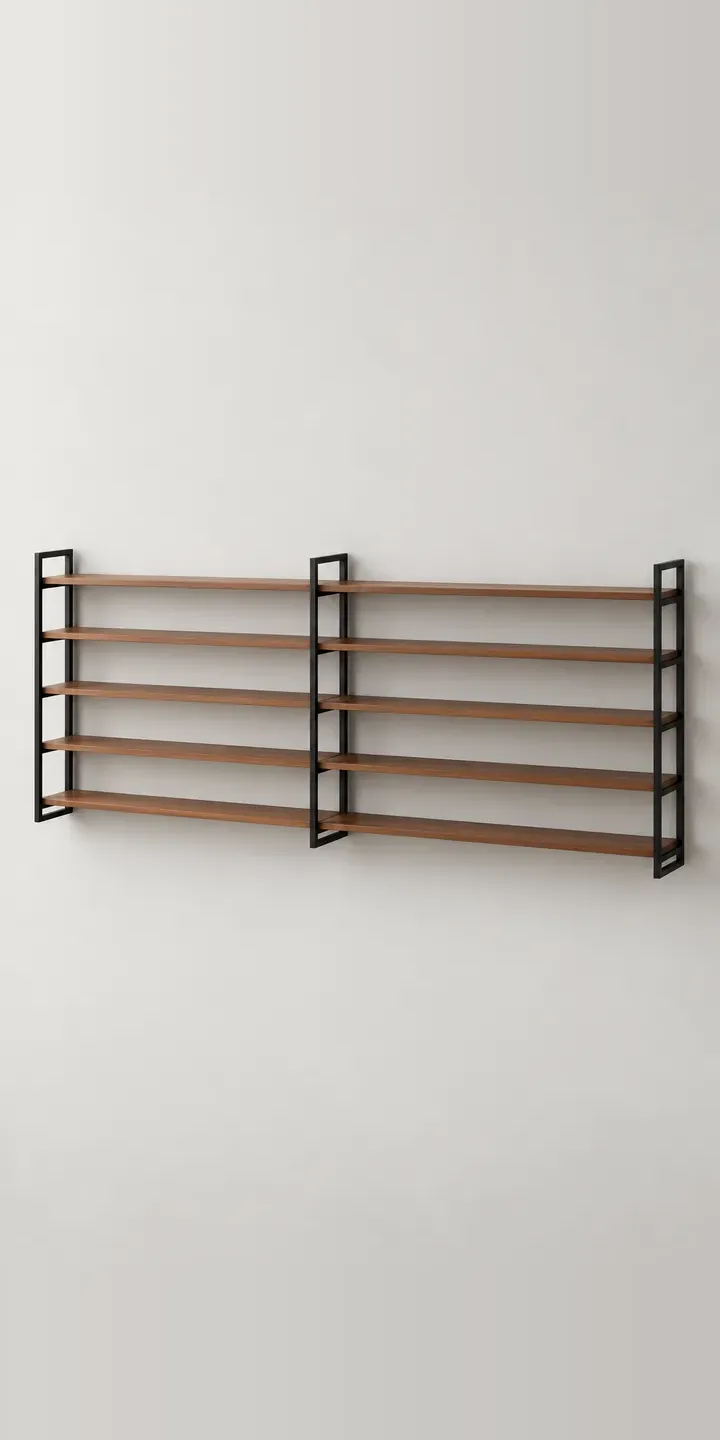
Timber shelves slot into black steel side frames, fixed to the wall with steel brackets. This illustrative bookshelf is configured by shelf finish and by a width of 120, 180 or 244 cm.
Wall shelving is bought by people who care what sits on it. Art books, records and a few objects get arranged and rearranged, so the shelves need to look right both full and nearly empty. Timber sets the tone against the black steel. Walnut and black ash read as a library, natural oak and white as a gallery wall. Width is a structural choice too, because a long run of books puts real weight on the fixings.
Furniture Configurator demo
Hanging Shelves
- Product
- Hanging Shelves
- Colour
- Walnut
- Width
- 120 cm
Illustrative product. The design and images are generated examples, not a real model for sale.
What you can configure
Shelves change between walnut, natural oak, black ash and white, all held in the same black steel frame. Smoked oak and pale ash are the other two timbers. The 120, 180 or 244 cm width is recorded without changing the image. With the frame black in every version, the timber choice is really about contrast with steel, and with the wall colour behind.
- Colour: Walnut, Natural Oak, Black Ash, White
- Width: 120 cm, 180 cm, 244 cm
Why a configurator suits wall shelves
Wall-mounted furniture carries a pre-sale question that freestanding pieces do not: will this wall hold it? Buyers want to know the fixing method, whether plasterboard needs special plugs, and how much each shelf can carry. Buried in a PDF at the bottom of the page, that information generates calls. Updated in the configurator with the chosen width, it answers them.
Width interacts with finish in ways a single photograph cannot show. A 244 cm shelf in walnut is a substantial line of timber across a wall, while in white it almost disappears. Across six finishes and three widths, the configurator can show each shelf against a choice of wall colours, which is how buyers actually think about it.
Shelving ranges often grow into systems. Buyers who start with one shelf may add a second above it, or a matching desk or cabinet hung from the same frames. A configurator built around the frame as the core component can offer those additions without separate product pages, and every part is listed on the order.
How a production version would be built
A wall shelf is a simple, effective image build. The steel frame is a constant layer, and each timber finish is a shelf layer composited into it, so new finishes need only new shelf images. Widths can be separate renders, with the grain kept at true scale rather than stretched. The retailer supplies finishes, widths, shelf depths, fixing hardware, load guidance and wall-type advice. On Shopify or WooCommerce, each width and finish maps to a variant. The right fixing kit for the chosen width can be added to the order automatically.
Build sheet for this range
- Colours in the full range: 6 (4 shown in this demo)
- Width choices: 3
- Combinations to support: 6 × 3 = 18
- Images for one photograph per combination at 3 angles: 54
- Images if widths can be shown as separate layers, at 3 angles: 27
- Data each of the 18 combinations needs: a SKU or variant ID, price, stock or lead time, and any dimensions or specification that change
Questions about wall shelf configurators
Can the configurator show load and fixing information for each width?
Yes. Load guidance and the fixing kit for each width are stored in the product data and update as the buyer changes size. The configurator can also ask about wall type and show the right fixings for masonry or plasterboard. That information then appears in the order confirmation for whoever installs it.
Can buyers preview the shelves against their own wall colour?
Yes, in a simple form. Making the background a separate layer lets the configurator place the shelf against a choice of wall colours, or one the buyer picks. It is a quick way to show how walnut reads on a dark green wall compared with white, and it is cheap to build.
Will the timber grain stretch oddly across different widths?
Not if it is handled properly. I render each width with the grain at its real scale rather than stretching one image across a longer shelf. Stretching is tempting because it saves time, but buyers notice it, especially on walnut and oak where the figure is strong.
Is a configurator worth it for a simple product like a shelf?
It can be, if the range has enough finishes and sizes to confuse buyers, or if fixing questions are generating support calls. The configurator does not need to be complex: finish, width and fixing guidance cover most of the value. My guide to what a product configurator is sets out when one is worth building.
More furniture configurator demos

All furniture configurator demos
A configurator for your wall shelves
This demo uses an illustrative product. If you sell wall shelves, I can build the same experience around your own range, photography and ordering process, connected to Shopify, WooCommerce or a quote workflow. I reply to enquiries within two UK working days.