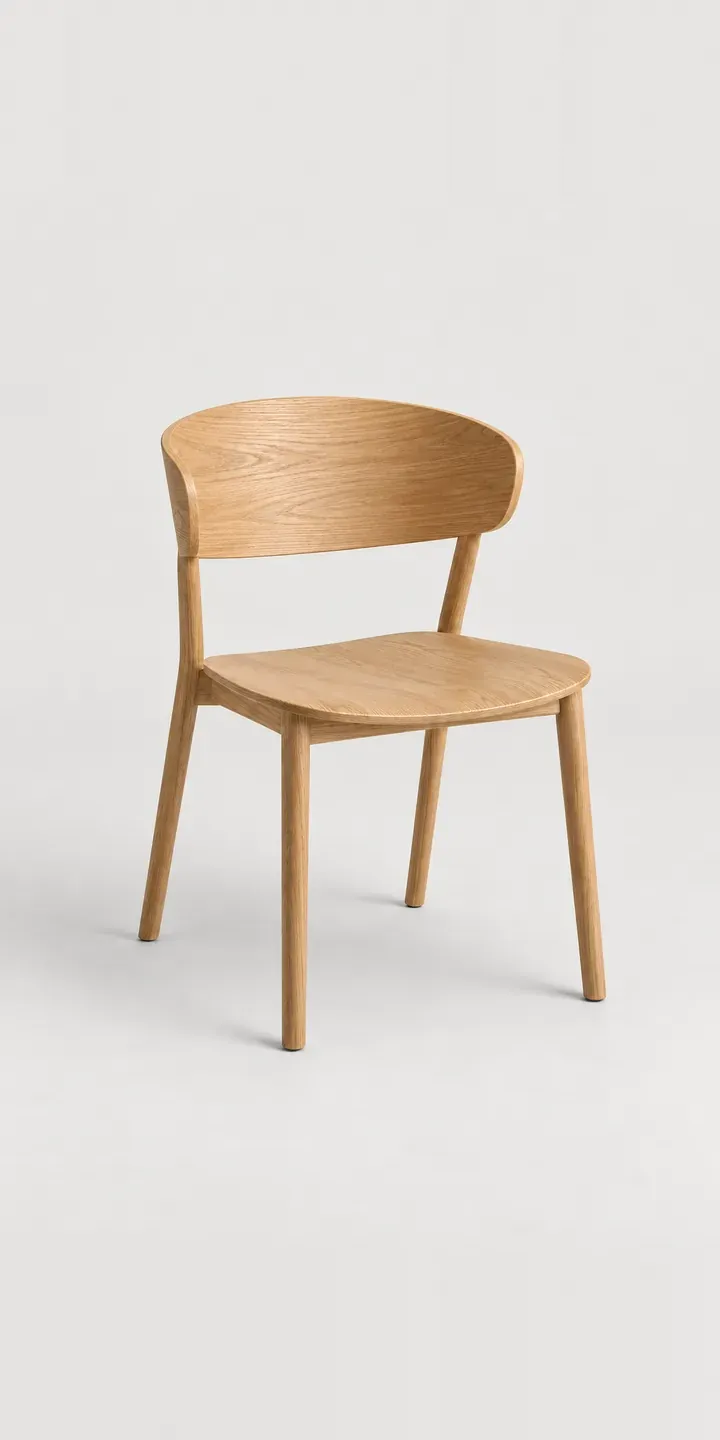
This example dining chair has a shallow dished seat with a softened front edge and a curved backrest joined into the seat. Choose a timber finish and a wood or padded seat, and the summary records your chair.
Dining chairs are bought in fours, sixes and eights, usually to go with a table the buyer already owns or is buying at the same time. The finish has to sit with that table. Oiled oak warms with age, soaped oak stays pale and matt, and black oak hides wear but shows dust. The seat choice is about long dinners. Padding adds comfort, but it also adds fabric that must survive spills.
Furniture Configurator demo
Dining Chair
- Product
- Dining Chair
- Colour
- Oiled Oak
- Seat
- Wood
Illustrative product. The design and images are generated examples, not a real model for sale.
What you can configure
Oiled oak, soaped oak, black oak and walnut are live, out of six that include sage and terracotta. Finish and grain show most at the dished seat edge and where the backrest joins the seat, so the photographs favour those angles. Wood or padded appears in the summary, but the image keeps the same timber seat for now. A production build would add a padded seat layer in a choice of fabrics.
- Colour: Oiled Oak, Soaped Oak, Black Oak, Walnut
- Seat: Wood, Padded
Why a configurator suits chairs
Quantity sets dining chairs apart. A buyer ordering six chairs is making one decision six times, and a mismatched delivery is a real problem. A configurator records finish, seat type and quantity as one line, which keeps the set consistent from order to dispatch. It can also offer carver versions for the head of the table if the range includes them.
Finish matching is the hardest question in dining furniture. Buyers send photos of their table and ask which oak will match. Showing each finish under consistent light, with notes on how it ages, gives a far better answer than a swatch photo. Soaped and oiled oak in particular look close on day one and drift apart over months.
Restaurants, cafés and hotels buy the same chairs in larger numbers. For them, the configurator ends in a trade quote with quantities, seat fabric and any contract fire-rating requirement noted. Structured enquiries make large orders easy to price consistently, and the same chair easy to reorder years later.
How a production version would be built
An image-based build works for dining chairs. Each finish gets its own photograph or render of the chair, and the padded seat is a separate layer with its own fabric options. With six finishes and a handful of seat fabrics, that is far fewer images than a full matrix. The data covers finish names, timber species, seat fabrics, stock and lead times for made-to-order finishes. Orders enter the basket with quantity, or go to a trade quote. A table configurator can share the same finishes, so customers configure a dining set together.
Build sheet for this range
- Colours in the full range: 6 (4 shown in this demo)
- Seat choices: 2
- Combinations to support: 6 × 2 = 12
- Images for one photograph per combination at 3 angles: 36
- Images if seat types can be shown as separate layers, at 3 angles: 24
- Data each of the 12 combinations needs: a SKU or variant ID, price, stock or lead time, and any dimensions or specification that change
Questions about chair configurators
Can customers match the chair finish to their existing table?
They can compare, though no screen guarantees a match. Showing each finish in the same light, with a close-up of the grain, helps a great deal. A sample request for shortlisted finishes is the safest step. If you sell matching tables, the configurator can suggest the paired finish automatically.
How do we explain the difference between oiled and soaped oak?
Put it beside the swatches in two lines. Oiled oak deepens towards a warmer honey tone and resists marks well. Soaped oak stays pale and matt, but needs regular soap treatment to keep that look. Buyers who know the care routine before they buy are less likely to be disappointed later.
Can a restaurant order forty chairs with padded seats in one fabric?
Yes, through a trade route that accepts quantities, seat fabric and finish and sends a single quote request. Contract buyers usually need fire-rating information for upholstery, so the configurator can flag which fabrics meet the standard you certify against. Your team then prices and confirms lead time from a clean specification.
Can the padded seat be offered in a range of fabrics?
That is how I would build it. The seat pad is a layer over the timber chair with its own fabric list. Adding a fabric means one new seat image, not a full chair shoot. You can also restrict fabrics by finish, for example keeping lighter fabrics off the black oak if they do not suit it.
More furniture configurator demos
All furniture configurator demos
A configurator for your chairs
This demo uses an illustrative product. If you sell chairs, I can build the same experience around your own range, photography and ordering process, connected to Shopify, WooCommerce or a quote workflow. I reply to enquiries within two UK working days.