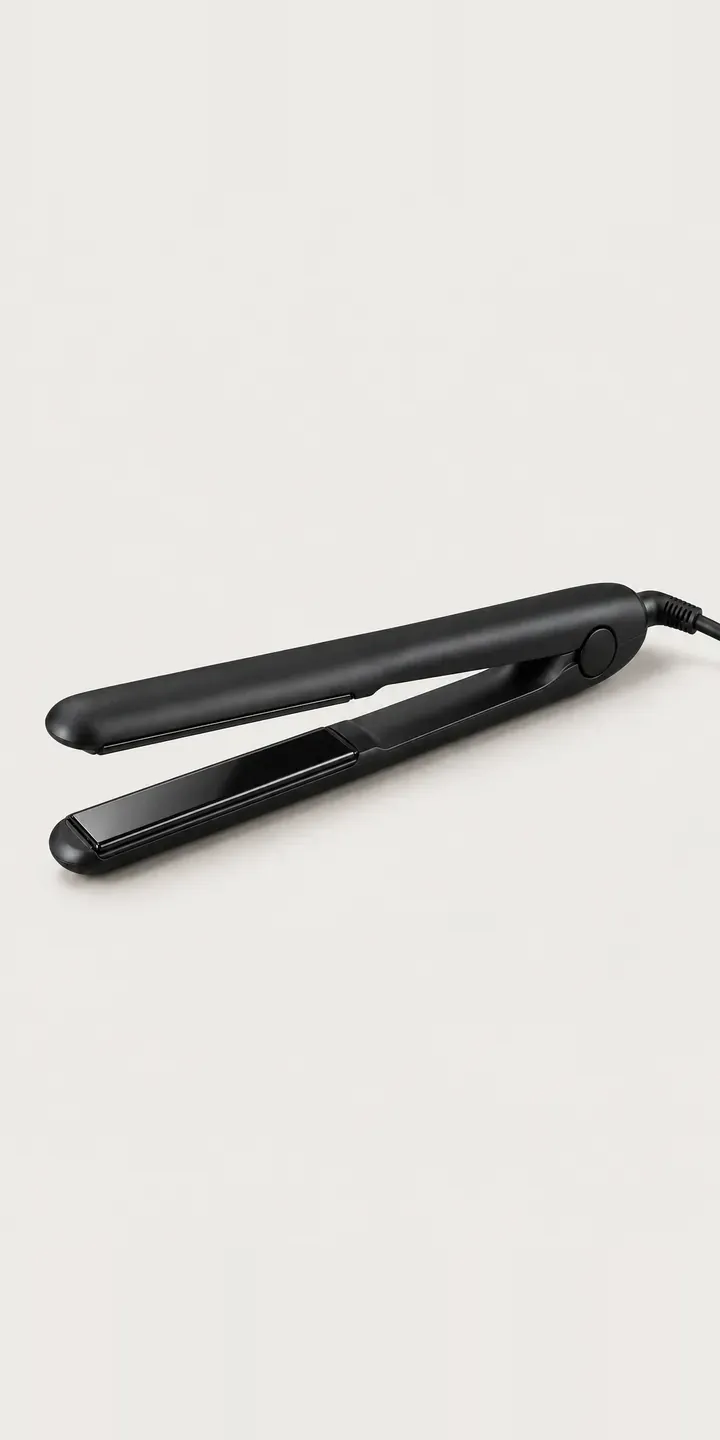
Here you can try a configurator for an illustrative salon straightener. Set a finish and a plate width, and the build is summarised for a quote request.
Professional stylists buy straighteners differently from the public. Many carry two: a 25 mm iron for curls, bobs and fringes, and a 38 mm iron for long, dense hair and quick sleek finishes. They judge an iron on how its plate edges glide, how the cord behaves at a busy station, and whether it survives a kit bag between bridal clients on a wedding morning.
Salon and barbering Configurator demo
Salon Straightener
- Product
- Salon Straightener
- Colour
- Matte Black
- Plate
- 25 mm
Illustrative product. The design and images are generated examples, not a real model for sale.
What you can configure
Four finishes are live: matte black, white, blush and champagne. Plates come in 25 mm or 38 mm. Rounded plate edges let a stylist bend hair into a wave as well as straighten it, and that technique is easier with the narrower plate. The summary records the width. The image is shared between both, which a production build would replace with a width-specific view.
- Colour: Matte Black, White, Blush, Champagne
- Plate: 25 mm, 38 mm
Why a configurator suits straighteners
With six finishes and two widths, a professional straightener line has twelve variants, and stylists often want two of them. The second width can be offered as a matched pair at the point of choice, rather than relying on the stylist to find it and add it separately.
Hairdressing academies and colleges add another route to market. Each intake buys student kits, usually through a distributor, with a fixed tool list and sometimes a set colour. A configured kit, saved and shared with the academy, becomes the reorder reference for every term. The distributor stops rebuilding the same order from an emailed list.
Bridal and session stylists are highly visible buyers. Their tools appear in preparation photos and in the content they publish, so finish matters to them more than to most. Champagne and blush sell partly on how they look in a bridal suite. Showing each finish photographed consistently, on the same plain background, gives them the confidence to choose without handling it first.
How a production version would be built
A layered approach suits a professional iron. Each finish is shot closed at one angle, and the plate widths appear in an open-jaw detail that composites across colours. The cord and heat mat can be separate layers if they come in matching finishes. The distributor supplies SKUs, plate dimensions, academy kit contents and trade pricing. Orders route to a trade quote for academies and to the basket for individual stylists. Paired irons and student kits sit in a saved configuration so every reorder matches the last one.
Build sheet for this range
- Colours in the full range: 6 (4 shown in this demo)
- Plate choices: 2
- Combinations to support: 6 × 2 = 12
- Images for one photograph per combination at 3 angles: 36
- Images if plate widths can be shown as separate layers, at 3 angles: 24
- Data each of the 12 combinations needs: a SKU or variant ID, price, stock or lead time, and any dimensions or specification that change
Questions about straightener configurators
Can stylists order both plate widths as a matching pair?
Yes. Once the first width is chosen, the configurator can offer the other as an optional pairing in the same finish by default. It goes through as two line items, each with its own SKU, so stock levels and warranty registration work exactly as they would for separate orders.
Can academies set up a fixed student kit?
Yes. A locked kit lists the required tools and allows only the choices the academy permits, such as finish. Students or the academy order against it, and the distributor sees a consistent order every intake. Changes to the kit list are made once, centrally, and apply to every new order.
Should the swivel cord and heat mat be part of the configuration?
Include them if they vary. A standard cord needs no choice, but a heat mat in matching colours, or a longer cord for salon use, can be an add-on step. Anything that ships in the box should at least appear in the summary, so the stylist knows what will arrive.
Where do orders go if we sell on trade terms?
Wherever your trade team already works. Builds can arrive as a quote email, a record in your CRM, or a pre-filled order in an ERP for account customers. Retail orders can go to a Shopify or WooCommerce basket. Many distributors run both routes side by side.
More salon and barbering configurator demos
All salon and barbering equipment configurator demos
A configurator for your straighteners
This demo uses an illustrative product. If you sell straighteners, I can build the same experience around your own range, photography and ordering process, connected to Shopify, WooCommerce or a quote workflow. I reply to enquiries within two UK working days.