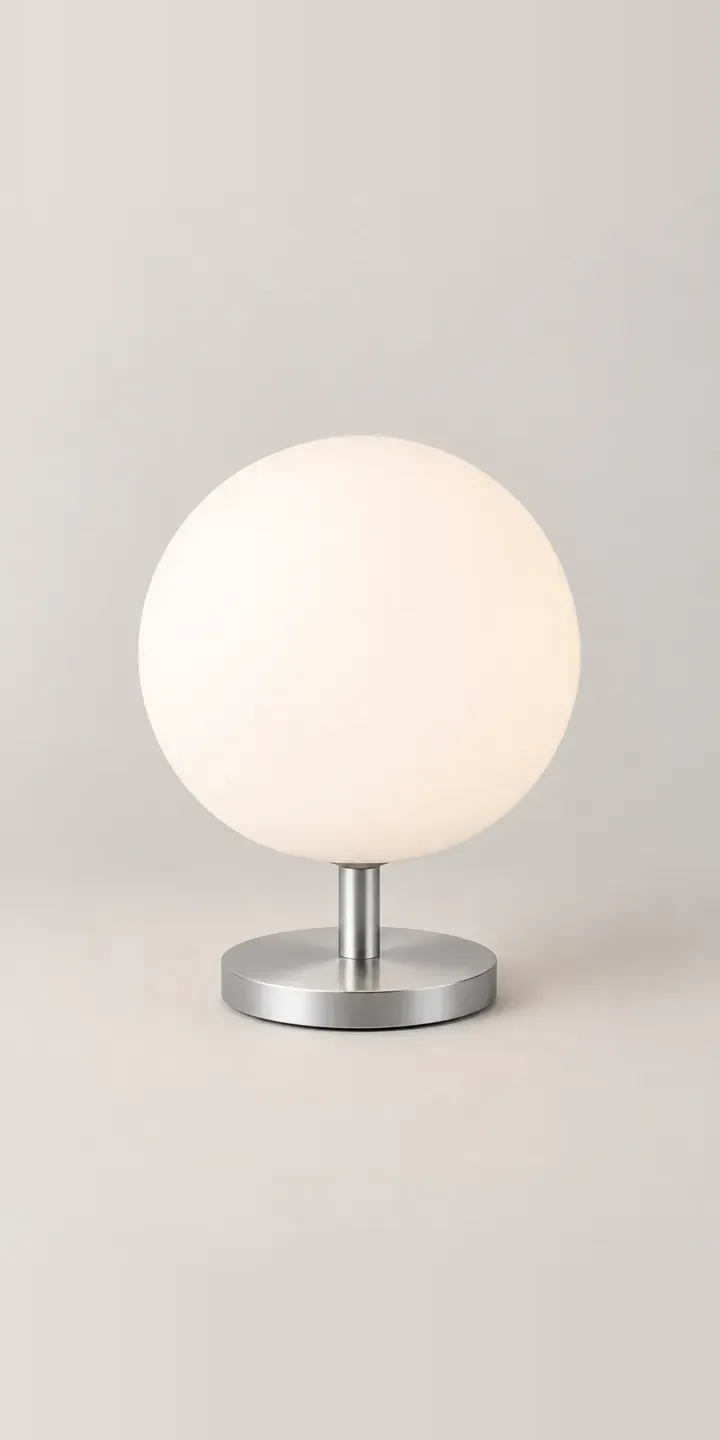
Two parts make up this illustrative table lamp: an opal glass globe and a metal base, joined by a short neck. The configurator sets the base finish and the globe diameter.
A sphere lamp is mostly bought to furnish a surface: a console, a sideboard or a reception desk. The globe size has to suit the furniture and anything hanging above it. A small globe under a large mirror looks lost, while a large one on a narrow hall table crowds the space. The base finish answers to the room's other metals, and is usually chosen to match rather than contrast.
Lighting Configurator demo
Sphere Table Lamp
- Product
- Sphere Table Lamp
- Colour
- Satin Chrome
- Diameter
- 230 mm
Illustrative product. The design and images are generated examples, not a real model for sale.
What you can configure
The swatches cover satin chrome, brass, black and white bases; copper and gunmetal are also offered. The opal globe stays identical in each image, so the comparison isolates the base and neck. Diameter, 230 or 330 mm, is chosen alongside and recorded, though the photograph does not resize. In production the two sizes would appear together on a console, which is how designers decide.
- Colour: Satin Chrome, Brass, Black, White
- Diameter: 230 mm, 330 mm
Why a configurator suits table lamps
Console lamps are rarely bought alone. They flank a mirror, sit either side of a doorway or mark the ends of a sideboard, so buyers judge two at once. The range runs to twelve lamps, but buyers really want to know how a pair will look on their own furniture. A single studio shot cannot answer that.
Scale is the decision most often got wrong. Dimensions on a product page are accurate but abstract, and a 330 mm globe sounds modest until it sits beneath a low mirror. A configurator that asks for the furniture width and suggests a diameter, then shows the pair at that scale, turns a guess into a measured choice.
Opal glass is fragile and expensive to send twice. A lamp ordered at the wrong size often means a returned globe that cannot be resold if it is chipped. Getting the diameter right first time protects margin on a product where carriage and breakage are already real costs.
How a production version would be built
Layering keeps this efficient. Each globe size is shot or rendered once, and each base finish is a separate layer at both sizes. Adding a finish then needs two images rather than a new set. A simple console outline, drawn to scale, lets the configurator show a pair at the right size without a room photograph. The retailer supplies base finishes, globe diameters, overall heights, bulb type and any pair pricing. 3D product visualisation can produce the base layers from one model.
Build sheet for this range
- Colours in the full range: 6 (4 shown in this demo)
- Diameter choices: 2
- Combinations to support: 6 × 2 = 12
- Images for one photograph per combination at 3 angles: 36
- Images if diameters can be shown as separate layers, at 3 angles: 24
- Data each of the 12 combinations needs: a SKU or variant ID, price, stock or lead time, and any dimensions or specification that change
Questions about table lamp configurators
Can the configurator show a pair of lamps either side of a mirror?
Yes. A simple wall and console outline, with two lamps composited in the chosen finish and size, shows symmetry and scale at once. It uses the same layered images as the single view, so it adds little to the build and answers the most common question from console buyers.
How do we help buyers choose between the 230 and 330 mm globe?
Ask for the width of the surface and whether anything hangs above it. A narrow hall table usually suits the smaller globe; a wide sideboard under a large mirror can take the larger one. The configurator applies your own guidance and shows the result on a scaled console.
Can interior designers see trade pricing in the configurator?
Yes. When a trade account is signed in, the configurator can show trade prices and add a project reference to the order. Retail visitors see the standard price. Designers can also save a configuration and send it to a client for approval before anything is ordered.
Can buyers see the base finish up close?
Yes. A detail view of the neck and base in each finish, at higher zoom, helps buyers tell satin chrome from the warmer metals and judge the brass tone. On a lamp where the base is the only part that changes, that close-up does a lot of the selling.
More lighting configurator demos
All lighting configurator demos
A configurator for your table lamps
This demo uses an illustrative product. If you sell table lamps, I can build the same experience around your own range, photography and ordering process, connected to Shopify, WooCommerce or a quote workflow. I reply to enquiries within two UK working days.