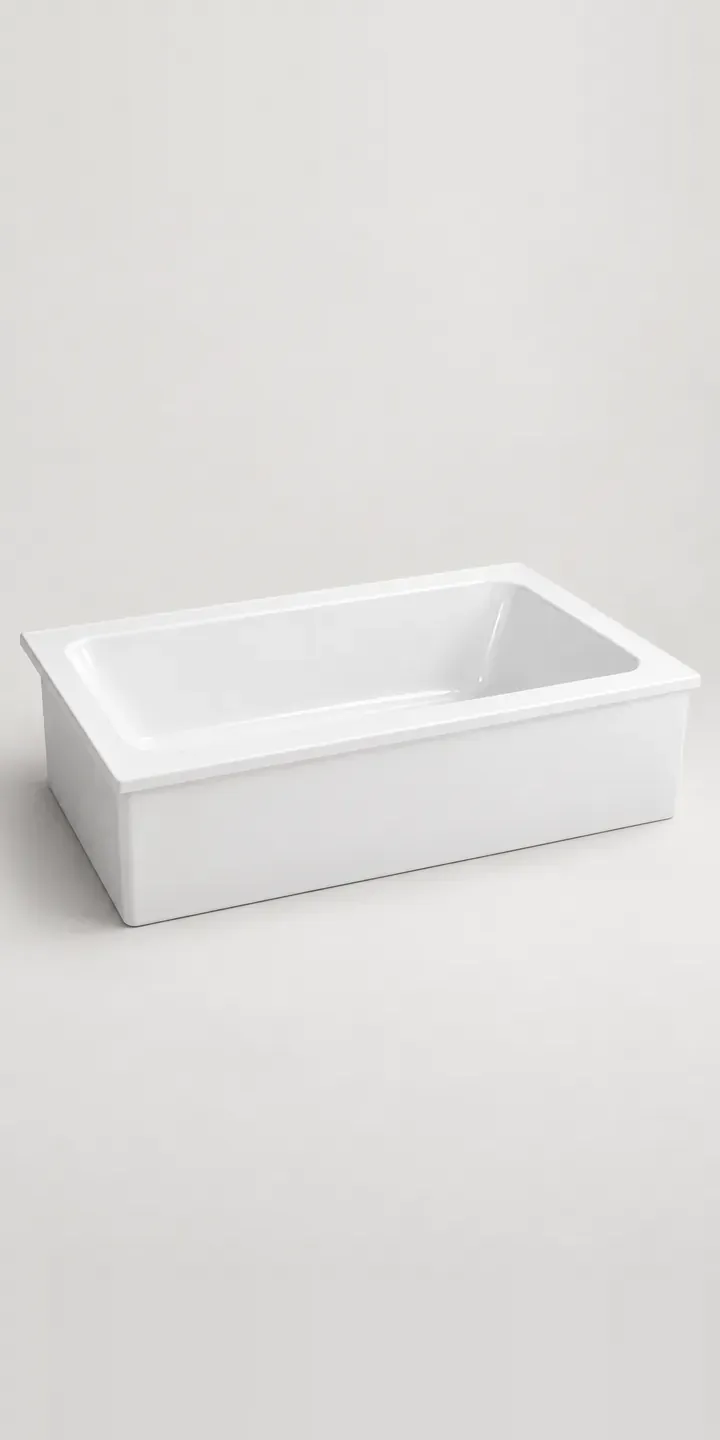
Most British bathrooms have their bath in a recess, tiled on three sides with only the front on show. This illustrative apron front bath is made for exactly that, with a smooth moulded front panel and a tiling flange along the back edge.
That shapes what the buyer is deciding. The apron is the only part of the shell facing the room, so its colour carries the whole look. White disappears; navy stands out against metro tiles. The second decision is less visible and easier to get wrong: which end the drain sits at. Order the wrong hand and the bath will not line up with the waste pipe already in the floor.

Bathroom Configurator demo
Apron Front Bath
- Product
- Apron Front Bath
- Colour
- Gloss White
- Drain
- Left
Illustrative product. The design and images are generated examples, not a real model for sale.
What you can configure
Swatches switch the bath between gloss white, biscuit, stone grey and navy, four of the six finishes in the range. The drain option sets it as left or right handed and appears in the summary, though the image stays the same in this demo. In a production build the picture would mirror, so the customer sees the drain end on the correct side before ordering.
- Colour: Gloss White, Biscuit, Stone Grey, Navy
- Drain: Left, Right
Why a configurator suits baths
Handing is a familiar source of returns in bathroom retail. Customers read left and right from a different viewpoint than the supplier, or simply guess. A picture defines the term better than any label: stand facing the apron, and the drain is on this side. The ambiguity is gone before the order exists.
Colour adds a second layer. Six finishes in two hands makes twelve distinct orders. A bath delivered in the right colour but the wrong hand is no more use than one in the wrong colour. When both choices arrive as structured fields, the warehouse or supplier picks the right unit without anyone reading back through an email thread.
Apron baths also tend to be bought as part of a full refit, with a shower over, a screen and new tiles. A configured bath gives the installer firm dimensions and the hand early on. The screen, shower valve position and tile setting-out can then be planned around it.
How a production version would be built
Handing makes this a good case for mirrored imagery. Each finish is photographed or rendered once, and the configurator flips the image for the opposite hand. The shot just needs checking for anything that looks wrong reversed, such as the direction of the light. Six finishes stay at six source images rather than twelve. The data needs a SKU per finish and hand, the external dimensions, and a plain definition of left and right. Orders pass into a basket or a quote with the hand written into the order line. My guide to configurator product data covers how to structure that.
Build sheet for this range
- Colours in the full range: 6 (4 shown in this demo)
- Drain choices: 2
- Combinations to support: 6 × 2 = 12
- Images for one photograph per combination at 3 angles: 36
- Images if drain sides can be shown as separate layers, at 3 angles: 24
- Data each of the 12 combinations needs: a SKU or variant ID, price, stock or lead time, and any dimensions or specification that change
Questions about bath configurators
How do you stop customers ordering the wrong hand of bath?
Show it rather than name it. The configurator displays the bath from the front with the drain end marked, so left and right are defined by the picture instead of by convention. The summary repeats it in words, such as drain at the left as you face the bath, which the customer sees again before sending.
Can the configurator check that the bath fits a customer's recess?
Yes, within limits. The customer enters the recess width and the configurator compares it with the bath length, allowing for the tolerance your fitters recommend. It can then warn, or suggest another size if the range has one. It does not replace measuring on site, but it filters out orders that were never going to fit.
Can we sell the bath with a matching screen and shower in one configuration?
It can. Further steps can add a bath screen, a shower set and a waste, each in its own finish where relevant. The summary then lists the full set for one quote or one basket. The useful part is the rules: a screen can be tied to the correct end for the chosen hand, and brassware finishes can be matched automatically.
Does it work with WooCommerce as well as Shopify?
Yes. I build configurators for both, and for quote-only sites with no basket at all. On WooCommerce each finish and hand maps to a variation, so stock and pricing behave as normal. The configured options appear on the order for the warehouse to read.
More bathroom configurator demos


All bathroom product configurator demos
A configurator for your baths
This demo uses an illustrative product. If you sell baths, I can build the same experience around your own range, photography and ordering process, connected to Shopify, WooCommerce or a quote workflow. I reply to enquiries within two UK working days.