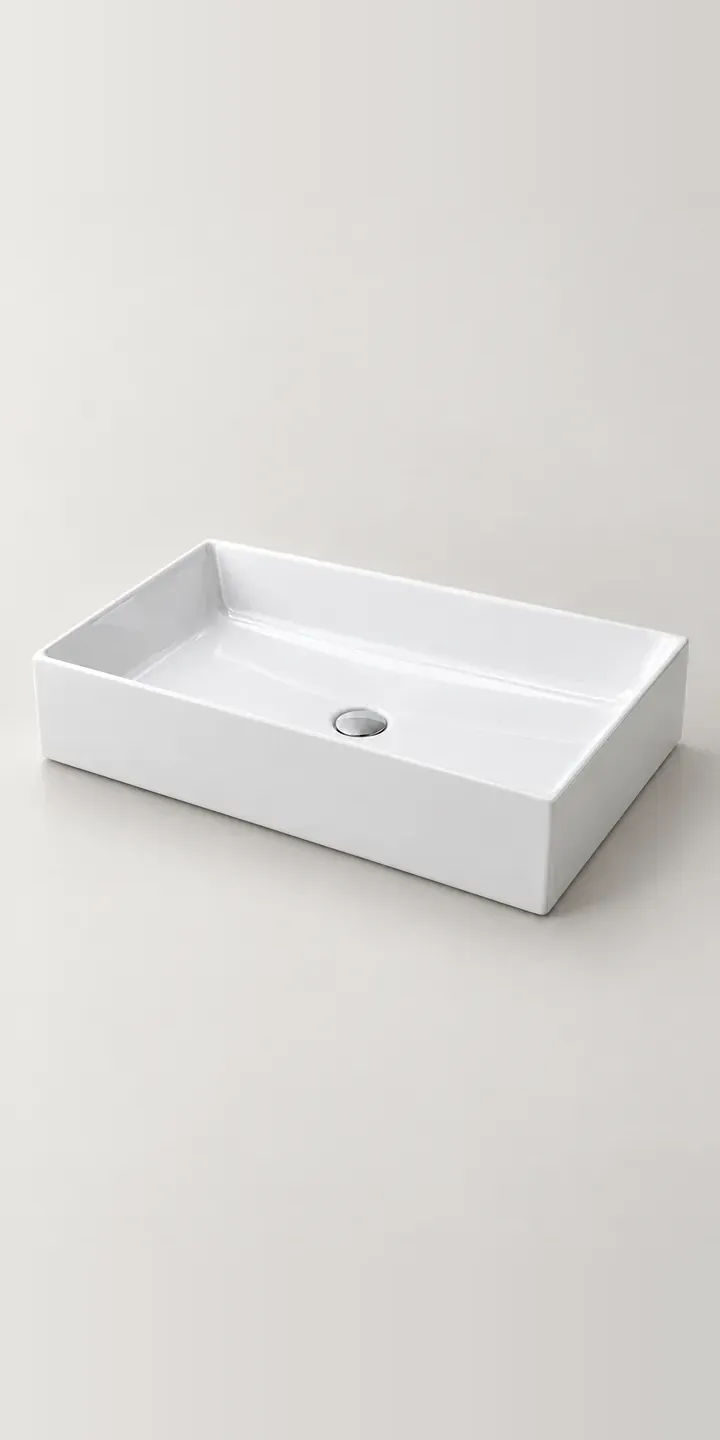
Most of this illustrative undermount basin disappears beneath the stone once it is fitted. The configurator lets you choose its glaze and a 480 mm or 540 mm width before that happens.
An undermount basin is chosen early and seen mostly from above. The stone or quartz top is cut to its exact outline, so the width has to be fixed before the fabricator templates the worktop. Once installed, only the bowl and a fine line of rim remain visible. The glaze is quieter than on a countertop basin, but no less permanent.

Bathroom Configurator demo
Rounded Inset Basin
- Product
- Rounded Inset Basin
- Colour
- Gloss White
- Width
- 480 mm
Illustrative product. The design and images are generated examples, not a real model for sale.
What you can configure
Four glazes are available to try: gloss white, biscuit, stone grey and matte black, from a range of six. Width comes in 480 mm or 540 mm. Biscuit is the period choice, warmer than white and suited to brass fittings. Width is recorded alongside the glaze but leaves the image unchanged here. A production build would show the bowl from above, as it is actually seen.
- Colour: Gloss White, Biscuit, Stone Grey, Matte Black
- Width: 480 mm, 540 mm
Why a configurator suits basins
The order of events makes undermount basins tricky to sell online. The customer buys the basin, the stonemason needs it or its template to cut the top, and the plumber fits it afterwards. A wrong width discovered at templating stops the whole job, and the fitter's diary with it. A configurator that fixes the width and supplies the cut-out template with the order removes that risk.
Six glazes in two widths give twelve basins. For a retailer serving bathroom fitters and stone fabricators, the trade buyer often matters as much as the homeowner, sometimes more. A configurator that produces a specification sheet with dimensions, cut-out shape and waste position gives the fabricator what they need without phone calls.
Showrooms gain too. A designer can configure the basin with the client and pass the saved configuration to the fabricator the same day. For a less common glaze, such as biscuit or slate blue, the lead time shows before ordering, not after the worktop is booked.
How a production version would be built
I would render each glaze in both widths from the manufacturer's CAD files, viewed from above and from a low angle through the worktop opening. The configurator then attaches the matching cut-out template as a PDF or DXF download. Needed from the retailer: SKUs, widths, internal depths, cut-out drawings, waste positions and lead times by glaze. Retail orders go straight to the basket. Trade orders go to a quote with the template attached, so fabricator and plumber work from one specification.
Build sheet for this range
- Colours in the full range: 6 (4 shown in this demo)
- Width choices: 2
- Combinations to support: 6 × 2 = 12
- Images for one photograph per combination at 3 angles: 36
- Images if widths can be shown as separate layers, at 3 angles: 24
- Data each of the 12 combinations needs: a SKU or variant ID, price, stock or lead time, and any dimensions or specification that change
Questions about basin configurators
Could the stonemason get a cut-out template from the configurator?
Yes. Each width has its own template file, attached to the configured basin as a PDF or DXF download. The fabricator receives the exact template for the width chosen rather than looking it up. If the manufacturer ships a physical template with the basin, the configurator can say so and note when it dispatches.
How do we show an undermount basin when most of it is hidden?
By showing it as it is seen. A top-down view through a stone worktop shows the bowl shape and rim line, and an angled view shows depth. A packshot of the whole basin still helps trade buyers. It should not be the main image for a homeowner choosing a glaze.
Can buyers compare the 480 mm and 540 mm widths in the same vanity?
They can. Rendering both widths into the same vanity top, at the same scale, shows how much worktop each leaves for soap and taps. That is the trade-off buyers are weighing. A dimension overlay can sit on top for fitters who want numbers rather than a picture.
Do biscuit and white need to be shot side by side?
It helps a great deal. Biscuit is a soft off-white, and on its own it can look like a badly balanced white photograph. Shown next to gloss white in the swatch row, under the same light, the warmth reads as intended. Calibrating both against samples keeps it accurate.
More bathroom configurator demos

All bathroom product configurator demos
A configurator for your basins
This demo uses an illustrative product. If you sell basins, I can build the same experience around your own range, photography and ordering process, connected to Shopify, WooCommerce or a quote workflow. I reply to enquiries within two UK working days.