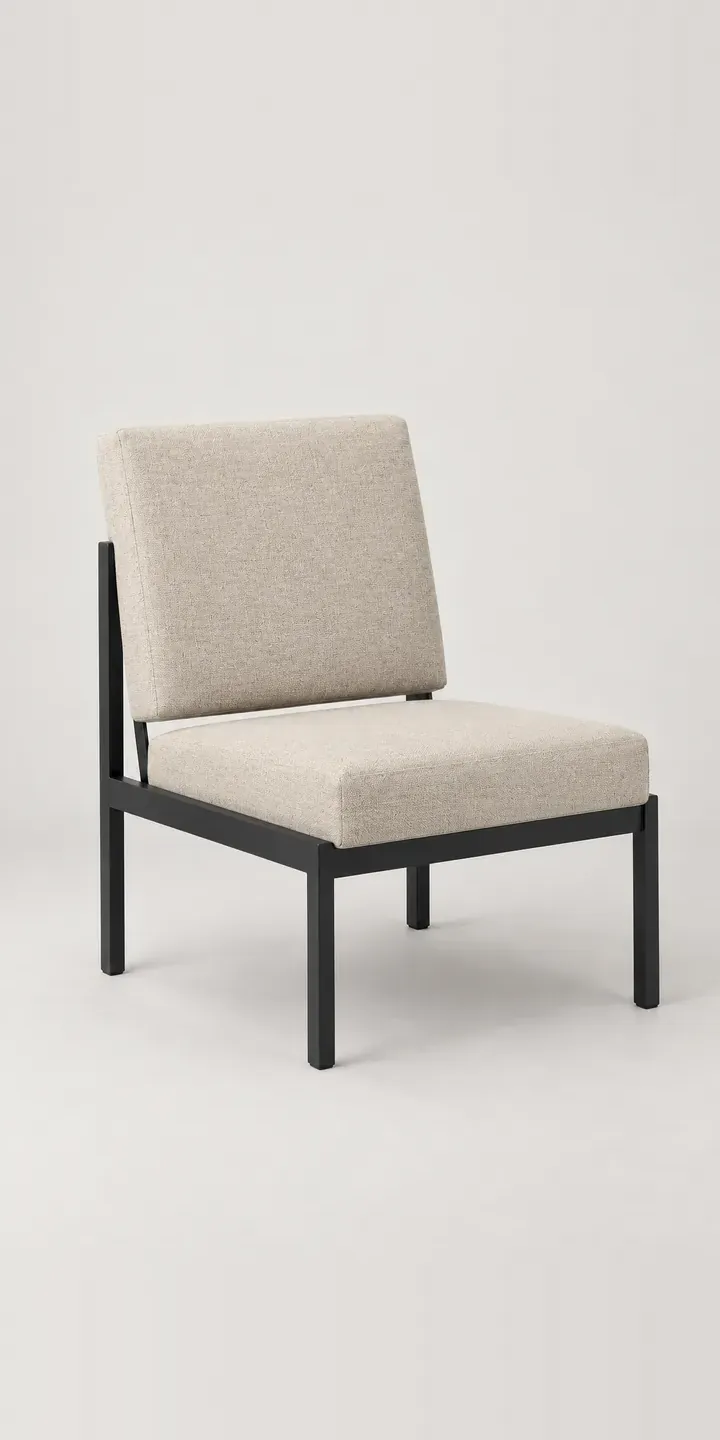
An upholstered seat and a separate back cushion on a black frame with straight rectangular legs make up the illustrative modular armchair configured here. Choose a cover, then set it as a single chair or as two or three joined seats.
Modular seating like this lives a double life. At home it is a calm armchair. In an office reception or hotel lounge it becomes a row of linked seats that must look tidy all day. The buyer is usually choosing a cover that will survive its setting and a size that suits the space. Contract settings add a third question: whether the fabric meets the fire and wear requirements of the project.
Furniture Configurator demo
Modular Armchair
- Product
- Modular Armchair
- Colour
- Natural
- Size
- 1-seat
Illustrative product. The design and images are generated examples, not a real model for sale.
What you can configure
The cover swatches run from natural through charcoal and ink blue to rust, all on the same black frame. Moss and black leather complete the six. Seat count, from one to three, is captured in the summary though the image itself is unchanged. For linked seating the cover matters more than for a lone chair, because a longer run shows every variation in colour and pile.
- Colour: Natural, Charcoal, Ink Blue, Rust
- Size: 1-seat, 2-seat, 3-seat
Why a configurator suits armchairs
Contract seating is ordered by specification. An interior designer planning a reception area needs cover code, fire rating, quantity and arrangement, and a supplier who can reply with a precise quote. A configurator that captures those fields, and attaches the fabric's test certificates from the product data, makes the supplier easy to specify.
Residential buyers bring a different worry. A modular chair is often bought as one seat and expanded later, so the cover has to stay available. Marking which covers are core range and which are seasonal gives buyers the confidence to start small. Six covers in three sizes already makes eighteen options, before any corner or end units come into play.
For a manufacturer selling to both markets, one configurator can do both jobs. Retail customers check out at a price, and trade customers request a quote with project details. The same product data and images serve both, so a new fabric added for a hotel project can appear for retail customers too, if the manufacturer chooses.
How a production version would be built
Linked seating suits compositing. Each unit is rendered once per cover, and the configurator places one, two or three side by side. A new cover then needs a handful of renders rather than a full shoot of every arrangement. For contract work, the product data should hold fire test results, Martindale rub counts and cleaning codes per fabric. These then display with the swatch and print on the specification. On Shopify the chosen size and cover map to variants, and trade enquiries go to a quote. The seating configurator demo shows another seating example.
Build sheet for this range
- Colours in the full range: 6 (4 shown in this demo)
- Size choices: 3
- Combinations to support: 6 × 3 = 18
- Images for one photograph per combination at 3 angles: 54
- Images if sizes can be shown as separate layers, at 3 angles: 27
- Data each of the 18 combinations needs: a SKU or variant ID, price, stock or lead time, and any dimensions or specification that change
Questions about armchair configurators
Can fire ratings and rub counts show for each fabric?
Yes. They sit in the product data alongside each cover and appear when a swatch is chosen, so a specifier can check compliance without asking. The same values print on the specification sheet. If a cover is not suitable for contract use, the configurator can label it residential only or hide it from trade buyers.
Can units be linked into sofas in the configurator?
A production build can. Each seat is a separate image layer or 3D part, so two or three seats can be assembled into a run. Corners can be added too if the system has them. The demo records the size choice but keeps one image per cover.
Can trade buyers see different prices from retail customers?
Yes. Logged-in trade accounts can see trade pricing, or the configurator can hide prices for trade buyers and send everything to a quote. On Shopify and WooCommerce this ties into customer groups, so the same configurator serves both markets without a separate site.
Can a designer share a configured layout with a client?
Yes. Each configuration can be saved as a link that reopens the exact build. Designers send it to clients for approval, and the client can request a quote from the same link. It removes the step of rebuilding the specification from screenshots, which is where errors creep in.
More furniture configurator demos
All furniture configurator demos
A configurator for your armchairs
This demo uses an illustrative product. If you sell armchairs, I can build the same experience around your own range, photography and ordering process, connected to Shopify, WooCommerce or a quote workflow. I reply to enquiries within two UK working days.