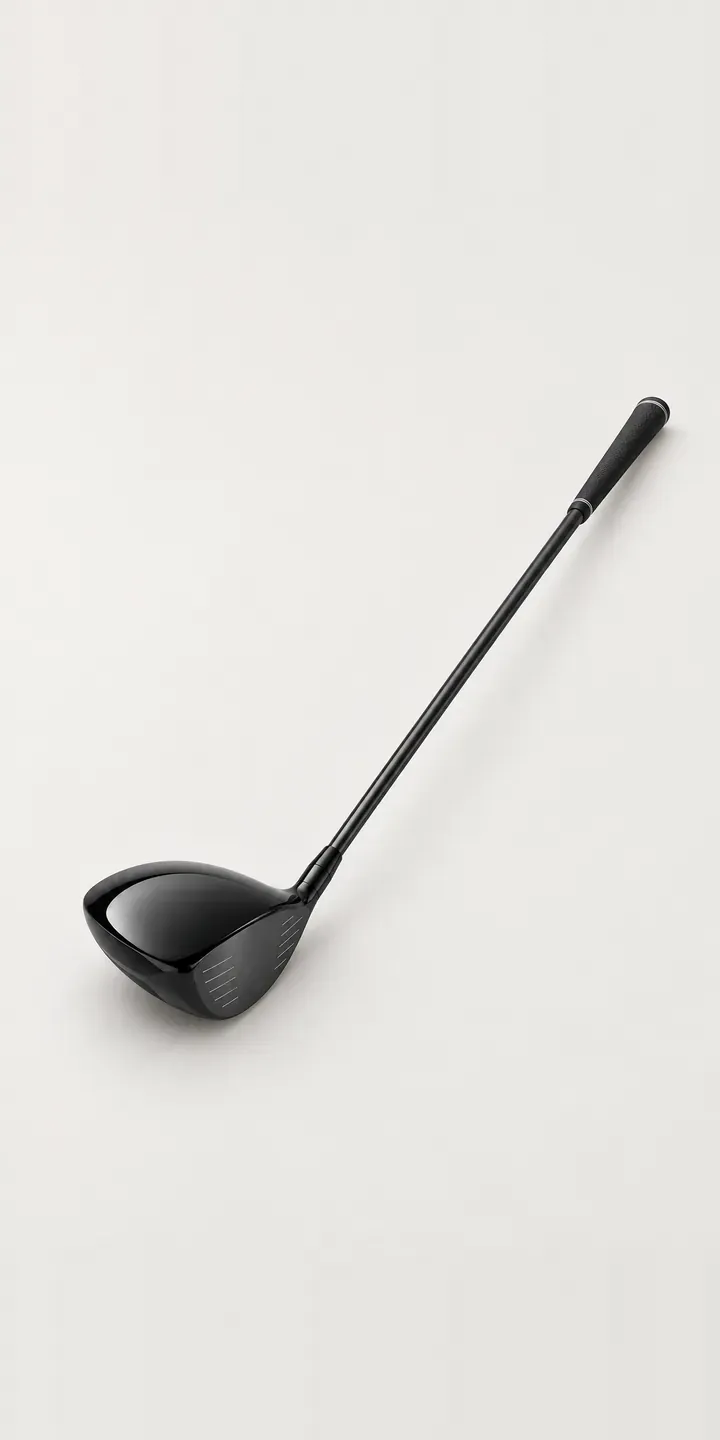
Here is an illustrative tour-style driver with an adjustable rear weight and a crown that flows into the sole without a visible join. Pick a crown finish and a loft of 9°, 10.5° or 12°, and the build goes to a quote.
Better players choose a driver on numbers first: loft, spin, launch, shaft. Crown finish matters more than it sounds, though, because it is what they look down at over the ball on every tee. Gloss black is traditional. Matte grey cuts glare in bright sun. Pearl white frames the ball cleanly at address, which some golfers find helps alignment and others find distracting.
Sports equipment Configurator demo
Tour Driver
- Product
- Tour Driver
- Colour
- Gloss Black
- Loft
- 9°
Illustrative product. The design and images are generated examples, not a real model for sale.
What you can configure
Crown finish is what changes on screen: gloss black, matte grey, navy and pearl white, from six. Loft is selected and summarised but leaves the image alone, which is honest, since at normal viewing angles a 9° and a 12° head look almost identical. Loft is where fitting begins, so a production build would pair it with shaft, flex and length choices.
- Colour: Gloss Black, Matte Grey, Navy, Pearl White
- Loft: 9°, 10.5°, 12°
Why a configurator suits drivers
A custom driver programme multiplies fast. Six crowns across three lofts is eighteen heads before shafts, flexes, grips, lengths and handedness are added, and handedness doubles part of the range again. Golf retailers manage this with fitting carts and paper order forms, and errors creep in when a fitter's notes are re-keyed into a supplier portal.
A configurator turns the fitting result into a structured order. The fitter, or the golfer at home, selects the exact loft, crown, shaft and grip, and the build reaches the workshop with no ambiguity. Brands selling through pro shops and green-grass accounts can place the same tool on each dealer's site. Shaft and grip codes travel with every order.
Custom-built drivers carry a lead time, and the configurator is the right place to state it. Golfers buying before a trip or a club championship need to know when the driver will arrive, and stock builds can be flagged as faster to ship. That date belongs on the order confirmation too, taken from the same record.
How a production version would be built
Image layers work well for a driver: the head per crown finish, the shaft per model and the grip per colour, all composited from the same angle. An address view from above, the angle golfers care about most, adds a second image set. Head, shaft and grip codes, permitted loft and shaft pairings, and handedness form the rule set. Stock builds route to a basket and fitted builds to a quote, both drawing on the same structured product data. Left-handed builds mirror the same layers.
Build sheet for this range
- Colours in the full range: 6 (4 shown in this demo)
- Loft choices: 3
- Combinations to support: 6 × 3 = 18
- Images for one photograph per combination at 3 angles: 54
- Images if lofts can be shown as separate layers, at 3 angles: 27
- Data each of the 18 combinations needs: a SKU or variant ID, price, stock or lead time, and any dimensions or specification that change
Questions about driver configurators
Can the configurator show the driver from the golfer's view at address?
Yes, and it should. A top-down address view shows crown shape, any alignment aid and the finish exactly as the golfer sees them over the ball. Many buyers judge a driver from that angle in the shop, so offering it online removes one reason to wait for a store visit.
Can it include shaft, flex and grip options as well as loft?
It can. Each component becomes a layer or data option with its own rules: which shafts suit which heads, which flexes each shaft offers, which grips come in which sizes. The finished build reaches the workshop as a clean specification instead of a handwritten fitting card.
Can our fitters use the configurator during a fitting session?
They can. On a tablet, the fitter enters the loft and shaft chosen from launch monitor results, then lets the golfer pick crown and grip. The build is saved to the golfer's account or sent straight to the order, so nothing is copied out by hand.
How do we show which heads come in left-handed versions?
Handedness becomes an option that mirrors the images and filters out heads not made for left-handers. Left-handed golfers are used to limited choice online. Showing exactly what exists in their orientation, with lead times, is a quiet but effective way to earn their trust.
More golf and racket sports configurator demos
All golf and racket sports configurator demos
A configurator for your drivers
This demo uses an illustrative product. If you sell drivers, I can build the same experience around your own range, photography and ordering process, connected to Shopify, WooCommerce or a quote workflow. I reply to enquiries within two UK working days.