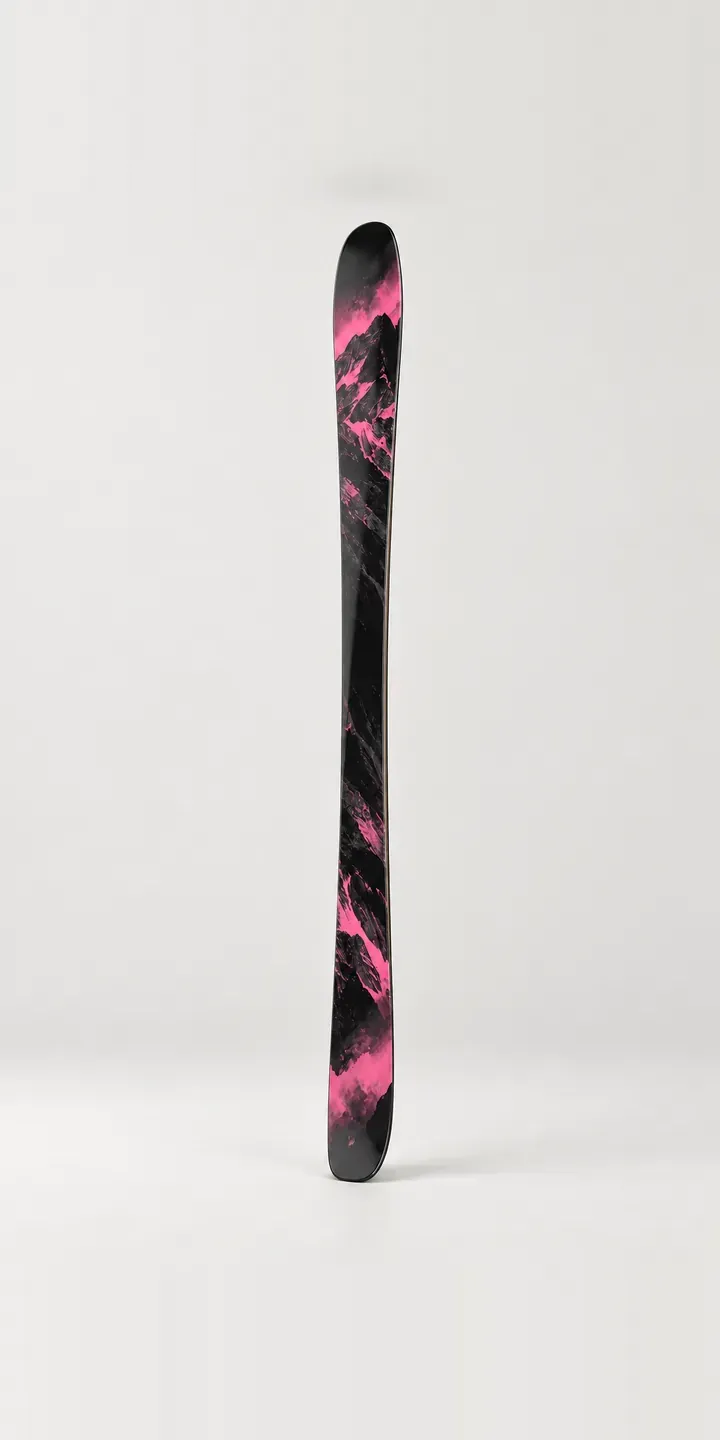
This demo is a configurator for an illustrative freeride ski. Choose a topsheet and a length, and the summary holds the build for a quote.
Freeride skiers buy with a clear idea of their terrain: open bowls, steep chutes and untracked snow away from the piste. Their questions are about length, how the ski floats with its upturned tip, and which binding goes on it. A freeride ski is rarely sold on its own. It leaves the shop with a binding mounted, and often with skins cut to match, which makes the purchase closer to a build than a single product.
Snow sports Configurator demo
Freeride Ski
- Product
- Freeride Ski
- Colour
- Black Magenta
- Length
- 174 cm
Illustrative product. The design and images are generated examples, not a real model for sale.
What you can configure
Four of six topsheets are in the demo: black and magenta, night blue, forest and ivory. Lengths are 174, 181 and 188 cm. Freeride skiers often size up from their piste ski for stability at speed and float in deep snow, but a long ski in tight trees is hard work. The length choice is saved to the summary. The product image stays the same across lengths.
- Colour: Black Magenta, Night Blue, Forest, Ivory
- Length: 174 cm, 181 cm, 188 cm
Why a configurator suits skis
Eighteen topsheet and length combinations is only the start. Add three binding types, a choice of brake widths and an optional skin, and a single freeride ski becomes dozens of possible builds. Most ski shops manage this in conversation at the counter, which does not translate to a product page with a single size dropdown.
Configuration captures what the ski technician needs. Binding choice depends on whether the skier tours or rides lifts. Brake width has to clear the ski's waist. Release settings need boot sole length, weight and ability. Collected during configuration, these details arrive with the order, ready for the workshop bench.
That turns online ski sales from a parcel into a service. The shop can promise a mounted, adjusted ski rather than a flat one the buyer has to take elsewhere. Specialist retailers competing with large online sellers usually win on the workshop, and the configurator is how that advantage becomes visible to someone browsing for next winter in October.
How a production version would be built
Each topsheet is photographed as a pair, top and base, so six image sets cover the visual range. Bindings are best composited as a layer at the mount point, letting any binding sit on any topsheet without a new shoot. Lengths are handled as data with a scaled comparison. Required data covers SKUs, waist widths, compatible bindings with brake sizes, and the workshop's mounting options and turnaround. My notes on configurator product data cover how to structure this. Orders flow to the basket with the workshop job attached, or to a quote for touring setups that need a fitting.
Build sheet for this range
- Colours in the full range: 6 (4 shown in this demo)
- Length choices: 3
- Combinations to support: 6 × 3 = 18
- Images for one photograph per combination at 3 angles: 54
- Images if lengths can be shown as separate layers, at 3 angles: 27
- Data each of the 18 combinations needs: a SKU or variant ID, price, stock or lead time, and any dimensions or specification that change
Questions about ski configurators
Can the configurator handle binding mounting?
Yes. Binding choice becomes a step after length, filtered to models whose brake width suits the ski's waist. Mounting, and the boot sole length needed to position the binding, are captured on the order. The workshop receives a complete job rather than a sales note to interpret.
Is it safe to set binding release values from information given online?
The configurator should collect the inputs, not make the final call. Weight, height, age, ability and boot sole length go to the technician, who sets and checks release values with the boot in hand wherever possible. Many shops ask online customers to send or bring their boots for this reason.
How do we show three lengths of the same ski?
A scaled side-by-side graphic works better than three near-identical photographs. Set against a height marker, it makes the jump from 174 to 188 cm obvious. Pair it with guidance on choosing a freeride length, so a skier understands why they might go longer than their piste ski.
Can skins be added and cut to the chosen length?
Yes. Skins can be an optional step that appears only when a touring binding is chosen, with the correct size selected automatically from the ski's length and shape. If the workshop trims skins to fit, that service can be recorded on the same order and scheduled with the mounting.
More snowboard and ski configurator demos
All snowboard and ski configurator demos
A configurator for your skis
This demo uses an illustrative product. If you sell skis, I can build the same experience around your own range, photography and ordering process, connected to Shopify, WooCommerce or a quote workflow. I reply to enquiries within two UK working days.