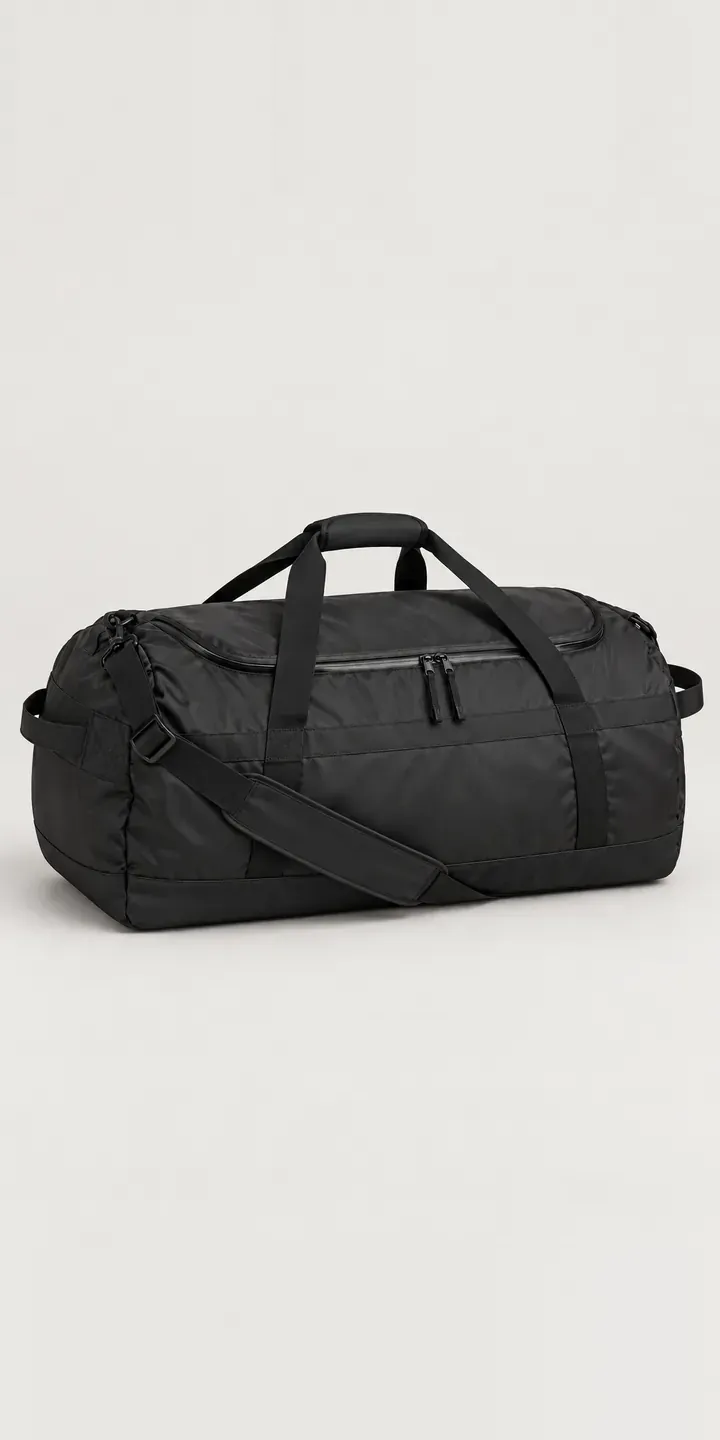
A main zip runs round the top of this illustrative gear bag, finished with an oversized pull, and a removable padded strap clips to metal D-rings. Colour and capacity are the two settings, and the configurator passes both into a quote.
Large gear bags carry kit that does not fold neatly: ski boots and helmets, dive equipment, climbing ropes, a team's worth of training gear. Buyers think in terms of what goes in, not litres. They also care how the bag behaves when full and heavy. Then there is how easy it is to spot in a baggage hall or a pile of identical black bags.
Bags and luggage Configurator demo
Large Gear Bag
- Product
- Large Gear Bag
- Colour
- Black
- Capacity
- 50 L
Illustrative product. The design and images are generated examples, not a real model for sale.
What you can configure
Black, forest, burnt orange and light grey are shown, and navy and khaki are also available. Capacity is 50, 70 or 90 litres. The image shows one size, and the capacity choice appears in the summary. Burnt orange is a practical choice as much as a style one, since it stands out on a luggage carousel or a snowy roadside. Light grey looks smart indoors but will show wear on gravel.
- Colour: Black, Forest, Burnt Orange, Light Grey
- Capacity: 50 L, 70 L, 90 L
Why a configurator suits gear bags
Gear bags have a second, larger market beyond individual buyers: clubs, schools and teams. A rowing club or ski school will order a batch in one colour, often with a logo, in two or three sizes for members. That is a quote-led sale with artwork, quantities and a deadline before the season starts.
A configurator built for that buyer takes the logo upload, places it on the bag, records quantities per size and sends it all as one request. The supplier receives structured data rather than an email thread and a low-resolution image. Six colours on three capacities is eighteen base variants before any branding, so structure matters.
For individual buyers, the risk is size. A 90 litre bag is unwieldy when full, and some buyers would be better served by two smaller bags. Showing a packed example for each capacity, such as boots, helmet and layers in the 70, helps them choose. Empty weight matters at the larger sizes as well, since it counts towards checked baggage allowances.
How a production version would be built
A production build would photograph or render each capacity once per colour, with a consistent reference object for scale. Logo placement works as an overlay on a defined print area, with the artwork checked for resolution before submission. Supplier data covers dimensions and empty weight per capacity, print or embroidery areas, minimum order quantities and lead times. Individual orders go to the basket. Team orders with logos go to a quote form, and from there into a CRM if the supplier uses one. Print areas are the piece of product data that needs most care.
Build sheet for this range
- Colours in the full range: 6 (4 shown in this demo)
- Capacity choices: 3
- Combinations to support: 6 × 3 = 18
- Images for one photograph per combination at 3 angles: 54
- Images if capacities can be shown as separate layers, at 3 angles: 27
- Data each of the 18 combinations needs: a SKU or variant ID, price, stock or lead time, and any dimensions or specification that change
Questions about gear bag configurators
Can clubs upload a logo and see it on the bag?
Yes. The configurator accepts the artwork, positions it on the bag's defined print area and shows a preview. It can check resolution and warn if the file is likely to print poorly. The final proof still comes from your production team, but the request arrives with the artwork attached and placed.
Can a team order different capacities in one request?
Yes. The buyer chooses the colour and branding once, then enters quantities for 50, 70 and 90 litre bags. That arrives as one quote with a clear breakdown. If you set minimum quantities for branded orders, the configurator can show them before the buyer submits.
How can buyers tell what fits in each capacity?
Show a packed example per size, using recognisable kit: boots, a helmet, a wetsuit or a set of training gear. A short list beside each capacity, written for the sport you sell to, helps more than litres. If you serve several sports, the examples can change with the buyer's choice.
Does a gear bag need 3D, or are images enough?
Images are enough for most retailers. Colours and sizes are clean swaps, and logos can be overlaid on a flat print area. 3D becomes worthwhile when buyers need to rotate the bag to check a logo on the end panel or inspect pockets. A 3D configurator can follow later using the same product data.
More bag and luggage configurator demos
All bag and luggage configurator demos
A configurator for your gear bags
This demo uses an illustrative product. If you sell gear bags, I can build the same experience around your own range, photography and ordering process, connected to Shopify, WooCommerce or a quote workflow. I reply to enquiries within two UK working days.